
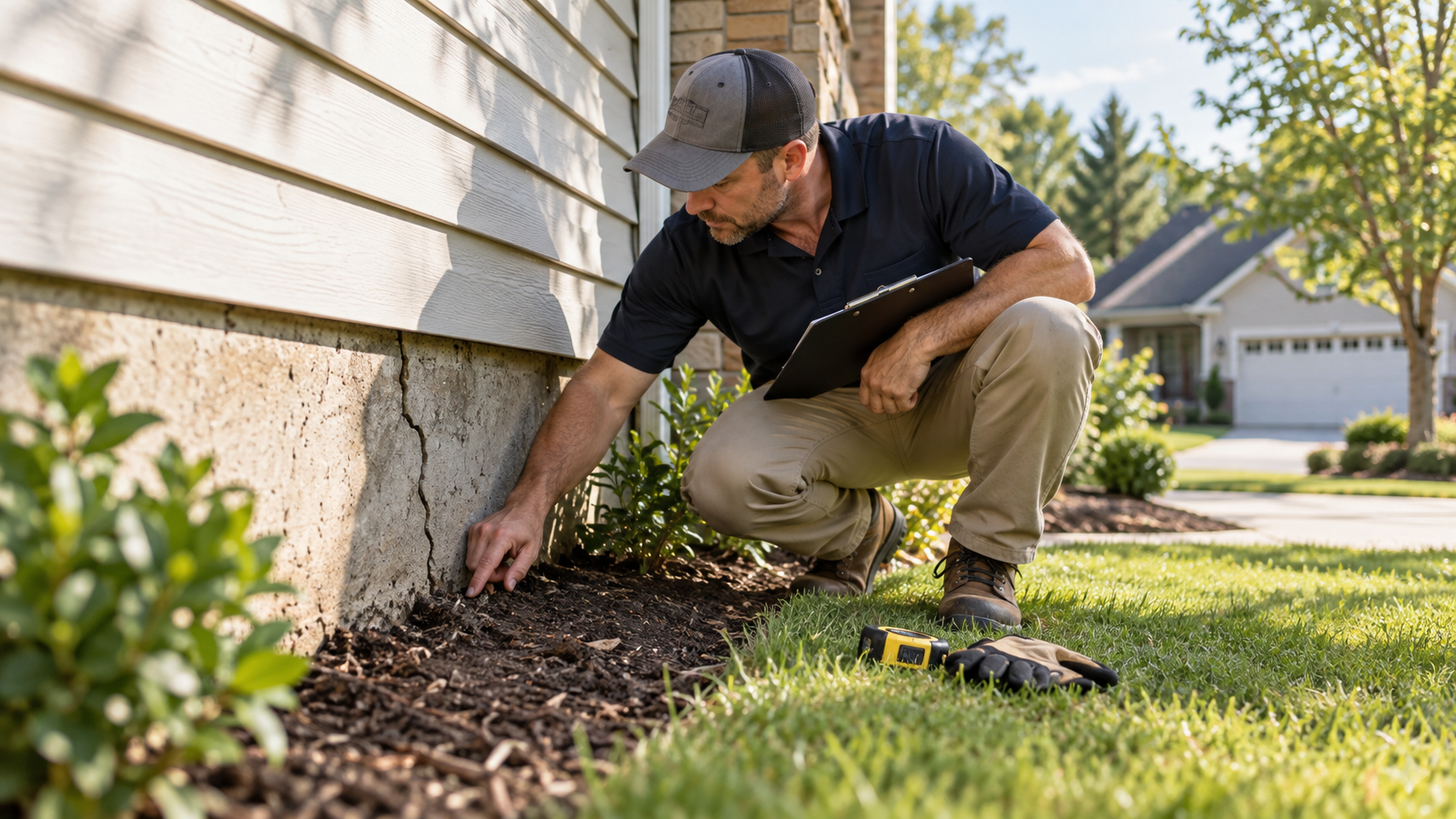

Foundation repair is one of those home projects nobody puts on a wish list.
A new kitchen sounds fun. A deck? Sure. New flooring? At least you get to enjoy looking at it. Foundation work is different. Most of it disappears underground, behind walls, or beneath the house once the job is finished.
Still, the foundation matters more than almost anything sitting on top of it.
If something starts moving below the house, you may notice the effects surprisingly far away: drywall cracks upstairs, doors that suddenly stick, gaps around windows, sloping floors, or a chimney that seems to be pulling away from the wall.
And here is the tricky part. Not every crack means disaster.
Concrete cracks. Houses settle. Wood moves with changes in moisture. Drywall develops hairline cracks for plenty of harmless reasons.
So the real question is not simply, “Is there a crack?”
It is, “Why is this happening, and is the movement still active?”
That distinction can save a homeowner from ignoring a serious problem or paying for a major repair that was never needed.
What exactly is foundation repair?
Foundation repair is a broad term for work intended to stabilize, reinforce, correct, or protect a home’s foundation.
The repair may be relatively simple, such as sealing a non-structural crack to stop water intrusion. Or it may involve underpinning part of the house with piers because the foundation has settled unevenly.
Different homes also have different foundation systems.
Across the United States, you may see concrete slab foundations, crawl spaces, basements, pier-and-beam construction, concrete block walls, poured concrete walls, and other regional variations.
A repair method that makes sense for a settling slab in Texas may have little to do with a bowed basement wall in Pennsylvania.
That is why a real diagnosis matters before anyone starts talking about a solution.
Some foundation movement is normal
This surprises people.
A newly built home can experience minor settlement as soil and construction materials adjust. Concrete also shrinks slightly as it cures, which can create small cracks.
Seasonal moisture changes may affect soils around a house too.
The concern grows when settlement becomes uneven, continues over time, damages structural elements, or creates openings that allow water inside.
A quarter-inch movement occurring once and then remaining stable is a very different situation from a crack that keeps widening every few months.
Context matters.
Common warning signs of foundation problems
Foundation issues often show themselves elsewhere in the house first.
You may notice a door rubbing before you ever look at the concrete below it.
One isolated symptom does not automatically mean foundation failure. Several related symptoms occurring in the same area deserve more attention.
- Cracks that grow noticeably wider or longer over time.
- Stair-step cracks running through brick or masonry joints.
- Doors or windows that suddenly become difficult to open.
- Visible gaps between walls, ceilings, floors, or trim.
- Floors that feel uneven, sloped, or newly bouncy.
- A chimney, porch, or wall separating from the main structure.
- Horizontal cracks or bowing in basement walls.
- Water entering through foundation cracks.
- Repeated drywall cracking after earlier cosmetic repairs.
Again, none of these alone gives you a complete diagnosis.
But patterns matter.
If a bedroom door sticks, there is a long diagonal drywall crack above it, and the nearby exterior brick has started separating, that combination deserves a closer look.
Vertical, horizontal, and stair-step cracks mean different things
The direction of a crack can provide clues, although it does not replace an inspection.
Small vertical cracks in poured concrete are often associated with concrete shrinkage or minor settlement.
Horizontal cracks in basement or foundation walls can be more concerning because they may be linked with lateral soil pressure pushing against the wall.
Stair-step cracking through masonry joints can appear when sections of a wall settle unevenly.
Diagonal cracks around doors and windows may also show that movement is happening somewhere nearby.
| Crack pattern | Possible explanation | Why it deserves attention |
|---|---|---|
| Thin vertical crack | Shrinkage or minor settlement | Often worth monitoring for change |
| Horizontal wall crack | Lateral soil pressure or wall movement | Can indicate structural stress |
| Stair-step masonry crack | Uneven settlement or movement | May show one area moving differently from another |
| Diagonal interior crack | Movement around openings | Can become more meaningful when paired with other symptoms |
| Wide or growing crack | Active movement | Change over time is often more important than appearance alone |
Width matters, but change matters even more.
A homeowner who photographs a crack every few months with a ruler beside it may learn more than someone who simply stares at it once and worries.
Why foundations move in the first place
Usually, the problem is not that concrete suddenly decided to misbehave.
Something around or beneath the foundation changed.
Soil is a major part of the story.
Some soils shrink when dry and expand when they absorb water. Others compress under load. Poorly compacted fill can settle. Erosion can remove support. Drainage problems can concentrate water next to the house.
Tree roots, plumbing leaks, drought, heavy rainfall, poor grading, frost in colder regions, and changes to nearby landscaping may all affect soil conditions.
And sometimes the original foundation or site preparation simply was not adequate for the conditions.
Water is behind a surprising number of foundation problems
You will hear foundation contractors talk about drainage a lot, and for good reason.
Water changes soil.
If rainwater repeatedly collects along one side of the house, that area may behave differently from drier soil on the opposite side.
Gutters that dump water directly beside the foundation do not help.
Neither does soil that slopes toward the house.
A leaking underground water or sewer line can create local soil changes too.
This does not mean every foundation problem is fixed with a downspout extension. Far from it.
But correcting drainage is often part of protecting a repaired foundation from continuing stress.
Check the simple things before assuming the worst
If you see a new crack, take a walk around the exterior before imagining the house sinking into the earth.
Look at drainage.
Are gutters clogged?
Are downspouts missing sections?
Does rainwater pour beside the footing?
Has a low spot developed next to the house?
Is an irrigation system soaking one narrow area every day?
Simple observations will not diagnose structural damage, but they can give useful context.
- Photograph visible cracks and date the pictures.
- Check whether doors and windows changed recently.
- Look for pooling water after rain.
- Inspect downspout discharge points.
- Look for unusual gaps around exterior trim or masonry.
- Notice whether floors slope more in one particular area.
- Ask whether recent plumbing leaks occurred nearby.
If symptoms are growing, widespread, or clearly structural, move beyond DIY monitoring and get professional input.
Who should inspect a foundation problem?
That depends on the situation.
A foundation repair contractor can inspect the property and recommend work their company performs.
A structural engineer can evaluate the structure from an engineering perspective and may provide recommendations without selling the repair itself.
Those roles are different.
If the issue appears serious, unusually complex, or disputed, an independent structural engineering evaluation can be useful.
Local licensing requirements and professional scopes vary by state, so check the rules where the property is located.
For real estate transactions, major structural movement, large retaining forces, unusual foundation systems, or competing repair opinions, independent technical evaluation can be especially valuable.
Foundation repair methods are not one-size-fits-all
The phrase foundation repair sounds like one service.
It is really a group of very different services.
A settled slab may require underpinning.
A bowed basement wall may need stabilization.
A leaking crack may need injection or sealing.
A crawl space with sagging beams may need structural supports.
And if water is the main issue, drainage or waterproofing work may be more important than structural lifting.
| Repair approach | Typical purpose | General project scale |
|---|---|---|
| Crack sealing or injection | Seal certain cracks or reduce water entry | Small to moderate |
| Steel piers | Transfer foundation loads to deeper supporting material | Major |
| Helical piers | Provide deep support through screw-like steel shafts | Major |
| Wall anchors | Stabilize certain inward-moving foundation walls | Moderate to major |
| Carbon-fiber reinforcement | Reinforce some foundation wall cracks or bowing conditions | Moderate |
| Crawl-space supports | Support sagging beams or floors | Moderate to major |
| Drainage correction | Redirect water away from the foundation | Small to major |
| Underpinning | Strengthen or deepen support beneath an existing foundation | Major |
The right method depends on why movement occurred, not simply on what the crack looks like.
Steel piers and helical piers: what is the difference?
These terms often appear in foundation repair estimates.
Both systems can provide support below problem areas, but they work differently.
Push or steel piers are generally driven into the ground using the weight of the structure as part of the installation process until suitable resistance is reached under the system’s design requirements.
Helical piers have screw-like plates and are rotated into the soil.
The appropriate choice depends on structural loads, soil conditions, access, design, and the specific repair plan.
This is not a situation where one technology is automatically “better” everywhere.
A good proposal should explain why a particular system fits the house.
Does foundation repair always lift the house?
No.
This is an important expectation to set before work begins.
Some repairs focus on stabilization – stopping additional movement.
In certain situations, lifting may be attempted as part of the repair. How much correction is practical or safe depends on the structure, the amount and history of movement, finishes, plumbing, framing, and other factors.
A home that settled gradually over many years may have adapted to that position.
Trying to force every part back to a mathematically perfect level can create new damage.
The goal should be clear in the contract: stabilization, lifting, or both.
Basement walls can fail differently from slabs
Basement wall movement often comes from pressure outside the wall rather than settlement directly below it.
Wet soil can exert substantial pressure against foundation walls.
In cold climates, frost and drainage conditions can add another layer to the problem.
You may see horizontal cracking, inward bowing, or movement near the center of the wall.
Possible repair approaches can include wall anchors, steel reinforcement, carbon-fiber systems, drainage improvements, or more extensive structural work.
The amount of movement and wall construction matter.
A slightly bowed wall and a severely displaced wall are not the same project.
What about slab foundations?
Slab-on-grade homes are common in many parts of the U.S., particularly warmer regions.
If sections of the slab settle differently, interior symptoms may appear far from the foundation perimeter.
Tile can crack.
Doors may shift.
Walls can separate from floors or ceilings.
Plumbing running through or beneath slabs can also complicate diagnosis.
A leak below the slab can affect surrounding soil, while foundation movement can sometimes stress plumbing.
When foundation symptoms and unexplained water usage appear together, plumbing evaluation may become part of the investigation.
Pier-and-beam and crawl-space homes have their own issues
Not every foundation problem involves concrete cracking.
In crawl-space construction, floors may sag because beams, joists, posts, or supports have deteriorated, shifted, or settled.
Moisture can cause wood decay.
Poor drainage can affect support points.
Insects may damage structural wood in some regions.
Improvised supports installed decades ago can create their own problems too.
If your crawl space contains a mysterious stack of bricks holding up a beam, that is probably worth a professional look.
How much does foundation repair cost?
There is no single honest answer for the entire United States.
Foundation repair costs vary dramatically because the work ranges from small crack repairs to extensive underpinning involving many support points.
Location also matters.
Labor rates, soil conditions, house construction, access, engineering requirements, permit fees, excavation needs, and repair systems vary by region.
A project involving several piers can cost far more than sealing a stable crack.
A basement wall stabilization project can also have very different pricing from a crawl-space support repair.
So when comparing quotes, do not compare only the total.
Compare what the contractor is actually proposing.
What should a foundation repair quote explain?
A useful proposal should tell you more than “foundation repair – $X.”
You want to understand what is being repaired and why.
- What problem did the contractor identify?
- What evidence suggests the foundation is moving?
- Which areas of the home are included?
- What repair system is proposed?
- How many piers, anchors, supports, or reinforcement points are planned?
- Is the goal stabilization, lifting, or both?
- Are excavation and backfilling included?
- Are permits or engineering services included where required?
- What happens to landscaping, patios, floors, or finishes disturbed during the work?
- What warranty applies, and what exactly does it cover?
If you receive three estimates and each company proposes a completely different repair, that is useful information.
It may mean the problem deserves another opinion before work begins.
Do foundation repair warranties matter?
Yes, but read the details.
“Lifetime warranty” sounds reassuring, yet the actual terms are what matter.
Who owns the warranty?
Is it transferable to the next homeowner?
Does it cover labor?
Does it cover only installed components?
Are annual inspections required?
Are drainage-related changes excluded?
What happens if the company closes?
A bold word at the top of a brochure is not the same thing as the written warranty.
Can foundation cracks simply be filled?
Sometimes.
If the crack is stable and non-structural, sealing it may make sense, particularly when the goal is controlling water entry.
But filling an actively moving structural crack without correcting the cause is like repainting a wall while a pipe behind it is still leaking.
It may look better for a while.
Then the problem returns.
The reason for cracking should be understood before cosmetic repairs hide the evidence.
Waterproofing and foundation repair are related, but not identical
A wet basement does not automatically mean the foundation is structurally failing.
Water can enter through cracks, wall joints, porous masonry, floor-wall transitions, windows, plumbing penetrations, or exterior drainage problems.
Likewise, a structurally moving foundation may remain completely dry.
Some homes need structural work.
Some need waterproofing.
Some need drainage improvements.
Some need a combination.
Good diagnosis keeps homeowners from paying for the wrong category of work.
Gutters are boring until they become expensive
Few home components receive less appreciation than gutters.
They collect thousands of gallons of rainwater and quietly move it away from the structure.
Until they do not.
Clogged gutters overflow.
Short downspouts release water beside the foundation.
Disconnected sections create concentrated wet spots.
Over time, drainage conditions around the house can change.
Keeping gutters functional and discharging water appropriately away from the structure is basic maintenance, but it can matter a lot.
Landscaping can affect foundation moisture
Beautiful landscaping is great.
A garden bed that traps water against the house is less great.
Soil around the foundation should generally support drainage away from the structure rather than directing water toward it.
Large trees may also influence soil moisture depending on species, distance, climate, and soil conditions.
This topic gets oversimplified online.
Cutting down a tree is not a universal foundation-repair strategy.
In some situations, major changes to vegetation can alter moisture conditions further.
Get site-specific advice before making a big change because someone on the internet blamed roots.
Drought can be hard on some foundations too
Foundation discussions often focus on too much water, but severe drying can matter in regions with expansive soils.
As certain clay-rich soils lose moisture, they can shrink.
That change may reduce support beneath parts of a foundation.
Then heavy rainfall can cause the same soil to swell again.
Repeated moisture swings may contribute to movement.
This is one reason foundation problems are so regional.
Local soil knowledge matters.
Can foundation repair damage plumbing?
Any significant structural movement – whether natural or during corrective work – can affect materials attached to the structure.
Plumbing is one concern.
Drain lines, supply pipes, gas lines, tile, drywall, trim, and cabinetry may respond differently as a structure moves.
If lifting is planned, ask how plumbing will be considered before and after the work.
In some projects, additional inspections or testing may be sensible.
Will foundation repair fix drywall cracks?
Not automatically.
Foundation stabilization addresses the structural cause when foundation movement is truly responsible.
Cosmetic damage inside the house may still need repair afterward.
In fact, many contractors prefer homeowners to wait until structural work is completed and the house has had time to settle into its repaired condition before spending money on perfect drywall finishes.
There is little joy in repairing the same crack twice.
Foundation repair and home sales
Foundation history can sound terrifying to buyers, but an unrepaired active problem may be more concerning than a documented repair.
Keep records.
Save engineering reports, contractor proposals, permits, invoices, warranty documents, repair diagrams, and photographs.
If the warranty can transfer to the next owner, keep the transfer instructions too.
Clear documentation tells a much better story than, “The previous owner said something was done over there.”
Should you buy a house with previous foundation repair?
Not automatically yes or no.
A repaired foundation can be perfectly reasonable.
The important questions are what went wrong, how it was repaired, whether the work was properly designed, and whether movement has continued.
Documentation helps.
An independent inspection may also be worthwhile when buying a property with known structural history.
You are evaluating the current structure, not merely reacting to the word “repair.”
DIY foundation repair has obvious limits
Homeowners can handle maintenance around the foundation.
Cleaning gutters, monitoring cracks, improving minor drainage issues, and keeping records are reasonable homeowner tasks.
Structural underpinning is different.
Foundation repairs affect how building loads reach the ground. Mistakes can make damage worse rather than better.
If a repair involves structural supports, significant excavation, wall stabilization, major lifting, or engineered systems, this is professional territory.
Permits and engineering requirements vary
Foundation repair rules are local.
Some jurisdictions may require permits for structural foundation work. Certain projects may require engineering documents, inspections, or licensed contractors.
Requirements can vary by state, county, and city.
Ask the contractor who is responsible for obtaining permits and whether engineering is included.
If someone tells you permits are never needed anywhere because “we do this all the time,” verify that claim with the local building authority.
Do not rush because someone says the house could collapse tomorrow
Some foundation conditions are genuinely urgent.
Severely displaced walls, rapidly increasing movement, unstable structural components, or other serious symptoms can require prompt attention.
But high-pressure sales tactics deserve caution.
If the house has shown the same modest crack for ten years and someone suddenly says you must sign a major repair contract today, a second opinion is reasonable.
Structural decisions deserve evidence.
Ask what changed.
Ask for measurements.
Ask why the proposed repair is necessary.
Ask what happens if nothing is done immediately.
How long does foundation repair take?
Small repairs may be completed quickly.
Major foundation projects can take several days or longer depending on access, excavation, number of support points, inspections, weather, and the repair system.
Landscaping, concrete, decks, porches, basement finishes, or flooring can complicate access.
The structural work itself may be only part of the timeline.
Restoring disturbed surfaces afterward can take additional time.
Questions to ask before hiring a foundation repair company
Foundation repair is expensive enough that asking questions is worth the awkward five minutes.
Find out how the problem was measured.
Ask whether elevation readings were taken.
Ask what part of the building is moving and what evidence supports that conclusion.
Ask why one repair system is recommended over another.
Ask about local experience with your soil and foundation type.
And ask who will actually perform the work.
A confident salesperson and an experienced installation crew are not necessarily the same thing.
When should you call someone quickly?
A tiny stable hairline crack usually does not require panic.
Some conditions deserve faster attention, though.
Rapidly changing cracks, visibly shifting walls, serious floor movement, a chimney pulling away, large masonry separation, major water entry, or signs that structural components are losing support should not be ignored.
If there is concern about immediate structural safety, keep people away from the affected area and seek qualified professional guidance promptly.
FAQ about foundation repair
What is the most common sign that a foundation needs repair?
There is no single universal sign. Growing cracks, sticking doors, uneven floors, masonry separation, and repeated drywall damage can all point toward movement. A pattern of symptoms is more informative than one isolated crack.
Are all foundation cracks serious?
No. Concrete can crack because of shrinkage and minor settlement. Cracks that widen, move, run horizontally, create masonry separation, or appear with other structural symptoms deserve closer evaluation.
Can foundation problems be fixed permanently?
Many foundation problems can be stabilized effectively when the cause is properly identified and the repair is suitable for the structure and soil conditions. No contractor can realistically promise that a house will never experience any future movement.
How much does foundation repair cost?
Costs vary widely depending on the problem, house type, region, soil, access, repair system, and amount of work. A small crack repair and a multi-pier underpinning project belong in completely different price categories.
Does foundation repair increase home value?
The effect varies by property and market. Documented professional repairs can remove a major concern for buyers, while unresolved structural problems may make a sale more difficult. Keep all reports, invoices, permits, and warranty documents.
Should I get more than one foundation repair estimate?
For significant work, getting more than one opinion can be useful. If recommendations differ dramatically, consider an independent structural evaluation before committing to a major repair.
Can drainage alone fix a foundation problem?
Drainage improvements can reduce moisture-related stress around a foundation and may be an important part of the solution. They do not reverse every structural problem, especially when significant settlement or wall movement has already occurred.
Conclusion: foundation repair starts with the right diagnosis
Foundation repair is not really about cracks.
It is about movement.
And more importantly, it is about understanding why that movement happened.
That is where homeowners sometimes get into trouble.
A crack appears.
Someone sees it.
A repair gets proposed immediately.
But without understanding soil conditions, drainage, structural movement, foundation type, and the pattern of damage, a repair recommendation can become guesswork.
Start with evidence.
Look at the whole house.
Notice whether symptoms are isolated or connected.
Monitor cracks if the situation is stable enough for observation.
Look at drainage.
Think about recent drought, heavy rain, plumbing leaks, landscaping changes, or construction nearby.
None of those observations replaces professional assessment, but they help you ask better questions.
And better questions matter.
If someone recommends piers, ask what they will support.
Ask how many are proposed.
Ask how their locations were determined.
Ask whether the purpose is stabilization or elevation correction.
Ask what happens to floors, pipes, walls, and landscaping during installation.
If someone recommends wall reinforcement, ask what kind of wall movement has been measured.
If waterproofing is the main recommendation, ask whether the issue is structural, moisture-related, or both.
You do not need to become a structural engineer overnight.
You just need enough clarity to understand what you are paying for.
Price should come after diagnosis.
A cheap repair that does not address the cause is not cheap.
A major repair that was never necessary is not a bargain either.
This is why multiple opinions can be valuable when the proposed work is expensive.
If two experienced contractors agree on the problem and repair approach, that gives you useful confidence.
If one recommends crack injection, one recommends twenty piers, and another says there is no active structural movement at all, stop and investigate further.
An independent engineering opinion may save a lot of confusion.
Drainage deserves attention even after structural repairs are complete.
Your foundation interacts with the soil around it every day.
Rain falls.
Soil dries.
Plants grow.
Pipes age.
Gutters clog.
Grades change as landscaping is altered.
A repaired foundation still benefits from reasonable water management around the house.
Walk around the property during a heavy rain occasionally.
It is surprisingly informative.
Watch where roof water goes.
Look for puddles.
See whether a downspout has disconnected.
Check whether mulch or soil has been piled in a way that traps water near the wall.
These are not glamorous homeowner jobs.
Neither is foundation repair.
But boring maintenance is often much cheaper than exciting repairs.
Inside the house, keep an eye on the same problem areas after repair.
Doors should not suddenly begin sticking again.
Old cracks should not keep opening dramatically.
Floors should not develop new movement without explanation.
If something changes, document it.
Photos with dates are useful.
So are measurements.
Keep your foundation repair records with the rest of the home’s important documents.
Do not throw away the elevation report.
Do not lose the pier diagram.
Keep the warranty.
Keep the invoice.
Keep any engineer’s report and permit paperwork.
Years from now, that file may be extremely helpful to you, a future contractor, or a buyer.
And keep expectations realistic.
A foundation repair does not necessarily make every floor perfectly level.
It does not automatically close every drywall crack.
It does not guarantee an old house will suddenly behave like a brand-new structure.
Often the main goal is simpler and more important: stop harmful movement and provide reliable support.
Sometimes lifting is possible.
Sometimes limited correction is sensible.
Sometimes stabilization alone is the responsible goal.
Make sure that distinction is clear before work starts.
If your foundation repair involves lifting, ask about plumbing and other rigid building systems.
A house is connected.
Move one part and other parts may respond.
That is one reason careful, gradual work matters.
It is also why the contractor should understand the building as a structure rather than treating the foundation like an isolated slab of concrete.
Most importantly, do not let the subject scare you into making a rushed decision.
The phrase “foundation problem” sounds dramatic.
Sometimes it is dramatic.
But sometimes the solution is straightforward.
A crack gets sealed.
A drainage problem is corrected.
A few support points are installed.
A basement wall is stabilized.
A sagging crawl-space beam gets proper support.
The key is matching the repair to the actual problem.
That is what good foundation repair should do.
Not sell the biggest system.
Not hide symptoms.
Not promise that a century-old house will never move another millimeter.
Just diagnose the cause, stabilize what needs stabilization, manage the surrounding conditions, and leave the structure better supported than it was before.
It may not be the most exciting money you spend on your home.
But knowing the house is standing on something dependable?
That is hard to beat.