
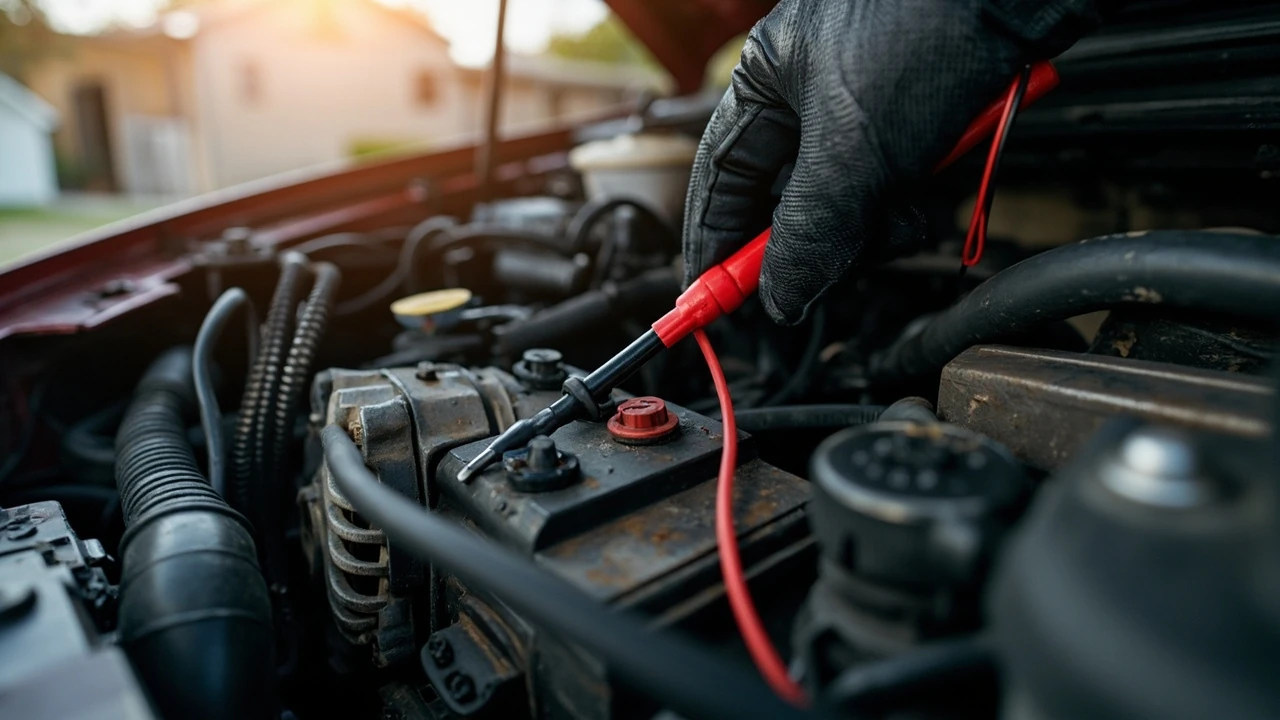

Signs of a bad car battery vs alternator: how to tell which one is the problem
You turn the key on a cold morning and the engine cranks slowly, the dashboard lights flicker, and a check-battery or check-engine warning appears for a moment. The vehicle may still start, or it may not start at all, and you are left wondering whether to replace the battery, the alternator, or both. The challenge is that a weak battery and a failing charging system produce overlapping symptoms, which is why the signs of a bad car battery vs alternator are so often confused.
This guide walks through what each component actually does, the symptoms that point more strongly to one or the other, the simple tests a homeowner can run with a basic multimeter, and the limits of those tests. It also covers the cost of typical repairs, when a tow to a shop is the right call, and how to avoid paying for parts you do not need.
What the battery and the alternator actually do
A car battery stores chemical energy and delivers a high burst of direct current to crank the starter motor. Once the engine is running, the battery’s main job shifts to stabilizing voltage and powering small loads when the engine is off, such as the alarm, clock, and keyless entry.
The alternator is a generator driven by the serpentine belt. It converts mechanical energy from the spinning crankshaft into alternating current, which an internal rectifier flips into direct current. That output recharges the battery while you drive and feeds the ignition coils, fuel injectors, infotainment system, lights, and climate control.
Because the two components are wired in series, a weak alternator can drag a healthy battery down to a dead state within a single drive cycle. A weak battery, on the other hand, can stress an alternator that is already near the end of its service life, because the alternator has to work harder to push current into a battery that will not hold a charge.
Symptoms more likely to point to the battery
Battery-specific symptoms tend to show up at start-up, after the car has been parked, or after a known short-trip driving pattern. A battery that has lost capacity can often still run the vehicle once the engine is going, because the alternator takes over.
- Slow or labored cranking on a cold morning, with the engine turning over sluggishly before firing.
- Clicking from the starter solenoid when you turn the key, but the engine does not turn over.
- A dashboard that lights up normally but loses power as you try to start, suggesting available voltage but not enough cranking amps.
- Visible corrosion, a swollen case, or a sulfur smell around the battery.
- Recent jump-starts that work but do not hold, with the car failing to start again the next morning.
- The vehicle is more than three to five years old, has sat unused for weeks, or has been driven mostly on short trips that never recharge a depleted battery.
These patterns describe a battery that is sulfated, deeply discharged, or near the end of its service life. The alternator is often still healthy in these cases, which is why a long drive after a jump can leave a driver stranded again the next day.
Symptoms more likely to point to the alternator
Alternator-specific symptoms tend to appear while the engine is running, because the alternator is the component that supplies power during operation. A car can start on a healthy battery, then begin to misbehave once the engine is idling or under load.
- The battery warning light, often shaped like a small battery icon, comes on while driving and may flicker with engine speed.
- Headlights and interior lights dim noticeably when the engine idles, then brighten when you rev the engine.
- Accessories such as the radio, power windows, or heated seats behave erratically or reset themselves.
- A whining, grinding, or squealing noise from the engine bay, often louder with electrical demand, sometimes tied to a failing bearing or worn brushes inside the alternator.
- A burning rubber or hot-wire smell, which can indicate a slipping belt or an overworked alternator.
- The vehicle runs briefly after a jump but stalls soon after, because the battery never receives a real charge.
These signs are consistent with a failing voltage regulator, a worn diode set, a slipping or broken serpentine belt, or a bad connection in the charging circuit. Drivers often describe the experience as the car slowly losing its nerve, with each system dropping out in turn as the available voltage falls.
A side-by-side comparison at a glance
The table below summarizes where battery and alternator symptoms tend to diverge. It is a starting point, not a diagnosis, because real failures often produce a mix of the two columns.
| Clue | More likely the battery | More likely the alternator |
|---|---|---|
| When the symptom appears | Mostly at start-up or after sitting | Mostly while driving or shortly after a jump |
| Cranking speed | Slow, dragging, or a single click | Normal at start, then voltage drops while running |
| Dashboard warning | Briefly at start, then clears | Battery or check-engine light stays on |
| Lights and accessories | Work normally once the engine is running | Dim at idle, brighten with revs, or flicker |
| Engine behavior | Starts and runs normally between jumps | Stalls, misfires, or runs rough as voltage falls |
| Unusual smells or sounds | Sulfur smell, visible corrosion, swollen case | Whining or grinding from the alternator, hot-wire smell |
| Effect of a jump-start | Car starts and stays running for days | Car starts but stalls again within minutes |
Quick tests you can run at home
Before paying for parts, a careful driver can narrow the problem down with a basic digital multimeter. The numbers are not perfect, but they reliably separate a dead battery from a weak charging system in most cases.
- Resting battery voltage. With the car off and the headlights left on for about a minute to remove surface charge, measure across the battery posts. A healthy, fully charged battery reads roughly 12.4 to 12.7 volts. Below 12.2 volts means the battery is partly discharged, and below about 11.8 volts usually means it is too low to reliably start the car.
- Cranking voltage. Have a helper crank the engine while you watch the meter. The voltage should stay above about 9.6 volts during cranking. A drop into the 7 to 8 volt range usually means a weak or shorted cell inside the battery.
- Running voltage at the battery. Start the engine and measure again at the battery posts. A healthy charging system holds between about 13.7 and 14.7 volts at idle. Numbers consistently above 15 volts point to a regulator pushing too hard, and numbers below about 13.2 volts point to an alternator that is not keeping up.
- Voltage under load. Turn on the headlights, blower fan, rear defroster, and heated seats. Voltage should hold in roughly the same 13.7 to 14.7 range. A drop of more than half a volt under this load, or numbers that wander up and down, suggest a weak alternator or a loose or corroded cable.
- Belt and connections. With the engine off, look at the serpentine belt for glazing, cracks, or fraying, and tug it lightly to check tension. Follow the positive and negative battery cables to the chassis and the engine block, and wiggle the terminals to feel for looseness or green corrosion.
If the resting voltage is low but the running voltage is in range, the battery is the most likely culprit. If the resting voltage is in range but the running voltage never reaches the 13.7 volt floor, the alternator or its regulator is more likely. Many auto-parts stores and service shops will run these checks for free if you bring the car in.
Tools, parts, and typical costs in the U.S.
Replacement costs vary by vehicle, region, and part brand, so the table below is a planning estimate rather than a quote. The goal is to set reasonable expectations before you call a shop.
| Repair | Typical part cost | Typical installed cost | Notes |
|---|---|---|---|
| Standard flooded lead-acid battery | About 90 to 180 dollars | About 130 to 250 dollars installed | Most common, available at parts stores, often installed while you wait |
| AGM or absorbed glass mat battery | About 180 to 320 dollars | About 220 to 400 dollars installed | Common on start-stop vehicles and cars with high electrical loads |
| Alternator rebuild | About 80 to 200 dollars for the core | About 180 to 350 dollars | Often cheaper than new, but availability has dropped at many shops |
| New alternator | About 200 to 500 dollars | About 400 to 850 dollars installed | European and luxury vehicles run higher, and some hybrids require special units |
| Serpentine belt replacement | About 25 to 70 dollars | About 90 to 200 dollars installed | Worth replacing on schedule if the alternator is being swapped |
Always ask the shop to test the old battery and the old alternator side by side before approving a second repair. A borderline battery that has been dragged down by a bad alternator can read as failed in isolation, then recover and behave normally once the charging system is fixed.
Edge cases that complicate the diagnosis
Several real-world conditions can make a clean battery-versus-alternator call harder than the rules of thumb suggest. A few of the most common deserve a closer look.
- Parasitic drains. A glove-box light, an aftermarket stereo, or a stuck relay can pull a few hundred milliamps overnight. After a few days, a healthy battery can read below 12 volts. The alternator is not at fault, but the symptom looks identical to a battery that has simply worn out.
- Cold weather. Capacity drops in cold temperatures, and engines require more cranking amps to turn over. A battery that is marginal in October can fail outright in January, even if the charging system is in good shape.
- Short-trip driving. Frequent five- to ten-minute trips never give a deeply discharged battery enough time to reach a full state of charge. The battery slowly sulfates, the alternator spends more time at high output, and both can fail earlier than expected.
- Loose or corroded grounds. A bad chassis ground or engine ground can mimic a failing alternator, because voltage drops across the corroded connection instead of reaching the battery. Cleaning and tightening grounds is a low-cost step that is easy to overlook.
- Belt slip on a wet morning. Water on a worn belt can make it slip briefly, leading to a momentary battery light and a flicker of accessories. If the light goes away and stays away, the belt is the most likely cause, not the alternator.
When to stop diagnosing and call for help
There are moments when the safer move is to stop testing and arrange a tow. Continuing to crank a weak battery can overheat cables and starter motors, and repeatedly jump-starting a vehicle with a failing alternator can fry the new battery that was just installed.
- The vehicle will not start, headlights are very dim, and you do not have a known-good donor car or a portable jump pack.
- The battery light is on, the engine is running roughly, and the smell of hot wire or melting insulation is present.
- You have replaced the battery, and the new one is dead again within a day, which strongly suggests the alternator is the real problem.
- There are visible signs of damage, such as a cracked battery case, leaking acid, or a belt that is fraying and shedding rubber.
- The vehicle is a hybrid or has a start-stop system, because the battery, the DC-to-DC converter, and the inverter all need to be checked with the right scan tool.
How to avoid paying for parts you do not need
Diagnostic shortcuts save real money, especially on vehicles that already have a mix of old and new parts. A few habits help keep the diagnosis honest.
- Ask for printed test results, including resting voltage, cranking voltage, and charging voltage under load, rather than a verbal summary.
- Have the shop test the battery after the alternator is replaced, because a deeply discharged battery can look permanently damaged until it has had a chance to recover on a proper charger.
- Keep the old battery until you are sure the new one is holding a charge, and ask for a pro-rated warranty in writing.
- Replace the serpentine belt and the battery cables at the same time if the vehicle is more than eight to ten years old and the parts are still original.
- Drive the vehicle for at least thirty minutes after any battery swap, and avoid only short trips for the first week, so the new battery reaches a full state of charge.
Frequently asked questions
Can a bad alternator destroy a new battery?
Yes. If the alternator is overcharging because of a failed voltage regulator, it can push the battery well above its normal voltage range. That cooks the electrolyte, warps the plates, and shortens battery life dramatically. A new battery installed in a vehicle with a bad alternator can be damaged within weeks.
How long should a car battery last before it needs replacement?
Most flooded lead-acid batteries last about three to five years in normal U.S. driving. AGM batteries often reach five to seven years. Hot climates, short-trip driving, and frequent deep discharges shorten that range, while moderate climates and regular longer drives extend it.
Will a car keep running if the alternator fails while driving?
Briefly, yes. The engine will run on whatever charge is left in the battery, but the battery was never meant to be the primary power source. Depending on the electrical load, a vehicle can drive for a few minutes to perhaps half an hour before the engine cuts out as voltage falls too low to feed the ignition and fuel systems.
Can I jump-start a car with a bad alternator?
You can jump-start it, and the engine will usually run on the donor battery’s charge for a short time. Once you disconnect the jumper cables, the failing alternator cannot recharge the battery, so the engine will stall. A jump is a way to move the car to a safe spot or a shop, not a real fix.
Do I need to replace the battery when I replace the alternator?
Not always. If the battery is less than three years old, has been load-tested, and holds a charge after the new alternator runs for an hour, it can usually stay. If the battery is near the end of its life or has been deeply discharged multiple times, replacing it at the same time is a reasonable choice that prevents another no-start in a few months.
What does a healthy charging system voltage look like?
At the battery posts, with the engine running, you should see roughly 13.7 to 14.7 volts at idle. Numbers above 15 volts point to an overcharging regulator, and numbers that stay below about 13.2 volts point to an alternator that is not keeping up with demand.
Are battery and alternator problems covered by a typical car warranty?
Coverage depends on the warranty. A new-vehicle bumper-to-bumper warranty usually covers both parts for the basic term. A powertrain warranty may cover the alternator but not the battery, since the battery is treated as a wear item. Extended warranties vary widely, so it is worth checking the specific contract language before approving a repair.
Why does my battery light stay on even after replacing the battery?
If the light stays on with a brand-new battery, the alternator or its regulator is the most common cause. A loose or corroded battery cable, a bad ground, or a worn serpentine belt can also trigger the same light. A short charging-system test at the shop will usually identify which one.
Is it safe to drive with the battery light on?
It is not safe to ignore. The light means the charging system is not keeping up with demand, and the vehicle is running on the battery alone. Drive directly to a shop or a safe place to stop, turn off non-essential accessories such as the heated seats and the rear defroster, and avoid shutting the engine off until you are parked, because it may not restart.
Can a loose gas cap really cause a check-engine light, or is the battery to blame?
A loose or damaged gas cap can trigger an evaporative-system code, which is separate from a charging-system problem. If the dashboard shows both a battery light and a check-engine light at the same time, scan the codes so you can address the real causes instead of guessing. A free OBD-II scan at many parts stores will usually identify which codes are stored.