
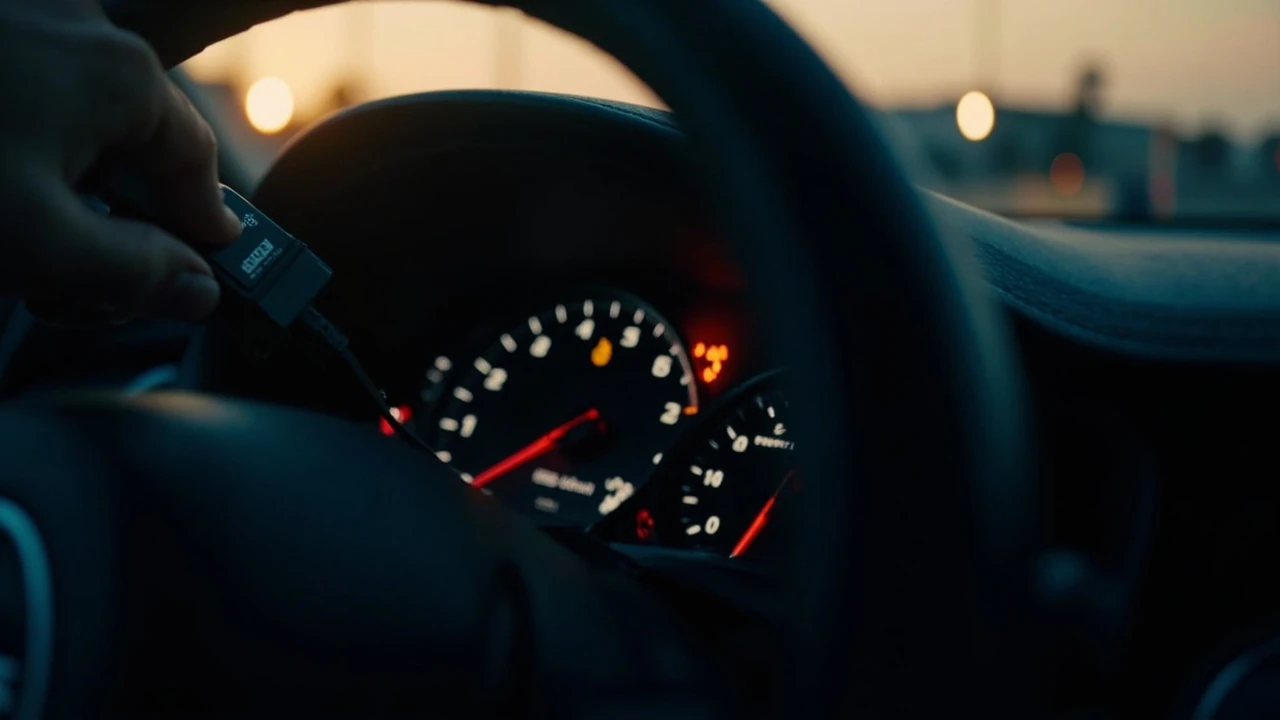

Check engine light blinking: what it really means
A flashing engine warning on the dash is one of the clearest signals a car can give that something is wrong right now. Unlike a steady glow, which usually points to a stored fault that the powertrain control module has flagged for service, a blinking warning indicates an active condition severe enough that the manufacturer considers continued driving a risk to the catalytic converter and the engine itself. Most often, the underlying cause is an engine misfire, and the system flashes the light on purpose to discourage you from driving the car home from the store or back across town.
This guide explains how the warning system is designed to behave, the most common mechanical reasons it starts flashing, the safe first steps to take at the roadside or in a parking lot, and the realistic costs and repair paths you can expect once a technician has had a look. The goal is to help you make a calm, informed decision in the minutes after the light starts blinking, rather than guessing and possibly turning a small problem into an expensive one.
How a flashing warning differs from a steady one
Modern vehicles use a single indicator for two very different messages. The amber icon that looks like a small engine block can either glow steadily or pulse, and the difference matters.
- Steady glow. The powertrain control module has detected a fault, stored a diagnostic trouble code, and decided the car can still be driven carefully to a service location. Common triggers include a loose fuel cap, a small emissions leak, an aging oxygen sensor, or a thermostat that is slow to open.
- Flashing or blinking. The same module is seeing a problem in real time severe enough to risk damage if you keep driving. A misfire is the textbook example: unburned fuel reaches the hot catalytic converter and can overheat it within minutes.
Some manufacturers add a third tier: a red or stop sign icon that means shut the engine off now. The amber blinking state is the middle of that range. It is not the same as the oil pressure light or the temperature warning, and it should not be treated as a casual reminder.
What the engine control system is actually detecting
When the check engine light starts blinking, the engine control unit has flagged a fault in real time, usually a misfire. A misfire means one or more cylinders failed to fire on a specific combustion cycle. The crankshaft position sensor notices the small drop in rotational speed, compares it to the expected firing order, and the controller logs a misfire code along with which cylinder is affected.
The system then takes a protective action. It enriches the fuel mixture, advances or retards timing, and in some vehicles cuts fuel to the offending cylinder entirely. None of that fixes the underlying problem. It just buys the catalytic converter a few extra minutes of life while the light demands your attention.
You can read more about how this warning indicator is designed to work in the overview of the check engine light on Wikipedia, which describes the two-stage steady-versus-flashing behavior used across the industry and the role of the engine control unit in storing the related fault code.
Most common causes of a blinking check engine light
Technicians see the same handful of root causes over and over when a customer describes a flashing engine warning. The table below summarizes the usual suspects, the symptoms that tend to travel with each one, and what a typical repair looks like.
| Likely cause | How it usually shows up | Typical repair | Estimated parts and labor range |
|---|---|---|---|
| Worn or fouled spark plug | Engine runs rough at idle, slight loss of power, fuel economy drops | Replace plugs, often with a fresh coil if the plug was shorted | Moderate cost, often a one- to two-hour job |
| Failed ignition coil | Strong vibration, hesitation on acceleration, sometimes a strong fuel smell | Replace the bad coil and inspect the plug that was running on it | Lower cost per coil, slightly higher if all coils are replaced |
| Bad spark plug wire or boot (older engines) | Visible arc at night, rough idle, misfire under load | Replace wires and boots as a set | Low to moderate cost, fast repair |
| Vacuum leak at intake gasket or hose | Hissing sound, idle surge, occasional stall | Replace gasket, hose, or cracked plastic intake runner | Low to moderate cost, diagnosis can take time |
| Low fuel pressure from failing pump or clogged filter | Long crank, stumble under throttle, intermittent misfire | Replace pump assembly or inline filter | Moderate to higher cost, depending on access |
| Faulty fuel injector | Cylinder-specific misfire, fuel smell, sometimes black smoke | Replace or professionally clean the injector, replace O-rings | Moderate cost per injector |
| Damaged timing chain or stretched timing components | Rattle on cold start, persistent misfire, occasional check engine light | Replace chain, guides, and tensioner | Higher cost because of labor |
| Failed catalytic converter | Sluggish acceleration, rotten egg smell, often follows an ignored misfire | Replace converter and resolve the original cause | Higher cost, both parts and labor |
These ranges are intentionally broad. A four-cylinder with accessible plugs costs far less to service than a V6 buried under an intake manifold. Where the part sits, the brand of the replacement component, and regional labor rates all move the final bill up or down.
What to do in the first ten minutes
A blinking warning on the dash is a driving decision, not just a diagnostic puzzle. The steps below are a safe default for most drivers who are not already within a few minutes of a trusted shop.
- Reduce load. Lift off the throttle, let the transmission downshift, and find a safe place to pull over. Avoid hard acceleration.
- Do not turn the engine off and on repeatedly. Each restart will usually just reset the warning without fixing anything and may clear the code that helps a technician diagnose the issue.
- Look for obvious clues. Listen for a strong misfire, smell for raw fuel, watch the temperature gauge, and glance under the hood for a disconnected hose or a plug wire that has come loose. Do not touch hot components.
- Decide whether to drive or tow. If the engine is running roughly, has a strong fuel smell, or the light returns within seconds of restarting, the safest call is a flatbed tow.
- If the car feels stable, drive gently to a nearby shop. Keep RPMs low, avoid highway speeds, and stay close to home or a service center rather than starting a long trip.
If your car is a project vehicle you are restoring at home, the same logic applies. A blinking light on a daily driver and a blinking light on a weekend build both deserve a prompt diagnostic check, because a misfire that ruins a catalytic converter is a repair measured in four figures rather than two.
Reading the trouble codes
Every time the check engine light blinks, the engine control unit stores one or more diagnostic trouble codes. These alphanumeric codes are the starting point for any repair, and they are easier to read than they used to be.
Onboard diagnostic port basics
Almost every gasoline vehicle sold in the United States since 1996 has a standardized OBD-II port, usually under the dash on the driver’s side. A basic Bluetooth or Wi-Fi scanner paired with a phone app can read stored codes, pending codes, and live data such as short-term fuel trim and RPM. The scanner does not fix anything, but it tells you what the car is complaining about before you spend money on parts.
What the codes actually mean
Misfire codes are the most common trigger for a blinking light. They follow a predictable pattern, with one digit identifying the system and the last identifying the cylinder.
| Code family | Typical meaning | First response |
|---|---|---|
| P0300 | Random or multiple cylinder misfire | Check plugs, coils, vacuum, fuel pressure |
| P0301 through P0308 | Misfire detected on a specific cylinder | Swap the suspect coil or plug with a known good cylinder and recheck |
| P0171 or P0174 | System too lean, bank 1 or bank 2 | Look for vacuum leaks, check MAF sensor, test fuel pressure |
| P0420 or P0430 | Catalyst efficiency below threshold | Address any active misfire first, then re-evaluate the converter |
| P0440 family | Evaporative emissions system fault | Inspect gas cap, EVAP hoses, and purge valve |
A code is a starting point, not a verdict. P0302, for example, tells you cylinder two is misfiring, but the same code can come from a worn plug, a cracked coil, a leaking intake gasket, a low compression reading, or even a wiring problem. The professional part of the job is figuring out which one.
Can you keep driving with a blinking light?
The honest answer is that you can, but you should not. The light is blinking because the engine control unit has seen something that can hurt the car if you keep running it. The most common damage path is unburned fuel entering a hot catalytic converter, which can overheat the substrate inside and melt it. A melted converter is expensive to replace on its own, and it can also be a sign of broader exhaust damage once exhaust flow is restricted.
There are also safety reasons to stop promptly. A misfire can cause a sudden drop in power at highway speed, which is a real hazard in traffic. A heavily rich mixture can wash oil off the cylinder walls and raise the long-term wear on piston rings, even if the immediate drive feels fine.
For a very short trip at low speed to a shop that is minutes away, with the engine running smoothly and no strong fuel smell, most technicians will accept the drive. Anything beyond that, especially on the highway or in heavy traffic, is better handled by a flatbed.
What a technician will actually do
A good diagnostic visit follows a fairly predictable order. Knowing the order helps you evaluate if you are getting a careful evaluation or a guess with a parts list attached.
- Scan and document. The technician reads stored and pending codes, then clears them and confirms which ones return during a test drive.
- Visual inspection. Plug condition, coil boots, vacuum hoses, the air intake, and any obvious wiring damage are checked first because they are the cheapest to fix.
- Component tests. A coil is checked with an ohmmeter or by swapping it to another cylinder. A fuel injector is tested for resistance and spray pattern. Compression and leak-down tests check the mechanical health of the cylinder.
- Live data review. Short-term and long-term fuel trims, O2 sensor waveforms, and misfire counters under load are reviewed to see whether the system is running rich, lean, or just plain unsteady.
- Repair and verification. Once the cause is identified, the bad part is replaced and the car is rechecked to confirm the code stays away and the engine runs cleanly.
A shop that skips the visual and live-data steps and immediately suggests replacing the catalytic converter on the strength of a P0420 code alone is selling a guess. The right shop will tell you what they found and what they ruled out, and they will usually show you the failed part.
Repair costs you can reasonably expect
Costs vary widely by region, vehicle, and part brand, so the table below uses typical ranges rather than precise prices. Treat these as a planning tool, not a quote.
| Repair | What tends to drive the price | What is fair to expect |
|---|---|---|
| Spark plug replacement | Number of cylinders, plug type, access | Low to moderate cost; often the lowest entry point for a misfire |
| Ignition coil replacement | Per-coil cost vs. full set, brand choice | Low to moderate cost; replacing all coils is sometimes preferred on higher mileage engines |
| Vacuum leak repair | Diagnostic time, part location | Low to moderate cost; labor can outweigh the part |
| Fuel injector service | One injector or all, cleaning vs. replacement | Moderate cost; a full set on a V6 or V8 can climb higher |
| Catalytic converter replacement | Converter price, federal emissions warranty eligibility | Higher cost; a converter itself is often the most expensive single part |
| Timing chain service | Engine layout, chain vs. belt components | Higher cost, mostly labor; not a beginner repair |
One often overlooked point is warranty coverage. In the United States, federal emissions components, including the catalytic converter and many sensors, carry an extended warranty of eight years or 80,000 miles on many recent vehicles. If your car is still within that window, the repair may be partly or fully covered. A quick call to the dealer with the VIN is worth the time before authorizing work at an independent shop.
Preventing a repeat episode
Most of the causes above are not random events. They are the result of parts that wear on a known schedule. A few habits reduce the odds of seeing a flashing engine light again.
- Follow the maintenance schedule. Plugs, coils, and air filters have a service interval for a reason. Replacing plugs before they fail is cheaper than replacing a converter.
- Use quality fuel. Top-tier gasoline contains more detergents and helps keep injectors and intake valves cleaner, which matters more on direct-injection engines that do not get the cleaning benefit of port injection.
- Fix small problems early. A steady check engine light is a warning. Ignoring it because the car still drives fine is how a $150 plug job becomes a $1,500 converter job.
- Address rough running promptly. A stumble, a hesitation, or a shake at idle is the mechanical version of a check engine light. The control module sees the same problem you do, just in numbers.
- Keep up with oil changes. Oil that has lost its viscosity is harder on timing components and variable valve timing actuators, both of which can contribute to a misfire.
None of these are a guarantee, but together they are the difference between a car that makes it to 200,000 miles and one that limps there.
When the light is blinking on a vehicle you are restoring
If you are working on a project car, a flashing light can be a welcome signal that the engine management system is doing its job. It means the wiring is intact, the sensors are reporting data, and the controller is willing to flag what it sees. Treat the code the same way you would on a daily driver: as a starting point for diagnosis rather than a reason to disconnect the battery and hope for the best.
For a fresh build or a long-stored car coming back to life, common triggers include:
- Loose or corroded grounds at the engine block or chassis.
- Vacuum lines routed to the wrong ports on the intake.
- Mismatched coil and plug combinations from a previous owner.
- Old fuel that has lost volatility, especially in vehicles that have sat through a season.
Going through the basics methodically saves hours of parts swapping. The same diagnostic order described above applies. A reliable build is one where the warning system has been silenced because the underlying problems have been fixed, not because the light has been disabled.
Common mistakes that make the problem worse
Several habits show up again and again when a small misfire turns into a major repair.
- Continuing to drive at highway speed. The catalytic converter can be damaged in a single long drive under load.
- Clearing codes without diagnosing. Erasing the code only hides the symptom. The fault returns, often with a different code layered on top.
- Replacing parts based on a single code. A P0301 can be a coil, a plug, a compression problem, or a wiring fault. Swapping the wrong part wastes money and delays the real fix.
- Using the cheapest available part. Low-quality coils and plugs have a short service life and can reintroduce the same misfire within months.
- Ignoring the gas cap. A loose or cracked cap triggers emissions codes that look like bigger problems. It is worth tightening it before paying for diagnostics.
Putting it all together
A blinking check engine light is the car telling you to act now, not later. Reduce load, find a safe place, and decide between a gentle drive to a nearby shop and a flatbed. Once the car is in the hands of a technician, the priority is a real diagnosis, not a parts swap. Read the codes, inspect the simple things first, and only replace components after they have been tested. The cost of a careful evaluation is almost always lower than the cost of a guess.
For most drivers, a single visit to a trusted shop resolves the underlying issue and the light stays off. For the rest, the warning becomes a reminder that engines still reward the same things they always have: clean fuel, fresh plugs, tight hoses, and a driver who pays attention when the dashboard asks for help.
Frequently asked questions
Is it safe to drive with a blinking check engine light?
It is best to avoid driving the car more than a short distance at low speed. A flashing engine warning usually signals a misfire, and continued driving can overheat and damage the catalytic converter. If the engine is running very roughly or smells strongly of fuel, a flatbed tow is the safer choice.
What is the most common reason for a check engine light blinking?
An engine misfire is the most common reason. The most frequent mechanical causes are a worn spark plug, a failed ignition coil, a vacuum leak, or a fuel delivery issue such as a weak pump or clogged injector.
Will a blinking check engine light reset on its own?
Sometimes the light will go out after the fault stops occurring, but the underlying problem usually returns. The stored code may also stay in memory and reappear as a pending fault, so a diagnostic read is still the right first step.
Can a loose gas cap cause a flashing check engine light?
A loose or cracked gas cap typically triggers a steady light tied to the evaporative emissions system, not a flashing one. If the light is blinking, the cap is unlikely to be the only issue, although it is still worth tightening as a free first check.
How much does it cost to fix a blinking check engine light?
Costs range from a modest plug replacement to a higher-priced catalytic converter or timing chain service. The only reliable way to estimate the bill is to read the codes and diagnose the specific fault rather than guess at parts.
Can I read the trouble codes myself?
Yes. An inexpensive OBD-II scanner paired with a phone app can read stored and pending codes from the standardized diagnostic port. The scanner will not fix the car, but it tells you what to investigate before paying a shop for diagnosis.
Does a flashing check engine light always mean a misfire?
Almost always, but not exclusively. A flashing light is the engine control unit’s way of saying that continued operation risks damage right now, and a misfire is the most frequent cause. Less common triggers include severe fuel trim errors and certain sensor failures.
Will disconnecting the battery clear the check engine light?
Disconnecting the battery may reset the light temporarily, but it will not fix the underlying problem, and the light will come back on as soon as the fault recurs. The reset can also clear other learned settings in the vehicle, so a scanner-based reset is generally a better option.
Is a blinking check engine light covered by warranty?
Many emissions-related components, including the catalytic converter and certain sensors, carry an extended federal emissions warranty of eight years or 80,000 miles on eligible vehicles. Powertrain coverage may also apply depending on the vehicle and mileage, so a quick call to the dealer with the VIN is worth the time.
What should I do first when the light starts blinking while driving?
Reduce throttle, find a safe place to pull over, and assess how the engine is running. If the engine is rough, has a strong fuel smell, or the light returns immediately, the safest move is a tow. If the engine feels stable, a short, low-speed drive to a nearby shop is usually acceptable.