
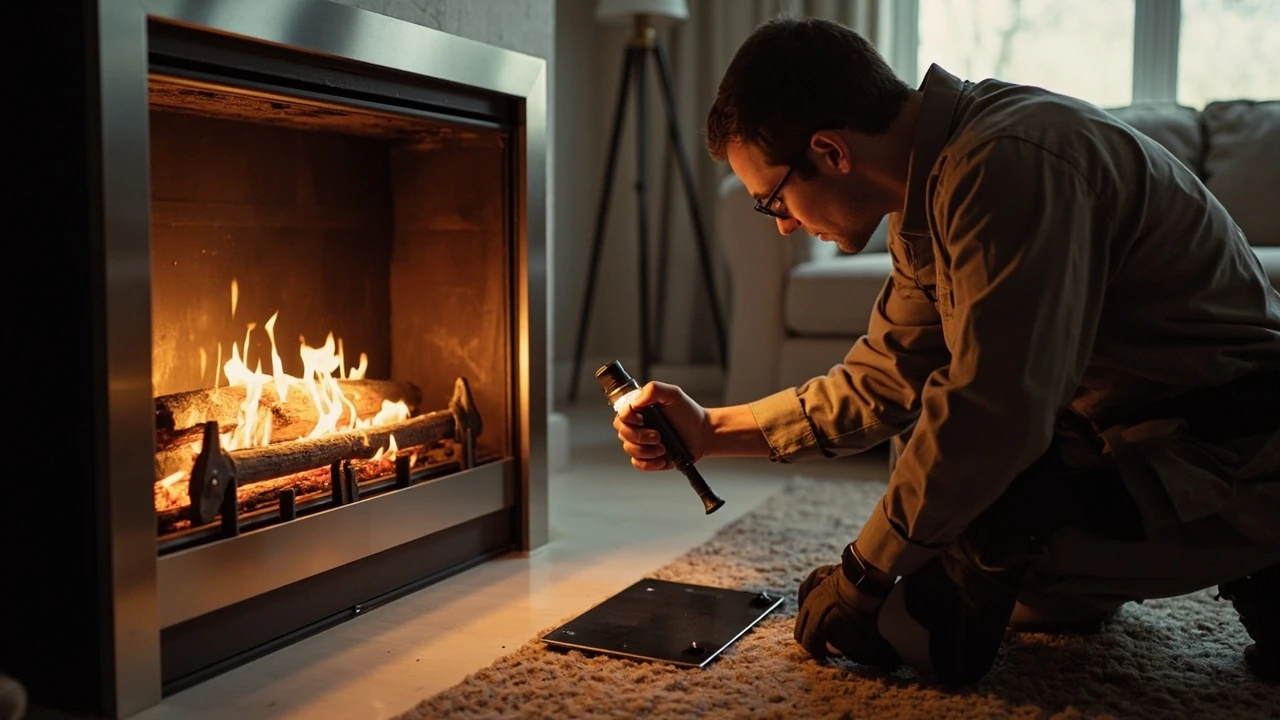

Gas fireplace service: what it covers and when to book it
A gas fireplace that lights, throws a nice flame, and warms the room on a cold evening can still be quietly wasting fuel, leaking combustion gases, or building up carbon inside the firebox. The problem is that most issues are invisible from the couch. A proper gas fireplace service visit is the routine that exposes those hidden problems before they shorten the life of the unit or push carbon monoxide into the house.
Annual service is also what most manufacturers and fireplace-safety organizations actually recommend, even when a unit appears to be running fine. This guide walks through what a real service appointment includes, the warning signs that mean you should book one sooner, the repair questions worth asking a technician, and how to compare quotes between providers. It is written for U.S. homeowners who own or are thinking about installing a gas fireplace, gas insert, or gas log set.
What gas fireplace service actually includes
The phrase “gas fireplace service” is used loosely in the trade. A bare tune-up from one company may be a basic visual check, while a full annual service from another company may include a multi-point inspection, cleaning, combustion analysis, and a written report. Knowing what is on the work order before booking saves awkward conversations later.
Standard items in a typical annual service
- Visual inspection of the firebox, glass, logs, burner, and refractory panels for cracks, soot, or corrosion.
- Cleaning the burner ports, pilot assembly, and orifice to remove dust, pet hair, and spider webs.
- Brushing and vacuuming the firebox and, where accessible, the pilot air intake.
- Checking the igniter, thermopile, thermocouple, and millivolt wiring for proper operation.
- Inspecting the glass gasket and door seal for tightness and integrity.
- Verifying the gas line, flex connector, and shutoff valve for leaks with a manometer or electronic leak detector.
- Confirming flame appearance is even, blue at the base with yellow tips, and free of lazy or lifting flames.
- Testing carbon monoxide levels in the room near the unit after a warm-up cycle.
- Confirming the blower, remote, wall switch, and any smart module operate correctly.
- Writing a short report listing findings, recommendations, and any parts that should be replaced soon.
The exact list depends on the unit type, age, and fuel. A vented gas log set, a direct-vent insert, and a top-of-the-line smart linear fireplace each have slightly different service points. A good provider will explain which items are part of the flat service fee and which are billed as repairs if a part needs replacement.
Why annual service matters for a gas fireplace
Gas burns clean compared with wood, but a gas appliance is still a small combustion system with moving parts, gaskets, and electronics. Over a year of use, several things quietly change inside the unit, and most of them are not visible without tools.
Combustion efficiency and fuel cost
Safety and indoor air quality
Gaskets around glass doors and between the firebox and the chase degrade with heat cycles. Worn gaskets can allow combustion byproducts to leak into the living space instead of exiting through the vent. Carbon monoxide is the headline concern, but soot and odors are also signs that something is wrong. A routine service includes checking gaskets and sealing surfaces, and verifying CO levels near the unit. The same New Jersey provider notes that worn gaskets can let poisonous carbon monoxide enter the home, which is why annual inspection and cleaning are part of their recommended service.
Warranty and resale value
Many manufacturers require documented annual service to keep the warranty in force. Skipping a service does not usually void a warranty on its own, but a denied claim after a heat-exchanger failure is much harder to fight without records. For homeowners planning to sell, a folder of service receipts is a small but real signal that the fireplace has been cared for.
Extending the life of the appliance
A gas fireplace that is clean, correctly fueled, and burning with the right flame profile puts less stress on the thermocouple, thermopile, blower motor, and control module. Routine service catches a slow thermopile before it strands the homeowner on a January evening with a pilot that will not stay lit. That kind of preventive care is the entire point of annual service.
Service vs. repair: how the two are usually priced
Homeowners often see a single line item for “service” and assume it covers anything wrong with the unit. In practice, most companies separate the diagnostic visit and the routine service from any actual repair work, and price them differently.
| Item | Typical purpose | How it is usually priced |
|---|---|---|
| Annual inspection and cleaning | Routine preventive maintenance with no broken parts | Flat fee, often quoted as a single trip charge |
| Diagnostic visit | Troubleshooting a specific problem the homeowner is reporting | Flat trip charge that is often credited toward the repair |
| Minor repair | Replacing an igniter, thermocouple, thermopile, or remote part | Trip charge plus parts and a small labor block |
| Major repair | Heat exchanger, gas valve, blower, control module, or glass replacement | Parts plus several hours of labor, often a separate quote |
| Emergency or off-season call | Same-day or after-hours service outside the normal schedule | Premium trip charge plus standard labor and parts |
Ask the provider up front whether the initial trip includes the basic cleaning and inspection, or whether each task is a separate line item. The difference between a $149 tune-up and a $349 full service is often just how the provider itemizes the same list of work.
Warning signs that mean you should book service sooner
Annual service is for healthy units. Some symptoms mean the fireplace needs attention before the next scheduled visit, regardless of how new it looks.
Visible signs around the firebox
- Black or white powdery residue on the logs, burner, or inside the glass.
- Soot streaks climbing up the glass above the burner ports.
- Cracked or visibly shifted refractory panels or logs.
- Discoloration on the surround, mantel, or wall above the unit.
Flame and ignition problems
- A lazy, yellow, or floating flame instead of a tight blue flame with small yellow tips.
- Flame rollout, where flames lick out of the firebox opening instead of staying inside.
- Pilot light that will not stay lit, or that re-lights only after the unit has cooled.
- Clicking igniter that does not light the burner after several tries.
Air and smell clues
- A burning or acrid smell the first few minutes after start-up, especially with new logs or after a long idle.
- A persistent “rotten egg” smell that may indicate a gas leak, which is a reason to leave the home and call the gas utility.
- Condensation or water marks on the inside of the glass during normal use.
- A milky haze on the inside of the glass that does not wipe clean.
Any single one of these is enough to book service. Several at once is a reason to stop using the unit until a technician has been through it.
How a service visit typically unfolds
Knowing the rough sequence of a visit helps homeowners know what to expect and what to have ready. The exact flow varies by provider, but the bones are similar.
Before the technician arrives
- Clear a working area in front of the fireplace so the technician can place tools and a small vacuum.
- Have the model and serial number of the unit ready, usually on a rating plate behind the lower louver or inside the firebox.
- Move pets to a separate room; the visit involves open panels, a running vacuum, and small parts.
- Be ready to describe the unit’s behavior over the last few months, not just on the day of the visit.
During the visit
- The technician turns off the gas at the shutoff valve and lets the unit cool to a safe working temperature.
- Front cover, glass, and logs are removed to expose the burner and firebox.
- Burner, pilot, and orifice are brushed and vacuumed; gaskets and refractory are inspected.
- Gas line and connections are tested for leaks with a calibrated instrument.
- The unit is re-lit and run for a burn-in, then the flame pattern and CO level are checked.
- Any failed parts are shown to the homeowner, with options for repair or follow-up.
After the visit
- Ask for a written report that lists the inspection points, parts replaced, and any open recommendations.
- Confirm the date of the next annual service and how reminders are handled.
- Keep the receipt and report in a folder with the owner’s manual.
- If a major repair was quoted, ask whether the price is honored for a defined window.
How to choose a gas fireplace service provider
Gas fireplaces sit on a regulated gas line, so the company you hire should be credentialed for fuel-gas work in your state, not just a general handyman service. There is no single national license for fireplace technicians, but the markers below are a useful filter.
Credentials and training
- NFI Certified Gas Technician or NFI Certified Master Hearth Professional for the technician who will do the work.
- Manufacturer training or factory certification for the brand of the unit, especially for direct-vent or power-vent models.
- State or local mechanical or gas-fitting license where required; in some states the company must hold a plumbing or gas-fitter license to legally work on the gas line.
- General liability insurance and, ideally, workers’ compensation coverage.
How to compare two or three quotes
| Question to ask | Why it matters |
|---|---|
| What is included in the flat service fee? | Separates a true annual service from a quick visual check. |
| Is the diagnostic fee credited toward the repair? | Prevents paying twice for the same visit. |
| Are parts priced at retail, or at a marked-up rate? | Affects the cost of any thermopile, valve, or module replacement. |
| What is the labor rate and the minimum labor block? | Small jobs can round up to a full hour of labor. |
| Is the technician NFI certified, and who actually does the work? | Some companies send a junior tech while the certification sits on a senior employee. |
| Do you service my brand and model? | Smart linear units and European imports need different training than legacy logs. |
| What is the warranty on the service work itself? | A 30- to 90-day workmanship warranty is a fair baseline. |
Dust, pet hair, and fine debris gradually clog burner orifices. When ports are partially blocked, less gas mixes with the same amount of air, the flame looks weak or uneven, and the unit has to work harder to throw the same heat. Industry guidance from the major gas fireplace manufacturers has long recommended an annual inspection and cleaning for this reason. The Wood Stove & Fireplace Center, which services Monmouth County, New Jersey, lists annual inspection and cleaning as a manufacturer-aligned practice that keeps a gas unit burning efficiently and prevents clogs from dust, carbon, and spider webs in the orifices and burner ports.
A quote that is meaningfully lower than two or three comparable local quotes usually means the scope is thinner, not that the company is more efficient. It is fair to ask for the inspection checklist in writing before the visit.
Costs, timing, and what affects the price
National averages are hard to pin down because the work is local, the unit types vary, and a service-only visit is different from a service-plus-repair visit. A few patterns are reliable enough to plan around.
Common price ranges in the U.S. market
- A basic annual inspection and cleaning for a standard gas fireplace or insert typically falls in the low-to-mid hundreds of dollars for a single visit.
- Adding a combustion analysis or written efficiency report moves the price toward the upper end of the same range.
- Replacing wear parts such as a thermocouple, thermopile, or igniter usually adds parts plus a small labor block on top of the service fee.
- Larger parts like a gas valve, blower motor, or control module can push a single visit into four-figure territory once labor is included.
What moves the price up or down
- Unit type: a direct-vent insert with electronics costs more to service than a simple vented gas log set.
- Access: a fireplace in a tight chase with hard-to-remove panels takes longer than a clean install on a main wall.
- Region: labor rates in major metros run higher than in rural service areas.
- Season: peak demand in late fall can stretch lead times and may affect off-season pricing.
- Age and parts availability: older units sometimes need parts that have to be special-ordered, which can mean a second visit.
Homeowners who want a steadier price often book the annual service during a slower shoulder season. Spring and early fall tend to have more open schedules than the weeks before Thanksgiving.
DIY tasks vs. what really needs a technician
There is a small set of gas-fireplace tasks a careful homeowner can do, and a much larger set that should stay with a trained technician. Mixing the two is how most warranty and safety problems start.
| Task | Homeowner | Technician |
|---|---|---|
| Cleaning the exterior glass with approved cleaner | Yes | Yes |
| Replacing batteries in the remote or receiver | Yes | Yes |
| Confirming the pilot stays lit after start-up | Yes | Yes |
| Brushing and vacuuming burner ports and pilot assembly | No | Yes |
| Leak-testing the gas line with a manometer | No | Yes |
| Adjusting the flame orifice or air shutter | No | Yes |
| Replacing a thermocouple, thermopile, or gas valve | No | Yes |
| Replacing a cracked refractory panel or log | No | Yes |
| Annual carbon monoxide test in the room | No | Yes |
Homeowners should also test their own CO detectors monthly and replace batteries twice a year. A working CO detector is a backstop for the whole gas appliance system in the home, and it is the one piece of safety equipment that should never depend on a service visit.
How to prepare the unit and the home for a service visit
Small steps before the technician arrives shorten the visit and reduce billable time.
- Run the fireplace for a few minutes the day before so the technician can see how it currently behaves.
- Locate the gas shutoff for the unit and make sure it is accessible.
- Clear a path from the door to the fireplace, including area rugs that may need to be lifted.
- Have the owner’s manual available if the unit is older or was inherited with the home.
- Write down a short list of questions, including what the warranty covers and what to do if the unit fails between visits.
Common repair questions worth asking
When a technician recommends a repair, the homeowner does not have to accept it on the spot. A few useful questions make the conversation more productive.
- Is the part failing because of age, or because of a deeper issue in the unit?
- What is the consequence of waiting one more season before replacing it?
- Is the replacement part OEM from the manufacturer, or a compatible third-party part?
- Is the repair covered by any active manufacturer warranty or service plan?
- Will the technician document the failing part in writing for the homeowner’s records?
These questions are especially important for older units, where the cost of one repair can approach the cost of a replacement insert. A trustworthy provider will talk through the trade-offs without pressuring the homeowner.
Special cases: inserts, log sets, and smart fireplaces
Not every gas fireplace is a traditional built-in unit. The service approach changes a bit for each format.
Vented gas log sets
Vented log sets sit in an existing wood-burning fireplace and burn with a yellow, more visible flame for looks rather than primary heat. They still need annual cleaning because soot and carbon can build up on the logs and on the damper area. Many service providers treat log-set service as a separate, simpler package than insert service.
Direct-vent gas inserts
Direct-vent inserts are sealed units that draw combustion air from outside and vent exhaust back outside through a co-axial pipe. They are the most common high-efficiency option in living rooms. Service is more involved because of the sealed glass, the co-axial vent, and the blower assembly. Annual service on an insert tends to be the most complete appointment of the three.
Linear and smart fireplaces
Newer linear units and app-controlled fireplaces add electronics, LED lighting, and sometimes a second burner stage. The service scope should include firmware updates where the manufacturer offers them, plus a check of the LED driver and any secondary air mixer. A technician who has not been trained on the specific brand is the wrong person to work on these units.
How gas fireplace service interacts with other home systems
A gas fireplace does not live alone in the house. A few interactions are worth knowing about before a service visit.
- CO and smoke detectors in the same room should be tested during the visit, not just the unit itself.
- If the home has a whole-house dehumidifier or strong HVAC returns near the fireplace, flame behavior can change when the HVAC is running; the technician can test under both conditions.
- A nearby kitchen range or dryer that shares the gas line with the fireplace can affect gas pressure readings; knowing which appliances run on gas helps with troubleshooting.
- Remodeling work in the room, from new paint to new flooring, can introduce fumes the first time the fireplace is used. The technician should know about any recent work.
Frequently asked questions
How often should I schedule gas fireplace service?
Most manufacturers and service companies recommend an annual service for a working gas fireplace, gas insert, or gas log set. If the unit runs heavily through a long winter, a mid-season check of the flame pattern and CO levels is a reasonable extra step.
Can a gas fireplace be serviced in the summer?
Yes. Off-season service is often easier to schedule and may cost less, and the technician can spot issues that would otherwise sit until the first cold evening. The trade-off is that a technician cannot fully observe flame behavior under real heating load, so a short follow-up check the first time the unit is used in fall is a good idea.
What is the average cost of a gas fireplace service visit?
Costs vary by region, but a standard annual inspection and cleaning for a residential gas fireplace typically falls in the low-to-mid hundreds of dollars. Add parts and additional labor for any repairs, and the visit can move into the upper hundreds or low thousands for larger component replacements.
Do I need to be home during the service?
Yes. The technician needs access to the inside of the home, the gas shutoff, and the area in front of the unit, and the homeowner is usually asked to confirm findings and sign off on any repair work before it starts.
What is the difference between a gas fireplace service and a gas fireplace inspection?
An inspection is the visual and instrumented check. A service is the inspection plus cleaning, adjustment, and minor maintenance. Many providers use the two terms interchangeably, so it is worth asking for the exact checklist before booking.
Will the technician need to turn off the gas to my whole house?
Usually not. The fireplace has its own shutoff valve, and a competent technician isolates the unit rather than the whole home. If the gas line itself needs work, the gas utility may need to shut off service briefly.
Can a gas fireplace service fix a pilot light that keeps going out?
Often, yes. A pilot that will not stay lit is usually a thermocouple, thermopile, pilot orifice, or draft issue, and all of those are part of a standard service visit. If the issue is a failing gas control valve, the technician will quote that as a separate repair.
Should I get my gas fireplace serviced before selling my home?
It is a small investment that tends to pay off in buyer confidence. A recent service record alongside the owner’s manual signals that the unit has been maintained, and a technician can flag any deferred repairs that could derail a home inspection.
Is it safe to use my gas fireplace if the glass is foggy?
Condensation or a milky haze on the inside of the glass can be normal on a cold start, but persistent fog or film is a sign to book service. It can point to combustion air issues, a cracked glass seal, or residue that needs to be cleaned off by a technician.
What should I do if I smell gas near my fireplace?
Leave the home, leave the door open on the way out, and call the gas utility from a safe distance. Do not operate light switches, phones, or appliances inside the home, and do not relight the unit until a qualified technician and the utility have confirmed it is safe.