
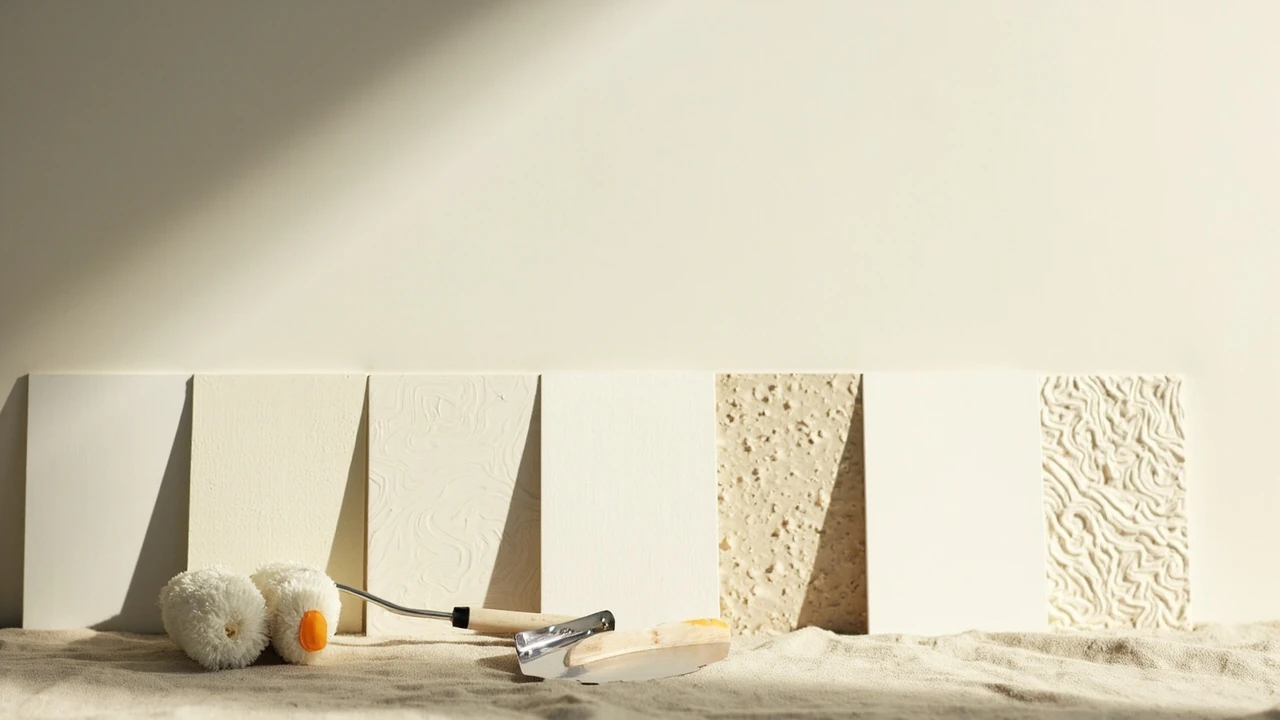

Ceiling texture types: a practical guide for homeowners
Walk into any older home and the ceiling tells a story. The fine, pebbled surface in the hallway is a different product from the broad, swooping arcs in the living room, and neither one matches the glossy flat finish in a modern kitchen. Ceiling texture types exist because builders and remodelers needed a way to hide framing imperfections, absorb sound, and add visual interest without the cost of a fully smooth, level-five drywall finish. Choosing among them affects how a room looks, how it sounds, how the surface ages, and how much it costs to repair later.
This guide compares the most common ceiling texture types used in U.S. residential work, including smooth, orange peel, knockdown, popcorn, slap brush, and a few specialty finishes. It explains how each is applied, what it is best used for, and the practical tradeoffs around cost, repair, and room acoustics, so you can decide what fits your project and budget.
What a ceiling texture actually does
A ceiling texture is a finish applied over taped and mudded drywall or plaster. The finish itself can be thinned joint compound, a spray-applied aggregate product, or a pre-mixed acoustic coating. Once dry, it is usually primed and painted, although some popcorn and acoustic coatings are designed to be left white.
Three jobs drive most texture choices:
- Hiding imperfections. Drywall seams, fastener pops, and minor framing variations disappear under a textured surface. A flat, smooth ceiling demands near-perfect drywall work, which costs more in labor.
- Managing sound. Porous, irregular textures soften echo and reduce the hard, reflective quality of a room. Popcorn ceilings in particular were specified in many mid-century tract homes for that reason.
- Adding visual interest. Texture breaks up what would otherwise be a large, flat plane. In rooms with low ceilings, a light texture can make the surface feel softer and less oppressive than a stark, glossy finish.
None of these effects are purely decorative. A heavy texture can also collect dust, yellow over time, and complicate any future renovation, especially the removal of older popcorn finishes that may contain asbestos.
The most common ceiling texture types at a glance
The table below summarizes the finishes covered in detail later in the article. Costs and difficulty are typical U.S. ranges for a standard 12 by 12 room and can vary widely by region and by the condition of the existing ceiling.
| Texture | Typical look | Application method | Best suited for | Relative cost | Repair difficulty |
|---|---|---|---|---|---|
| Smooth (level 5) | Flat, even surface with no visible pattern | Hand-taped, skim-coated, sanded | Modern interiors, low ceilings, kitchens, baths | High | Moderate, blending required |
| Orange peel | Light, dimpled surface like citrus skin | Hopper spray gun with thinned mud | Hiding minor flaws in most rooms | Low to moderate | Easy |
| Knockdown | Flatter splatters partially smoothed with a knife | Sprayed, then knocked down with a wide blade | Open living areas, new construction | Moderate | Easy to moderate |
| Popcorn (acoustic) | Heavy, bumpy, cottage-cheese look | Sprayed acoustic coating, often pre-mixed | Older homes, sound dampening, hiding flaws | Low installed, high to remove | Difficult to match |
| Slap brush (stomp brush) | Bold, crisscrossed, raised pattern | Thick mud applied with a stiff brush, often two colors | Bedrooms, accent ceilings, rental properties | Low | Very difficult to patch |
| Swirl, rosebud, and combed | Decorative circular or linear patterns | Hand-applied with a brush, trowel, or comb | Formal rooms, historic reproductions | Moderate | Very difficult |
| Sand swirl and Spanish lace | Sand-flecked or lace-like raised patterns | Sand mixed into mud, then swirled or sponged | Mid-century homes, retro styling | Moderate | Very difficult |
Smooth (level 5) ceilings
A smooth ceiling is not really a texture at all, but it is the reference point that every other ceiling texture type is compared against. In the drywall industry this is called a level 5 finish, meaning the entire surface is skim-coated with a thin layer of joint compound and sanded flat before priming.
Smooth ceilings photograph cleanly, work with any color, and suit contemporary and minimalist interiors. They also expose every imperfection, so they require careful framing, hanging, taping, and finishing. Lighting plays a big role: a smooth ceiling under harsh downlights will show roller marks, lap lines, and any waves in the framing.
For a homeowner weighing smooth against textured options, the practical question is whether the room’s lighting and framing can support a flat finish. Older homes with slightly uneven joists often look better with at least a light orange peel, which disguises the same waves that a smooth finish would highlight.
Orange peel
Orange peel is a fine, dimpled finish that resembles the surface of an orange rind. It is created by spraying thinned joint compound through a hopper gun, which atomizes the mud into a mist of droplets that dry in place on the ceiling.
Because the pattern is small and consistent, orange peel hides small drywall flaws and minor framing variations without dominating the room. It is one of the most common ceiling texture types in newer U.S. tract homes because it goes on quickly with a rented or contractor-owned sprayer and it is forgiving on less-than-perfect framing.
Repair is straightforward. A small hole or water stain can be patched with a piece of drywall, floated out, and resprayed with a small hopper gun. Even a hand-applied “pickup” with a sponge or brush can blend into orange peel well enough to disappear under primer and paint.
Knockdown
Knockdown starts the same way as orange peel: a hopper gun sprays thinned mud onto the ceiling. The difference is that the mud is mixed slightly thicker, so the splatters hold their shape. After a few minutes, when the droplets have set up but are still wet, the installer drags a wide, flat knife across the surface to flatten the peaks. The result is a mottled, low-relief pattern with soft edges.
Knockdown became popular in the 1990s and 2000s for new construction because it hid framing and drywall imperfections while reading as a more upscale finish than heavy orange peel or popcorn. It is also quicker to spray and knock down than to skim-coat a perfectly smooth surface.
Two practical caveats come with knockdown. First, the pattern is directional. The way the knife moves affects the look, so repairs often show unless the patch is large enough to re-spray an entire section. Second, knockdown collects dust in the flattened pockets, and the pattern can be hard to clean without a soft brush attachment on a vacuum.
Popcorn (acoustic) ceilings
Popcorn is the heavy, bumpy texture that defined ceilings from the 1960s through the late 1980s. It is usually a pre-mixed or spray-applied acoustic coating that contains a lightweight aggregate, which is what creates the rough, three-dimensional surface. In many homes it was sprayed directly over unfinished drywall and never painted, leaving the characteristic bright white.
Popcorn ceilings earned their place for three reasons. They hid poor drywall work in an era of fast residential construction. They absorbed sound, which was useful in open-plan homes with hard floors. And they were cheap and quick to apply compared with skilled hand finishing.
The downsides are familiar. Popcorn traps dust, cobwebs, and cooking residue, and it is hard to clean. It also dates a room quickly. Most homeowners who want to refresh a popcorn ceiling either paint it with a thick-nap roller or remove it entirely. Removal is messy, often requires scraping and re-skimming the underlying drywall, and in homes built before the mid-1980s the original material may contain asbestos, which means it should be tested by a licensed professional before any disturbance.
Slap brush, stomp brush, and Spanish lace
Slap brush, sometimes called stomp brush, is a deliberately bold, hand-applied pattern. The installer dips a stiff-bristled brush into thinned joint compound, presses it against the ceiling, and lifts it away, leaving a crisscrossed, raised pattern. Done in two layers of different colors, it creates a deep, almost sculptural effect that hides everything underneath.
This kind of finish is common in apartment complexes, rental homes, and accent bedrooms. It is fast, low-skill, and extremely effective at disguising terrible drywall. The trade-off is that it is one of the hardest ceiling texture types to repair. A patch cannot be blended in with the surrounding pattern without redoing a large area.
Spanish lace and sand swirl are related finishes. Spanish lace is a sponged, lace-like pattern often built up in two contrasting colors. Sand swirl mixes fine sand into the mud and then brushes it in arcs, producing a sparkly, mid-century look that turns up in many 1960s and 1970s homes.
Swirl, rosebud, and combed patterns
Swirl, rosebud, and combed patterns are hand-applied decorative textures. The installer works with a brush, trowel, or notched comb to create arcs, fans, or linear striations in wet joint compound. These finishes show up in formal living rooms, dining rooms, and historic homes, often with a faux-finish glaze layered on top for depth.
These ceiling texture types are not the right choice for a fast remodel. They are slow, skill-dependent, and expensive, but they can be the right choice when the goal is a specific period look or a high-touch feature ceiling. Repairs are similarly demanding, since matching the pattern across a patch usually requires a specialist.
Choosing a texture for the room you have
The best ceiling texture for a given room depends on more than personal taste. Ceiling height, lighting angle, existing drywall condition, and how the room is used all push the decision in different directions.
Low ceilings and modern rooms
For ceilings under 8 feet, heavy texture can make the room feel closed-in. Smooth, orange peel, or a very light knockdown tends to read as clean and contemporary without drawing the eye down. Modern kitchens, primary bathrooms, and home offices usually benefit from a finish in this group.
Rooms with strong, angled lighting
Downlights and tall windows cast shadows that exaggerate any surface variation. A heavy knockdown or slap brush ceiling will look dramatic, while a smooth ceiling will reveal every imperfection. For most living rooms with can lights, orange peel or a medium knockdown is a safe middle ground.
Older homes with imperfect framing
If the joists are not perfectly level and the drywall has waves, a textured finish is a friend. Orange peel, knockdown, and slap brush all hide framing problems. A smooth finish in this setting is only sensible after a full re-leveling of the framing or a careful skim coat by a finisher who specializes in older homes.
Rental properties and investment homes
For a property where durability and cost matter more than design, slap brush and heavy knockdown are the practical choices. They stand up to years of tenant turnover, cover a wide range of drywall conditions, and can usually be repainted without losing the pattern. Some investors also choose popcorn for the same reasons, though buyer preferences have moved away from it in most U.S. markets.
Application methods compared
How a texture is applied affects both its look and its price. The table below compares the three main methods used for the ceiling texture types above.
| Method | Tools required | Skill level | Speed for a 12 by 12 room | Typical U.S. cost per square foot, installed |
|---|---|---|---|---|
| Hand trowel and brush (smooth, swirl, slap brush) | Hawk, trowel, brushes, sanding poles | High for smooth, moderate for slap brush | 1 to 3 days for smooth, half a day for slap brush | Higher for smooth, very low for slap brush |
| Spray and knock down (orange peel, knockdown, popcorn) | Hopper gun, air compressor, knockdown knife | Moderate | Half a day to a day, plus drying time | Low to moderate |
| Pre-mixed acoustic (popcorn) | Sprayer or hand application tools | Low to moderate | Half a day | Low installed, high to remove |
The dollar ranges above are general U.S. residential ranges and do not include paint. Local labor rates, ceiling height, the number of fixtures to mask, and the condition of the substrate all move the price up or down.
Repair and patching: what to expect
Every ceiling texture type is repairable, but the difficulty varies enormously. Before choosing a texture, it is worth thinking about how the ceiling will be repaired if a pipe leaks, a fixture is replaced, or a section has to be opened for electrical work.
- Smooth: Small patches can be skim-coated and sanded, but the surrounding area often needs to be repainted to hide the repair.
- Orange peel: A rented hopper gun and a little practice produce patches that disappear. For very small spots, a hand-applied “texture in a can” spray works well.
- Knockdown: Patches need to be resprayed, then knocked down to match the surrounding pattern. Blending the edges of the patch with the existing texture is the hard part.
- Popcorn: Pre-mixed popcorn patch products in aerosol cans can blend well if the original ceiling was never painted. Painted popcorn is harder to match because the paint changes the surface sheen.
- Slap brush, swirl, and decorative patterns: These ceiling texture types are the hardest to patch invisibly. The usual fix is to repair a rectangular area and re-create the pattern across the whole room, which is rarely worth doing for a small damage spot.
Acoustic and lighting effects
Texture affects how a room sounds, especially in homes with hard floors, large windows, and minimal soft furnishings. Popcorn and other heavy textures scatter and absorb sound waves, reducing echo. Smooth ceilings, by contrast, reflect sound, which can make a room feel livelier and noisier.
In a home theater, nursery, or open-plan living area with high ceilings, a heavy texture can be a quiet asset. In a small bedroom or a home office where voice clarity matters, a smoother finish is usually the better choice.
Lighting interacts with texture in similar ways. A heavy texture creates a soft, diffuse look that hides imperfections. A smooth ceiling under recessed lighting shows off any waves in the framing and any unevenness in the paint. For a truly flat appearance under harsh downlights, a level 5 finish with a flat or matte paint is the standard.
Painting textured ceilings
Painting a textured ceiling is different from painting a smooth one. The two practical issues are how to get paint into the texture without leaving lap marks, and how to do it without flattening the pattern.
For most ceiling texture types, a thick-nap roller, typically half an inch to three-quarters of an inch, is the right tool. The nap pushes paint into the low spots while rolling over the high spots, producing even coverage without crushing the pattern. For very heavy popcorn, some painters prefer to spray the paint with an airless sprayer and back-roll lightly to work it into the crevices.
Flat ceiling paint is the standard choice because it does not reflect surface variations. Eggshell and higher sheens highlight every flaw. Cutting in at the edges with a brush, then rolling the field, gives the cleanest result and avoids the lap marks that show up when a roller is used too close to the wall.
Common mistakes to avoid
Most ceiling texture problems show up months after the work is done, when paint sheen, lighting, and humidity expose shortcuts taken during application. A few recurring mistakes are worth flagging.
- Skipping primer. Joint compound and acoustic coatings absorb paint unevenly. Without a dedicated primer, the final paint job looks blotchy and the texture can flake.
- Mixing inconsistent batches. For spray textures, slight changes in mud thickness change the droplet size. A new batch mid-room creates a visible line.
- Not protecting walls and floors. Spray textures drift. Drop cloths and plastic on walls are not optional for hopper-gun work.
- Painting popcorn without testing it first. Especially in older homes, painting a popcorn ceiling locks in the existing color and makes future removal more difficult.
- Ignoring asbestos risk. Popcorn ceilings in homes built before the mid-1980s may contain asbestos. Any work that disturbs the surface, including drilling, scraping, or aggressive cleaning, should follow current EPA and state guidance on testing and abatement.
Frequently asked questions
What is the most popular ceiling texture type today?
Orange peel and a light knockdown are the most common ceiling texture types in newer U.S. residential construction. They hide minor drywall flaws, are quick to spray, and read as neutral in most design styles. Smooth ceilings are also increasingly common in higher-end and modern homes, while heavy popcorn has largely fallen out of favor.
Are popcorn ceilings out of style?
Heavy popcorn is considered dated in most U.S. real estate markets, and many buyers and renters prefer to see a smoother finish. A light acoustic texture, such as a fine orange peel, is generally read as neutral rather than dated. Whether to remove an existing popcorn ceiling usually depends on the home’s price point and the cost of a smooth or lightly textured replacement.
Can I paint over a popcorn ceiling?
Yes, popcorn ceilings can be painted, usually with a thick-nap roller and flat ceiling paint. Painting does not remove the texture, but it can brighten a yellowed surface and unify the look. If the ceiling was installed before the mid-1980s and may contain asbestos, only gentle cleaning and painting are recommended, and any disturbance of the material should follow current safety guidance.
Which ceiling texture hides imperfections best?
Slap brush and heavy knockdown hide the most, followed by popcorn and standard knockdown. Orange peel hides minor flaws but still shows waves and bad seams. A truly smooth, level 5 finish hides the least and demands the best drywall work.
How do I match an existing texture after a repair?
The easiest approach is to use the same application method, thinned joint compound for orange peel and knockdown, pre-mixed patch product for popcorn, and a hand brush or comb for decorative patterns. Practice on cardboard first, and feather the edges of the patch so the new texture blends into the old. For very heavy or decorative textures, a small sample board is often the most reliable way to dial in the match.
What is the cheapest ceiling texture type to install?
Slap brush and sprayed popcorn are the cheapest ceiling texture types to install on bare drywall because they go on quickly and demand little surface preparation. They are not the cheapest over the long term if you factor in the cost of removal, repair difficulty, and current buyer preferences.
Do textured ceilings lower home value?
It depends on the market, the texture, and the rest of the home. A dated, heavy popcorn ceiling in a home that is being updated for sale can lower offers because buyers factor in the cost of removal. A clean orange peel or a light knockdown is usually neutral. A well-executed smooth ceiling in a modernized home can be a selling point.
Can I texture over a smooth ceiling?
Yes, but the existing ceiling must be clean, sound, and primed. Bare drywall should be primed before any spray texture, and previously painted surfaces should be scuff-sanded so the new mud can grip. Skipping this step causes the new texture to peel.
What is the quietest ceiling texture for a bedroom?
Heavier, more porous textures absorb more sound. Popcorn and thick slap brush finishes are the most effective at reducing echo in a bedroom, especially when paired with soft furnishings. A smooth ceiling will not absorb sound on its own, although acoustic paint and a drop ceiling with insulation underneath can help.
How long does a ceiling texture last?
Most ceiling texture types last as long as the drywall underneath, provided the home does not suffer leaks, humidity problems, or settling. Popcorn is the most likely to yellow and trap dust over time. Painted textures can be refreshed indefinitely by repainting, while unpainted popcorn and acoustic coatings tend to oxidize and need replacement every 10 to 20 years.