
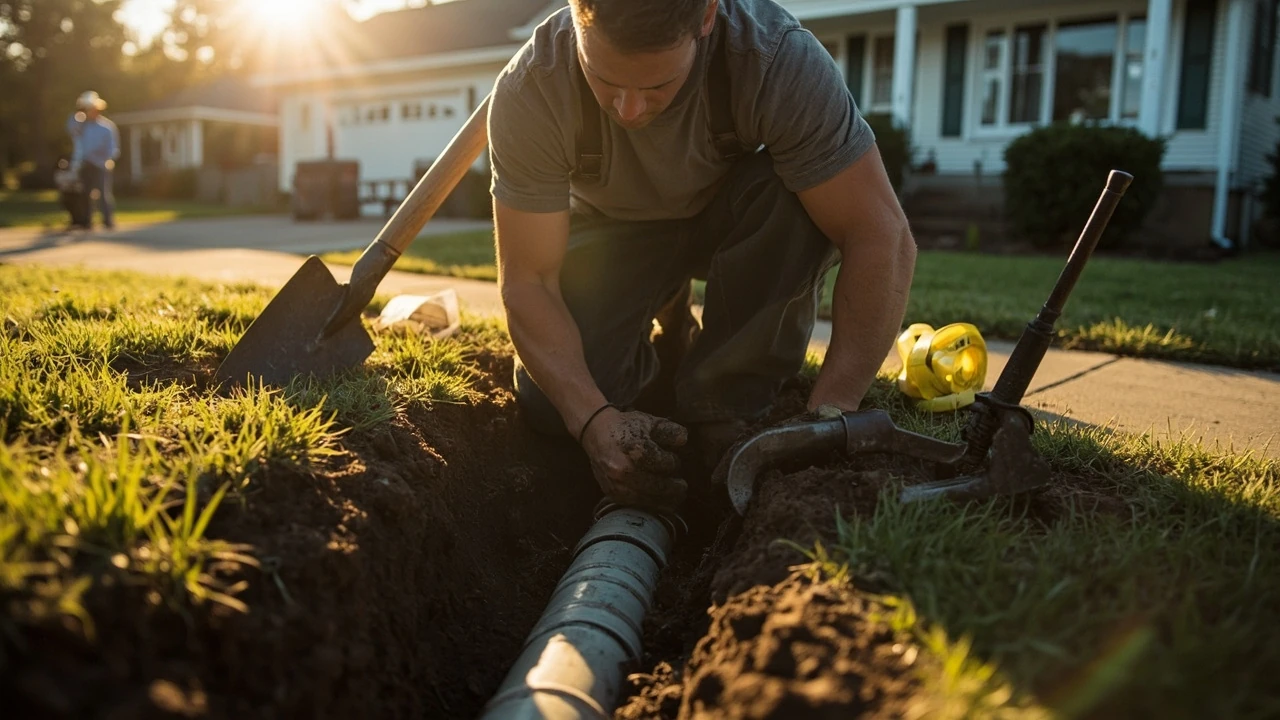

Main water line repair: what every homeowner should understand before digging starts
A burst service pipe at 2 a.m. is the way most homeowners first learn about their main water line. By the time the utility shuts off the curb stop and the yard is filling with water, the conversation has already shifted past theory into urgent decisions about cost, scope, and who is allowed to dig. The hours you spend understanding the basics before that moment are the ones that protect your budget, your landscaping, and your insurance coverage.
The main water line, sometimes called the water service line, is the single buried pipe that runs from the municipal water main in the street, across your property, and into your home. Every drop of water you use for drinking, bathing, cooking, and laundry passes through it. Because it is out of sight, it is also out of mind, until something goes wrong. Main water line repair is the work done to fix a localized failure on that pipe without replacing the entire run. Knowing when a repair is the right answer, when full replacement is cheaper in the long run, and what the job should look like is what separates a clean, well-documented project from one that drags on for months and leaves the lawn in pieces.
What the main water line actually does in your home
The service line is the only pipe in your plumbing system that the water utility owns in part and you own in part. In most U.S. jurisdictions, the utility is responsible for the pipe from the main to the curb stop (the valve near the street), and the homeowner is responsible for the pipe from the curb stop into the house. That split matters because the rule determines who pays for what, who pulls the permit, and who has the legal right to excavate in the right-of-way.
Most residential service lines run somewhere between 20 and 80 feet, depending on how far the house sits from the street. Older lots, houses on alleys, or homes with deep setbacks can have service lines exceeding 100 feet, and every extra foot adds labor, material, and excavation cost to any future work. The pipe also has to be buried below the local frost depth, which is 42 inches or more in cold-weather states. In the Chicago area, for example, many older lines are actually 4 to 6 feet deep, which is one reason excavation costs more there than in regions with shallower requirements.
Inside the home, the service line typically enters through the foundation wall or floor and connects to the water meter, then to the main shutoff valve. From there, the household plumbing branches out. Because the service line is the single point of entry, any restriction, leak, or contamination on it shows up everywhere in the house at once, which is the most useful clue for diagnosing problems.
Common materials and why they fail
The material of your service line is one of the strongest predictors of how it will fail and when. Four materials cover most U.S. homes.
- Lead. Common in homes built before 1986, still present in thousands of older properties. The EPA’s revised Lead and Copper Rule now requires utilities to identify and replace lead service lines nationwide, and several states run grant or loan programs that can reduce or eliminate the homeowner’s out-of-pocket cost.
- Galvanized steel. Standard through the mid-20th century. It corrodes from the inside out, gradually restricting flow until the pipe rusts through. Once galvanized begins to fail, repairs tend to become frequent because the rest of the line is usually in similar condition.
- Copper. The dominant material from roughly the 1950s through the 1990s. Copper is durable but vulnerable to pinhole leaks in aggressive soil, freeze-thaw damage in cold climates, and stray electrical current that accelerates corrosion.
- PVC or PEX. Modern standard for new construction and full replacements since the 1990s. Resistant to corrosion and soil chemicals, with a service life that in most cases exceeds the homeowner’s planning horizon.
For a localized problem, the material tells you whether a spot main water line repair is reasonable. Copper and PVC can often be repaired cleanly with a single new section. Lead and badly corroded galvanized usually call for full replacement because the rest of the line is rarely far behind.
Warning signs that point to a service line problem
Main water line failures rarely announce themselves dramatically. The early clues are usually subtle, and easy to mistake for other household issues. Tracking them together is what tells you the source is the service line and not, say, a fixture supply line or a water heater.
Inside the house, watch for:
- A sudden drop in water pressure throughout the home, not just at one fixture.
- Discolored or rust-tinted water, especially on first use in the morning, that clears after a minute or two.
- An unexplained spike in the water bill with no change in household usage.
- Gurgling or hissing sounds from pipes when no water is running.
- Sputtering faucets caused by air entering the line through a leak.
Outside the house, look for:
- Wet or soggy patches in the yard that persist in dry weather.
- Sinkholes or depressions forming along the path from the street to the foundation.
- A narrow strip of unusually green grass where leaking water is fertilizing the soil above the pipe.
- Water seeping up through cracks in a driveway or sidewalk.
- Muddy or discolored water from an outdoor spigot when the line is under pressure.
Any single sign on its own can have a benign explanation. Two or more signs together are a strong reason to call a licensed plumber for a pressure test and leak detection before the leak gets worse. A detailed look at how suburban plumbing experts describe the warning signs and cost factors confirms that the same checklist applies across most older U.S. housing stock.
How plumbers confirm a service line leak
Before any trench is dug, a good contractor verifies the leak, pinpoints its location, and confirms the pipe material. The work usually moves through a fixed sequence.
- Visual inspection and meter test. With all fixtures off, the water meter should not move. If it does, water is leaving the system somewhere on the property side.
- Pressure test. The plumber isolates the house and pressurizes the service line to see whether it holds. A drop confirms a leak on the buried line rather than inside the home.
- Acoustic leak detection. Sensitive microphones or ground microphones pick up the hiss of escaping water. Modern equipment narrows the location to within a few feet.
- Video inspection. A small camera is pushed through the pipe to record cracks, root intrusion, corrosion, or collapsed sections. This is the most reliable way to judge whether the damage is isolated or systemic.
Once the location and extent are known, the plumber can give you a written scope that says repair or replacement, with a price tied to actual conditions rather than guesswork. A contractor who skips these steps and quotes a job on the phone is asking you to pay for the risk of being wrong.
Repair versus replacement: how the decision is actually made
For additional context, Not every service line problem calls for a full replacement. The right choice depends on four factors: location of the damage, extent of the damage, pipe material, and the overall condition of the rest of the line.
| Situation | Best fit | Why |
|---|---|---|
| Single crack, single joint failure, or one localized corrosion point on copper or PVC | Spot repair | The rest of the line is in acceptable condition, so a small excavation and a new section of pipe solves the problem permanently. |
| Recurring leaks at different points along an older galvanized line | Full replacement | Galvanized corrodes uniformly; fixing one spot just shifts the failure to the next weak point. |
| Lead service line of any age | Full replacement | Health risk plus the EPA mandate; spot repairs are not considered a long-term solution. |
| Root intrusion at a single joint with the rest of the line intact | Spot repair plus root barrier | Removing the roots and rebuilding the joint is reasonable if the camera shows no other damage. |
| Collapsed or bellied pipe over a long section | Full replacement | A patch will not restore grade; the pipe has to be re-laid correctly. |
As a rule of thumb, a main water line repair makes sense when the damage is isolated, the rest of the line is in acceptable condition, and the pipe material is one that ages well. Replacement is the right call when the failure is systemic, the material is at the end of its service life, or the line is lead.
Typical cost ranges in 2026 and what drives them
Service line work is one of the more variable line items in residential plumbing because the price is shaped by the specific site rather than by a flat book rate. The figures below reflect realistic U.S. ranges for 2026 and are useful for budgeting, not for accepting any individual quote.
| Job type | Typical U.S. range | Main cost drivers |
|---|---|---|
| Spot repair on accessible section | $1,500 to $4,000 | Depth, surface material (soil vs. concrete), pipe material, permit fees. |
| Trenchless spot repair (pipe lining or pipe bursting on a short section) | $2,500 to $6,000 | Access pits, length of section, soil conditions, ability to pull a liner. |
| Full replacement, short run, open trench | $5,000 to $12,000 | Length, depth, surface restoration, permit and inspection fees. |
| Full replacement, long run or under driveway or mature landscaping | $10,000 to $25,000+ | Surface demolition and restoration, traffic control, deeper excavation. |
| Emergency or after-hours repair | Add 20% to 50% on top of the standard price | Off-hours labor, immediate mobilization, often winter freeze-damage jobs. |
The largest single variables are almost always length, depth, and surface restoration. Cutting through a concrete driveway, brick paver walkway, or finished landscape can add $1,000 to $5,000 to a job that would otherwise be straightforward. Permit fees are usually a small line item by comparison, typically $100 to $500 depending on the municipality, but skipping the permit is a serious mistake that can void insurance coverage and create problems at resale.
Why a permit matters and what it covers
Pulling a permit for service line work is not optional in any U.S. jurisdiction that the authors are aware of. The permit exists to protect you, the next owner, and the municipal water system. Work done without a permit creates documented problems:
- It can void your homeowner’s insurance coverage for any future water damage related to the line.
- It creates a title and disclosure issue when you sell the home.
- It removes any inspection check that the work was actually done to code, including proper backfill, proper pipe material, and a working shutoff.
- It can trigger fines from the municipality if discovered during unrelated work.
The typical process is the same almost everywhere. The contractor submits an application to the local building or water department, the permit is issued in 1 to 5 business days for standard jobs, the work is performed, and a municipal inspector verifies the work before the trench is closed. In some jurisdictions the permit is routed through the water utility rather than the building department, and in a few both are required. A licensed contractor who works in your area regularly will know the local process and handle the permit for you. If a contractor tells you a permit is not needed for service line work, treat that as a serious red flag and get a second opinion.
Trenchless options and when they make sense
Not every service line job has to mean an open trench across the lawn. Trenchless methods have matured into reliable options for the right conditions.
- Pipe lining (CIPP). A resin-saturated liner is pulled or inverted into the existing pipe and cured in place, creating a new pipe within the old one. Best for continuous runs with limited joint failure and adequate host-pipe condition.
- Pipe bursting. A bursting head is pulled through the old pipe, breaking it outward while pulling a new HDPE pipe into the same path. Useful when the old line is too damaged to line or when upsizing the diameter.
- Directional boring. A small pilot bore is drilled from one access pit to another, and the new pipe is pulled back through. Common under driveways, sidewalks, and mature landscaping where open trenching would be destructive.
Trenchless methods typically cost more per foot but save on surface restoration. They are not appropriate for every situation. A collapsed pipe, a pipe with a severe belly, or a line with multiple sharp bends may still require open trenching. The camera inspection is what determines which method is feasible.
How to choose a contractor for the work
Service line work is concentrated in a small number of firms in any given market, and quality varies. A short checklist helps separate the contractors you want from the ones you do not.
- License and insurance. Verify the state plumbing license and ask for a current certificate of insurance that lists general liability and workers’ comp. Anyone who hesitates on this is not the right fit.
- Camera inspection before quoting. If a contractor quotes a price without seeing the pipe, the quote is a guess.
- Written scope with line items. The proposal should list excavation, pipe material, depth, surface restoration, permit, and inspection as separate items.
- References in your municipality. Local references confirm the contractor knows the local soil, frost depth, permit office, and utility coordination.
- Warranty in writing. Look for at least a one-year warranty on workmanship and the manufacturer warranty on the pipe material.
- Utility coordination included. The contractor should handle the tap inspection, the curb stop, and the meter reconnection, not leave that to you.
Get at least two written bids for any non-emergency job. Pricing for the same scope can vary by 30% or more between contractors, and the lowest bid is not always the best one if it skips steps the others include.
Working with your water utility and your insurance
Because the service line crosses between utility ownership and homeowner ownership, coordination matters. Before any work begins, call your water utility to confirm where the curb stop is, whether the utility will shut off the main for the contractor, and whether the utility needs to inspect its side of the connection. Some utilities also maintain records of the original pipe material, which can save a step.
On the insurance side, review your homeowner’s policy before the work starts. Many standard policies cover the cost of tearing out and replacing a section of driveway, sidewalk, or landscaping if the damage is sudden and accidental, but only up to sublimits that are often much smaller than homeowners expect. Some insurers offer a separate service line endorsement for a modest annual premium that covers the line itself plus the cost of access. Whether to add the endorsement depends on the age and material of your line, your soil conditions, and the policy’s existing sublimits. For additional context, The Wikipedia entry on water service lines gives a useful overview of how the line is defined and how ownership is split in different jurisdictions, which is the right background for any conversation with your insurer.
Preventing the next service line problem
Once the line is repaired or replaced, a few habits reduce the odds of doing the job again.
- Know where the curb stop and the main house shutoff are. Label them. In an emergency, every minute counts.
- Protect the line from tree roots. Plant new trees away from the service line path, and remove aggressive species that have already found the pipe.
- Keep records. File the permit, the inspection report, the contractor’s warranty, and a sketch of where the line runs. Future owners and future plumbers will thank you.
- Watch the water bill. A sudden unexplained increase is the earliest signal of a slow leak, often weeks before you see any surface evidence.
- Winterize the line. In cold climates, insulate any above-grade sections, disconnect hoses before the first hard freeze, and keep the house temperature above freezing if you travel.
These steps are small and inexpensive compared with the disruption of an emergency excavation, and they buy you time to plan any future work rather than rushing into it.
Internal resources for related home projects
Frequently asked questions
How do I know if the leak is in the service line and not inside the house?
Turn off the main house shutoff valve and watch the water meter. If the meter continues to register flow with every fixture in the house off, water is leaving the system between the meter and the house, which is the service line. A plumber can confirm with a pressure test and acoustic equipment.
How long does a typical main water line repair take?
A spot repair on an accessible section of pipe usually takes a single day, plus another day for inspection and backfill. Full replacements typically take two to five working days, depending on length, depth, surface conditions, and inspection scheduling. Emergency excavations to stop active flooding can often be stabilized in a few hours, with permanent repair scheduled afterward.
Will my yard be destroyed by the excavation?
An open trench does cut a strip across the lawn, and the disturbed area is usually wider than the trench itself because of the excavated soil piled alongside. A responsible contractor backfills, compacts, and grades the area, and most lawns recover within one growing season. Driveways, walkways, and mature landscaping are the bigger restoration cost, and trenchless methods are usually chosen specifically to avoid disturbing them.
Is a permit really required for a small repair?
Yes, in nearly every U.S. municipality. The permit is what triggers the inspection that confirms the work meets code and what protects your insurance coverage. Even a small spot repair involves tying a new section of pipe into a pressurized system that connects to the public water main, which is exactly the kind of work that building departments regulate.
Can a service line be repaired in winter?
Yes, but it is more expensive and slower. Frozen ground is harder to excavate, concrete and asphalt are more difficult to cut cleanly, and any emergency call outside business hours carries a premium. In regions with deep frost, contractors often recommend a temporary stabilization in winter and a permanent repair in spring, once the ground thaws enough to allow proper backfill and compaction.
What is the difference between the utility’s pipe and my pipe?
In most jurisdictions, the utility owns the pipe from the water main to the curb stop (the valve near the street), and the homeowner owns the pipe from the curb stop to the house. The exact split varies by municipality, and a few utilities own the entire run up to the meter. Your water utility can tell you how the split is drawn on your property.
Does homeowner’s insurance cover main water line repair?
Standard homeowner’s policies cover sudden and accidental damage in many cases, but they usually limit coverage for the service line itself to a sublimit that is much lower than the policy’s main dwelling limit. Many insurers offer a service line endorsement for a modest annual premium that raises the limit and sometimes covers the cost of access. Read the declarations page carefully and ask your agent before the work starts.
How do I find out what material my service line is made of?
Start with your water utility, which often has records of the original tap. A licensed plumber can also identify the material at the point where the line enters the house, usually by exposing a small section at the foundation. For homes built before 1986, the safest assumption is that the line may contain lead until a professional confirms otherwise.
What if my service line turns out to be lead?
Replace it rather than repair it. Lead service lines are a documented health risk, and the EPA’s revised Lead and Copper Rule requires utilities to identify and replace them. Several states and municipalities run programs that cover part or all of the cost. Contact your water utility before hiring a contractor, because you may be eligible for fully or partially funded replacement.
How long should a new service line last?
Modern copper, PVC, and HDPE service lines are typically expected to last 50 to 100 years under normal soil conditions, with PEX slightly lower at the short end of that range. Actual life depends on soil chemistry, frost depth, water chemistry, and whether the line is protected from physical damage and root intrusion. A replaced line installed under permit and inspected by the municipality is one of the longest-lasting infrastructure upgrades a homeowner can make.