
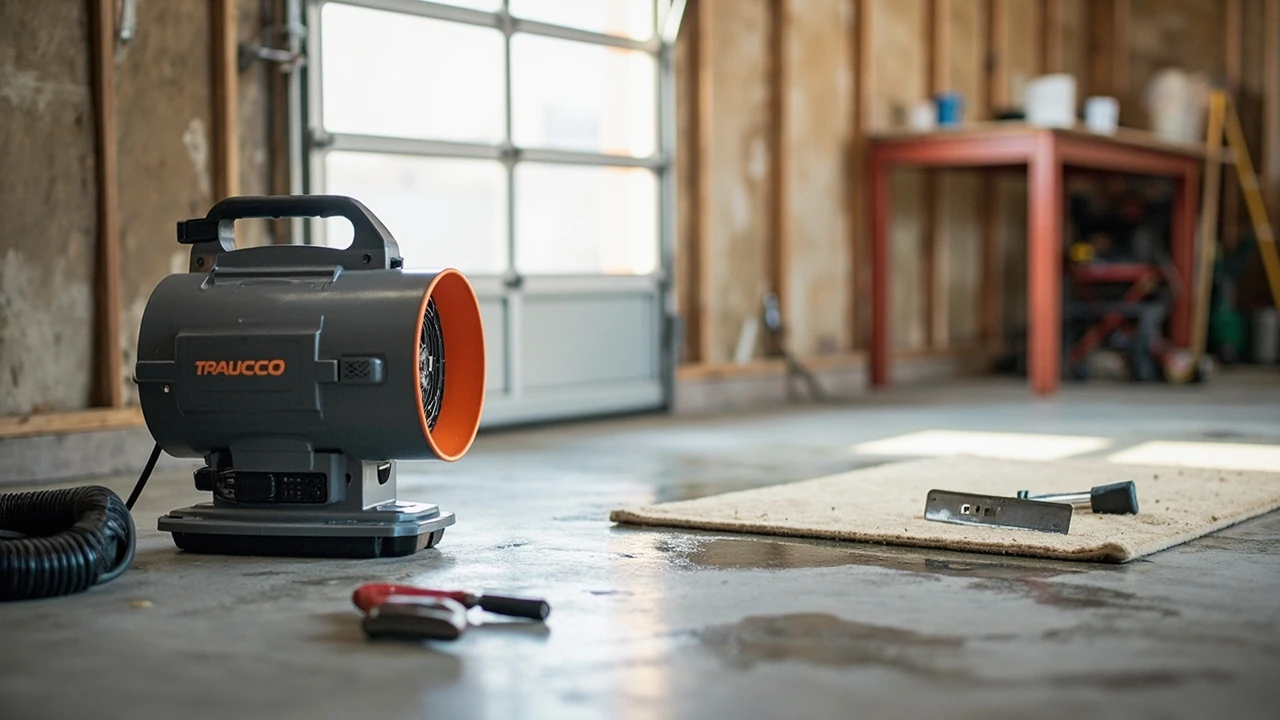

Blower fan: what it is and why it matters
A blower fan sitting on a basement floor after a water leak, a utility fan aimed across a fresh coat of paint, a small centrifugal unit bolted inside an HVAC cabinet — these are all versions of the same basic tool. A blower fan moves air through a confined path using an impeller or wheel, so the air comes out faster, straighter, and at higher pressure than it would from an ordinary oscillating room fan. That difference is what makes the device useful for drying, ventilating, exhausting fumes, and pushing air into ductwork.
Homeowners, contractors, mechanics, and restoration crews run into blower fans in many settings. The term covers everything from a 12-inch pivoting utility unit on a shop floor to a 1/4 HP centrifugal air mover used to dry carpets after water damage, and it can also describe the internal fan wheel inside a furnace or a computer. The reader who searches for “blower fan” is usually trying to decide which type fits a job, how to use one safely, or why a particular fan is failing. This guide treats the keyword as a practical seed and answers those questions in plain language.
How a blower fan differs from a regular fan
A standard room fan uses angled blades arranged in a circle to push a broad cone of air outward. It is built for comfort cooling across a wide area. A blower fan uses an impeller inside a housing, often a squirrel-cage or centrifugal wheel, that draws air in through the center and forces it out at a right angle through a narrow opening. The result is a column of high-velocity air under higher static pressure.
That pressure is the key difference. A regular fan moves a lot of air at low pressure, which is fine for cooling a person. A blower fan trades some of that volume for pressure, which is what you need to push air through ductwork, across a wet surface, or into a confined space such as a crawlspace. The housing also shapes the airflow, so a blower fan typically produces less of a circular breeze pattern and more of a focused jet.
Main types of blower fans
Looking at product listings from major retailers and at the way professionals talk about airflow, the blower fan category breaks down into a handful of recurring designs. Choosing the right one is mostly about matching airflow style to the job.
Centrifugal air movers
Centrifugal air movers, often called carpet dryers or floor blowers, are the heavy-duty workhorses of the category. They use a squirrel-cage wheel inside a round or rectangular housing, draw air in from one side, and expel it from a rectangular outlet at high velocity. Restoration contractors use them to dry water-damaged carpets and subfloors because the focused airflow strips moisture from surfaces faster than a regular fan. Many models also tilt to several angles and stack together for storage and daisy-chaining.
Axial utility fans
Axial utility fans look more like an ordinary box fan. The motor and blades sit on a single axis, and air passes straight through. They move slightly less pressure than centrifugal models but cover a wider area and cost less. They are a good match for ventilating a room, exhausting paint fumes, or circulating warm air from a space heater into a cold corner of a garage.
Pivoting high-velocity fans
Pivoting high-velocity fans are a common sub-type of axial utility fan. The head tilts up or down and sometimes rotates, so the operator can aim the airstream at a workbench, a wet floor, or a person without moving the entire unit. They often include one or two 120 V outlets on the side so you can chain several fans from a single wall socket or power a work light.
Inline duct blower fans
Inline duct blower fans install inside a length of ductwork. They look like a metal cylinder with mounting clamps on each end and a motor in the middle. Growers, hobbyists, and HVAC installers use them to push or pull air through long duct runs, carbon filters, or heat exchangers. They are quieter than a comparable portable unit because the duct absorbs some of the sound.
Compressed air dusters
Compressed air dusters are a smaller, battery-powered offshoot of the category. They use a high-RPM brushless motor and a small centrifugal or axial impeller to blow a narrow stream of air at very high speed. They are popular for cleaning keyboards, camera gear, and tight electronics where canned air is wasteful. They are technically blowers, but they are not what most people mean when they search for a blower fan in a home or shop context.
Common jobs a blower fan handles well
Because a blower fan focuses on pressure and direction, it tends to outperform a regular fan in tasks that need movement of air through resistance. The following are the situations where shoppers, contractors, and homeowners most often reach for one.
Drying wet surfaces
After a small flood, a dishwasher leak, or a cleaning job that used a lot of water, a blower fan aimed across the wet area will speed up evaporation dramatically. The focused airflow disrupts the boundary layer of humid air sitting on the surface, allowing more water molecules to leave the carpet, pad, or subfloor. Restoration companies routinely place several centrifugal units at angles to cover a large area and rotate them every few hours.
Ventilating fumes and odors
Paint, solvent, adhesive, and exhaust fumes all benefit from active ventilation. A blower fan placed near an open window can pull contaminated air out of the room, or it can be aimed across the work area so fumes move past the worker and toward an exhaust path. For solvent-heavy projects such as finishing a wood floor or gluing countertop seams, this kind of directed airflow is a basic safety step.
Cooling a person or a work area
When a regular room fan is not strong enough — in a garage, a workshop, a gym, or a barn — a high-velocity blower fan can provide relief. The focused stream feels stronger at a distance, which means one unit can serve a wider area than a typical tower fan. Many home gyms use them because they keep a workout space moving without the noise of an air-conditioner compressor.
Supporting combustion appliances
Furnaces, water heaters, and boilers often rely on an internal blower to push combustion gases through a heat exchanger and out the flue. These are not portable units, but they are still blower fans, and when one fails, the appliance usually shuts off or triggers a safety lockout. Knowing the difference between a portable blower fan and an internal combustion blower helps when you are troubleshooting a no-heat call.
Supplying air to a space
Some homes and additions have air quality problems because the HVAC system cannot push enough fresh air into a tight, modern envelope. A small inline blower installed in a fresh-air duct can solve that, and it is the same hardware category as a portable blower fan, just mounted permanently.
Key specifications to compare
Two blower fans in the same price range can perform very differently, so it helps to know which numbers on the box actually predict real-world results.
Airflow in CFM
CFM stands for cubic feet per minute and measures the volume of air a fan moves. Higher CFM is better for drying large areas or ventilating a big room, but it does not tell the whole story. A 1,000 CFM fan with a tight, focused outlet will dry a wet spot faster than a 1,000 CFM fan with a wide grille, because the air is denser where it hits the surface.
Static pressure
Static pressure is how forcefully the fan can push air through resistance, such as a long duct, a filter, or a narrow opening. Centrifugal blowers generally produce more static pressure than axial fans. If you need to move air through ductwork, look at static pressure, not just CFM.
Motor power in watts or horsepower
Motor power is the electrical input the fan draws. Higher wattage usually means more airflow, but it also means more heat and a higher electric bill. For a small drying job in a bedroom, a 100 to 150 W fan is plenty. For a large restoration site, the 1/3 HP and 1/2 HP industrial models make sense.
Speed settings and tilt range
Two or three speed settings are common and useful, because low speed is quieter and high speed is for difficult jobs. A wide tilt range, often 90° to 185°, makes the fan more flexible. Some models also stack for storage and daisy-chain, meaning you can plug one fan into another to run several units from one outlet.
Outlets and cord length
Many blower fans include one or two 120 V outlets on the housing. That feature is helpful on job sites, but the outlets are usually unfused and intended only for low-power accessories such as lights or another fan. Cord length matters in larger rooms and outdoor setups, where running an extension cord is awkward or unsafe.
Quick comparison of common blower fan types
| Type | Typical airflow | Best for | Trade-offs |
|---|---|---|---|
| Centrifugal air mover | 600 to 2,200 CFM | Drying carpets, subfloors, and water-damaged areas | Heavier, louder, and more expensive than axial fans |
| Axial utility fan | 300 to 800 CFM | General ventilation, paint fumes, light drying | Lower static pressure, less effective through ductwork |
| Pivoting high-velocity fan | 300 to 1,100 CFM | Garages, gyms, basements, and job sites | Focused jet, so coverage area is narrower |
| Inline duct blower | Varies, often 200 to 800 CFM | Long duct runs, grow tents, fresh-air intake | Requires installation and matching duct diameter |
| Compressed air duster | Very low volume, very high velocity | Electronics, keyboards, camera gear | Not designed for room ventilation |
Where the keyword fits in a broader category
The phrase “blower fan” is a seed that can lead to several different search intents. To avoid duplicating existing material on this site and to stay focused, this page treats the keyword as a practical buying and use guide. Related terms and adjacent pages can be linked from elsewhere on the site, but the page you are reading is the entry point for a first-time buyer or a homeowner deciding between a small utility fan and a more powerful centrifugal unit.
Readers who want to compare blower fans to the rest of a car, or who are troubleshooting dashboard airflow rather than a portable unit, can read the site’s overview of suspension and chassis systems in the explanation of how a car suspension works for a different angle on automotive air handling. Readers who are weighing the cost of home repairs and want a sense of how professional service calls are priced may find the guide to free car inspection offers useful for the same kind of practical framing applied to a different field.
How to choose the right blower fan for a job
Choosing a blower fan is mostly an exercise in matching airflow, pressure, and durability to the work. The list below is a reasonable starting checklist.
- Decide whether the job needs high static pressure (ductwork, filter) or high volume (room ventilation, drying). Centrifugal units win the first category; axial units usually win the second.
- Measure the space. A small bathroom with a minor leak can be handled by a 300 to 600 CFM fan. A flooded basement needs 1,000 CFM or more, often with two or three units placed at angles.
- Check the tilt range and the number of speed settings. A pivoting head and at least two speeds give the most flexibility.
- Look at the cord length and the housing outlets. A 10 to 15 foot cord with two pass-through outlets is a strong combination on a job site.
- Confirm the certifications. ETL or UL listings indicate the fan has been tested for electrical safety, and for commercial or restoration work that matters more than for occasional home use.
- Read the warranty terms. A 1-year limited warranty is typical; longer warranties usually signal a more rugged motor and housing.
Safe use and basic maintenance
Blower fans are simple machines, but they still involve a fast-spinning impeller, a heated motor, and a long power cord. The most common accidents are falls over the cord, blocked inlets that overheat the motor, and water entering the housing. The steps below cover the safety basics that come up again and again in incident reports and product manuals.
- Place the fan on a flat, stable surface, and route the cord so it does not cross foot traffic.
- Keep the intake and outlet clear. Curtains, rags, and loose paper can be pulled into the impeller, which can damage the fan or start a fire.
- Never point a blower fan directly at an open flame or a space heater. Focused airflow can cause a candle or a gas flame to flare or to blow out and release unburned fuel.
- If you use the fan to dry a wet area, unplug it before moving it through standing water, and never submerge the motor housing.
- Wipe the grille regularly. Dust buildup on the intake side reduces airflow and forces the motor to work harder.
- Inspect the cord and plug before each use. Cracked insulation and bent prongs are common failure points on portable fans that get moved around a lot.
Troubleshooting common blower fan problems
Most blower fan problems fall into a small set of recurring issues. Walking through them in order usually gets to a fix without calling in a technician.
The fan will not start
Check the outlet first by plugging in a lamp or a phone charger. If the outlet is fine, confirm that any circuit breaker on the fan housing is in the reset position. Many utility fans include a small push-button breaker that trips when the motor overheats. After resetting, wait a few minutes for the motor to cool before trying again.
The fan runs but airflow is weak
Weak airflow usually means the intake is blocked or the motor is failing. Vacuum the grille, the inside of the housing, and the area immediately around the fan. If the airflow is still weak, the motor bearings may be wearing out, which is more common on cheaper brushed motors than on brushless designs.
The fan is louder than it used to be
New noise from a blower fan typically points to a loose housing panel, a worn bearing, or debris inside the impeller. Tighten the visible screws, listen for a wobble, and look at the impeller through the grille to see whether anything is caught. A grinding or scraping sound usually means a bearing failure, and the fan should be taken out of service.
The fan trips a breaker when it starts
Large centrifugal blowers can draw a brief surge of current on startup. If the breaker is rated for the fan’s amperage and trips immediately, the motor is likely shorted. If the breaker is undersized, either move the fan to a different circuit or use a fan with a smaller motor.
When a portable blower fan is not the right tool
It is worth pausing on the limits of portable blower fans, because the keyword is sometimes used in places where a portable unit is the wrong product entirely. Furnace and boiler blowers, for example, are matched to the appliance by static pressure and by combustion requirements. Swapping a generic hardware-store fan for a failed combustion blower is unsafe and can introduce carbon monoxide into the home. Likewise, dust collection in a woodworking shop usually needs a high-static-pressure dust collector, not a portable blower fan, because the resistance of a hose and a filter is much higher than the resistance of open air.
For a quick home fix to improve room comfort, a portable blower fan is usually the right answer. For a permanent installation, a major airflow change, or anything involving combustion gases, the right answer is a properly sized, code-compliant product, and the project often warrants a licensed trade.
Sample buyer scenarios
Walking through a few realistic scenarios is a useful way to anchor the specification differences described above.
| Scenario | Recommended type | Why | Realistic spec range |
|---|---|---|---|
| Drying a small wet carpet after a dishwasher leak | Centrifugal air mover | Focused high-velocity airflow speeds up evaporation | 600 to 1,000 CFM, 3 speeds, 4 tilt angles |
| Cooling a home gym in a converted garage | Pivoting high-velocity fan | Strong straight stream, easy to aim | 300 to 600 CFM, 3 speeds, 185° tilt |
| Ventilating paint fumes in a small bedroom | Axial utility fan | Enough airflow, lower cost, easier to position near a window | 200 to 400 CFM, 2 to 3 speeds |
| Supplying fresh air through a long insulated duct | Inline duct blower | Higher static pressure to overcome duct resistance | 200 to 500 CFM, matching duct diameter |
| Cleaning dust from a desktop computer | Compressed air duster | Targeted, high-velocity, low-volume air | Battery powered, multi-speed |
Frequently asked questions
What is a blower fan used for?
A blower fan is used wherever air needs to be moved under pressure or in a focused stream. Common uses include drying wet floors and carpets, ventilating fumes from paints and solvents, cooling garages and gyms, and supplying combustion air inside appliances such as furnaces.
Is a blower fan the same as a regular fan?
No. A regular room fan moves a large cone of air at low pressure for comfort cooling. A blower fan uses an impeller inside a housing to move air at higher pressure and in a more focused direction, which makes it better for drying, ventilating, and ducted applications.
What is the difference between an axial and a centrifugal blower fan?
An axial blower fan pushes air straight through the housing along the same axis as the motor, similar to a box fan. A centrifugal blower fan draws air in through the center of a wheel and forces it out at a right angle, which produces higher static pressure and a more focused stream.
How many CFM do I need to dry a carpet?
For a small spill, a 300 to 600 CFM fan is usually enough if it is placed close to the wet area. For a fully soaked room, restoration professionals typically use one or more 1,000 to 2,200 CFM centrifugal air movers and reposition them every few hours.
Can a blower fan replace a furnace blower?
No. Furnace blowers are matched to the appliance in static pressure, airflow, and safety controls. A portable blower fan is not designed to handle combustion gases, and using one in place of a furnace component can create a carbon monoxide hazard.
Are blower fans energy efficient?
Compared with air conditioning, blower fans use very little electricity. A typical 100 to 200 W utility fan costs pennies per hour to run, and even a 1/2 HP industrial unit draws less than 400 W. The bigger efficiency question is matching the fan to the job, because an oversized fan wastes energy and an undersized fan runs for hours without finishing the work.
How loud is a blower fan?
Smaller axial utility fans run at roughly 50 to 60 dB, similar to a box fan on high. Centrifugal air movers with 1/4 HP or larger motors can reach 70 to 80 dB at full speed, which is loud enough to require hearing protection for long shifts on a job site.
Can a blower fan be used outdoors?
Yes, as long as the fan is rated for the environment. Most portable blower fans are designed for dry indoor use, but many models tolerate covered outdoor work such as drying a deck or ventilating a covered patio. Avoid using any portable blower fan in standing water or in direct rain.
Do blower fans need maintenance?
Very little. Keeping the intake and outlet free of dust, checking the cord and plug for damage, and wiping the housing every few months is enough for most home use. Commercial and restoration units benefit from a deeper cleaning and a bearing check once a year.
What safety certifications should I look for?
Look for an ETL or UL listing on the label. These marks indicate the fan has been tested for electrical safety under U.S. and Canadian standards. For commercial job sites, some contractors also prefer fans that meet specific daisy-chain and ground-fault guidelines, but for most home use a basic ETL or UL mark is sufficient.