

Car suspension explained: how it works, common problems, and what to check
A car suspension is the system of springs, dampers, linkages, and tires that holds a vehicle off the road, supports its weight, and keeps the tires in contact with the surface through every turn, bump, and stop. When the system is in good shape, a car rides smoothly and steers predictably. When it is worn or damaged, drivers usually notice it first as a rough ride, a drifting feeling in corners, or a tire that wears out before its time.
Most U.S. drivers will replace or repair some part of the suspension during the life of a vehicle. Understanding what the parts do, what the warning signs mean, and what a technician is actually looking for makes it easier to decide what work is needed and what can wait.
What a car suspension actually does
A suspension has to do two things that pull in opposite directions. It has to keep the car comfortable by absorbing bumps, and it has to keep the tires pressed firmly against the road so the steering, braking, and acceleration feel stable. Engineers call this the compromise between ride quality and road holding. Getting that balance right is the entire job of suspension tuning.
In simple terms, the system has three jobs:
- Support the static weight of the vehicle, passengers, and cargo.
- Absorb energy from bumps and dips so the body does not bounce endlessly.
- Maintain a consistent contact patch between the tire and the road so grip is predictable.
If the springs are too soft, the car floats, sways, and bottoms out on rough pavement. If the springs are too stiff, the ride becomes harsh and the tires can lose contact over small bumps. The dampers, often called shock absorbers, control how quickly the springs extend and compress. Without them, a car would continue to oscillate long after hitting a bump, which is both uncomfortable and unsafe.
Suspension also protects the rest of the vehicle. Repeated harsh impacts can crack wheel housings, loosen interior trim, and stress the frame. Cargo and passengers ride more comfortably when the body is isolated from road shock. The mechanical layout that makes this possible is more involved than it looks from the driver’s seat.
Main components of a modern car suspension
Most passenger vehicles use independent suspension at the front, and either independent or a solid rear axle at the back, depending on the design. The basic parts overlap in either case.
| Component | Primary function | Where it sits | Typical wear symptom |
|---|---|---|---|
| Coil spring | Supports vehicle weight and absorbs vertical impacts | Between body and lower control arm or strut | Sagging ride height, clunk over bumps |
| Shock absorber or strut | Damps spring movement, controls bounce | Inside or beside the spring, body to wheel | Excessive bounce, nose-dive when braking |
| Control arm | Connects wheel hub to frame, controls geometry | Lower or upper front suspension | Loose steering, uneven tire wear |
| Ball joint | Pivots between control arm and steering knuckle | End of control arm | Clunk on bumps, wandering steering |
| Sway bar (anti-roll bar) | Reduces body roll in corners | Across the front or rear axle | Excess body roll, knocking noise |
| Sway bar end link | Connects sway bar to control arm or strut | Outer end of sway bar | Rattle over rough roads, clunk in turns |
| Wheel bearing | Allows wheel to rotate smoothly on hub | Inside the wheel hub | Humming that changes with speed, uneven tire wear |
| Bushing | Cushions metal-on-metal contact between parts | Inside control arms, sway bars, subframes | Sloppy feel, vibration through the cabin |
Most of these parts wear gradually. A worn ball joint, a cracked bushing, or a leaking strut is normal on a vehicle that has seen 80,000 to 120,000 miles of real road use. The challenge for a driver is figuring out which part is the source of a new noise or handling change.
How the main types of car suspension differ
Different vehicles use different layouts. The most common configurations on U.S. passenger cars and crossovers are explained below. Each design has trade-offs in cost, ride, handling, and repair complexity.
| Type | How it works | Common use | Strength | Limitation |
|---|---|---|---|---|
| MacPherson strut | Combines damper and spring in one tall unit, mounted to the steering knuckle | Most front-wheel-drive cars and crossovers | Compact, light, inexpensive to produce | Strut replacement can be costlier than separate shocks |
| Double wishbone | Two control arms above and below the wheel allow finer geometry control | Performance cars, some trucks | Better camber control through travel | More parts, heavier, more complex alignment |
| Multi-link rear | Several arms control each rear wheel independently | Modern sedans and crossovers | Excellent ride and handling balance | More bushings to wear, pricier repairs |
| Solid live axle | One rigid beam connects both rear wheels | Older trucks, some work-oriented SUVs | Simple, strong, good for heavy loads | Less refined ride and handling when unloaded |
| Torsion beam | A transverse beam links the rear wheels with limited independent movement | Compact and economy cars | Cheaper than full multi-link, light weight | Less precise handling, harder to tune independently |
| Air suspension | Air springs replace coil springs, with a compressor and ride height control | Luxury sedans, some trucks and SUVs | Adjustable height, comfortable load leveling | Compressor and air spring replacement costs are higher |
The trade-off between ride comfort and handling is built into every design. According to the long-form overview of vehicle suspension design on Wikipedia, suspensions must support both road holding and ride quality even though those two goals pull in opposite directions, which is why the tuning of springs, dampers, and bushings is a deliberate compromise rather than a search for one perfect setting.
How to tell when a car suspension needs attention
Suspension problems rarely show up all at once. They creep in as bushings harden, struts leak, and ball joints develop play. A driver who pays attention to small changes can often catch a problem before it becomes a safety concern or a tire replacement bill.
Below are the most common warning signs and what they usually point to. None of these are definitive on their own, but a couple of them together usually justify a closer look.
- Excessive bouncing after a bump, or a ride that feels floaty on the highway.
- Nose-dive when braking, or squat at the rear when accelerating hard.
- Clunking, knocking, or rattling from the wheel area over rough pavement.
- Steering that wanders, drifts, or requires constant correction on a straight road.
- Uneven tire wear, especially inside or outside edge wear that returns quickly after a rotation.
- A corner or side that sits visibly lower than the others when the car is parked on level ground.
- A sharp decrease in ride quality after a specific event such as a curb strike, pothole, or accident.
One useful test is the bounce test done at a stop. Push down hard on each corner of the car and release. The body should rise and settle within one or two cycles. If it keeps bouncing, the struts or shocks are likely worn. This is a rough check, not a substitute for a raised inspection, but it is a reasonable starting point.
Another check is the visual one. A tire that wears on the inside edge only is often a sign of worn bushings or a bent control arm. A tire that is feathered across the tread points to alignment problems that may trace back to worn suspension parts. A simple look at the tires after a rotation often tells more than a test drive.
What a technician actually inspects
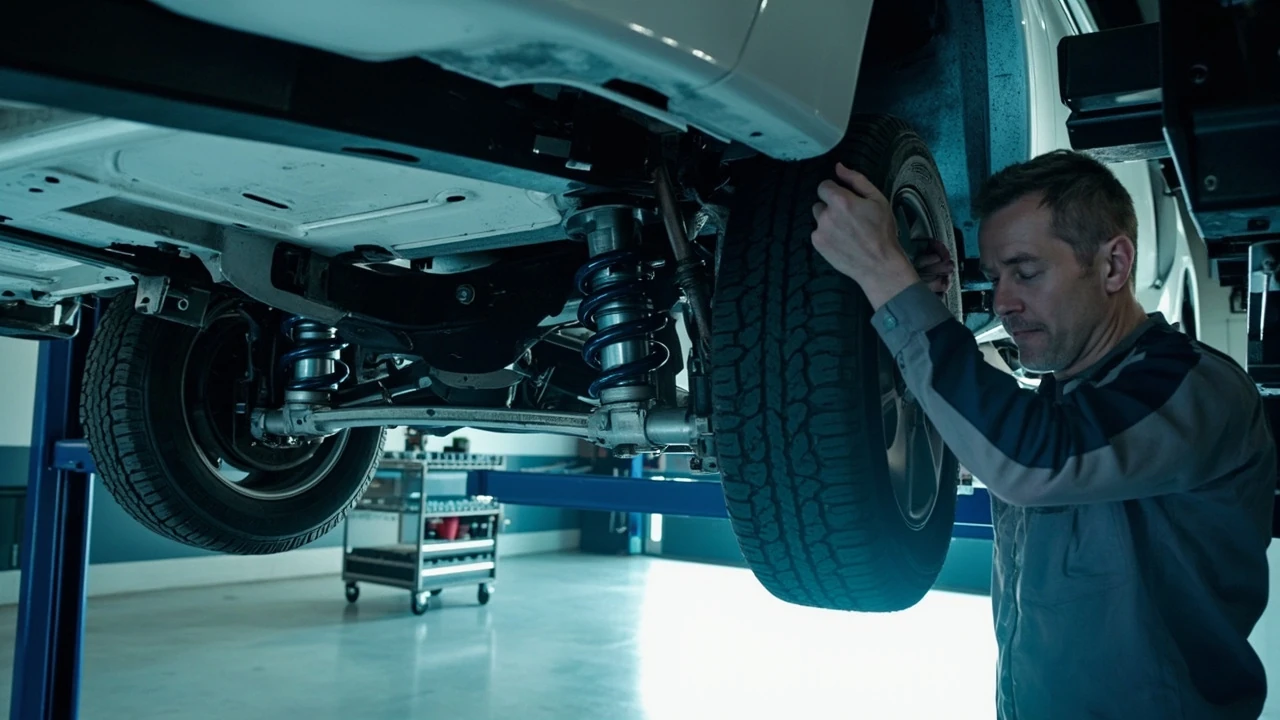
A proper suspension inspection takes more than a test drive. A technician will usually lift the vehicle, check each wheel for play, and look at the parts up close. The goal is to find the source of a symptom, not just to confirm that something is worn.
A typical inspection covers the items below. Not every shop includes every step, so it is reasonable to ask which ones are part of the estimate.
- Visual check of struts, shocks, and springs for leaks, dents, or sag.
- Hand check of each wheel for play in the ball joints, wheel bearings, and tie rod ends.
- Inspection of bushings for cracking, splitting, or separation from the metal housing.
- Check of the sway bar, end links, and mounting brackets for wear or broken hardware.
- Tire inspection for uneven wear patterns that suggest alignment or component issues.
- Test of the brake system where it interacts with suspension, including hoses and caliper brackets.
For vehicles with air suspension, the inspection also includes the compressor, air lines, valve blocks, and ride height sensors. These parts add another layer of complexity and a different set of failure modes compared to a steel spring setup.
Common repair decisions drivers face
Suspension work is rarely all-or-nothing. Most repairs can be staged, and a good shop will usually separate the must-do items from the can-wait items. The right decision depends on the vehicle, the mileage, the symptoms, and how long the owner plans to keep it.
Struts and shock absorbers
These are the most commonly replaced suspension parts. Most vehicles use them in pairs, and replacing them on the same axle at the same time is the usual recommendation so handling stays balanced. A single worn strut on one side will pull the car off line under braking and can lead to uneven tire wear. Pricing varies widely by vehicle, but on a typical sedan, replacing all four corners is a meaningful service interval rather than a minor repair.
Control arm bushings and ball joints
On some vehicles, the control arm is replaced as a complete assembly because the bushings and ball joint are pressed in. On others, individual bushings can be replaced separately. The decision is usually based on cost, availability of parts, and whether the surrounding metal is corroded. A control arm with a slightly worn bushing but otherwise solid metal can often be re-bushed for less than a full replacement.
Sway bar links and bushings
These are among the cheaper suspension parts, and they often produce disproportionate noise. A rattling noise on rough roads is a classic end link symptom. Replacing links and bushings is usually a short job, and it can make a noticeable difference in how solid a car feels in daily driving.
Springs
Coil springs can sag with age and miles, especially on vehicles that carry heavy loads or that have been driven hard. A visibly sagging corner or a car that bottoms out over speed bumps is a sign to look at the springs. Springs are usually replaced in pairs on the same axle. Some shops recommend replacing the struts at the same time since the labor overlaps.
Wheel bearings and hub assemblies
A humming that changes with speed, or a noise that disappears in turns one way but not the other, often points to a wheel bearing. Modern vehicles often use a complete hub assembly, which simplifies the job but raises the parts cost. Catching a worn bearing early avoids the risk of seizure, which can lead to more serious damage.
Cost and timing considerations
Pricing for suspension work depends heavily on the vehicle, the region, and whether original equipment or aftermarket parts are used. A rough sense of typical ranges on common U.S. passenger cars is shown below. These are general ranges, not quotes, and a real estimate from a local shop will vary.
| Repair | What it usually involves | Typical parts cost per corner | Typical labor time |
|---|---|---|---|
| Strut or shock replacement | Remove wheel, unbolt strut, swap assembly, alignment check | Modest to high, depending on vehicle | One to two hours per corner |
| Control arm replacement | Remove wheel, unbolt arm, replace assembly or bushings | Moderate | One to two hours per side |
| Sway bar link replacement | Remove link, install new hardware | Low | Under one hour per side |
| Wheel bearing or hub assembly | Remove wheel, press out old bearing or unbolt hub | Moderate | One to two hours per corner |
| Coil spring replacement | Compress spring, swap with new, often paired with strut work | Low to moderate | Included in strut job on most cars |
Most independent shops will also recommend a four-wheel alignment after any major suspension work, because even small changes in component length or bushing position can affect toe, camber, and caster. Skipping the alignment can mean a brand new set of parts and a vehicle that still pulls to one side or wears tires unevenly.
How driving habits affect suspension life
How a car is driven changes how long the suspension lasts. A vehicle that is gently driven on smooth suburban roads will see far less wear on its springs and struts than the same model driven aggressively on broken pavement. There is no way to avoid all wear, but a few habits help.
- Slowing before speed bumps, driveways, and known potholes rather than hitting them at speed.
- Avoiding curbside parking that forces a hard turn over a high curb.
- Loading the vehicle within its rated capacity, especially on trucks and SUVs with leaf or coil springs in the rear.
- Checking tire pressure monthly, since underinflation adds sidewall flex and extra work for the suspension.
- Rotating tires on schedule so wear stays even and the suspension is not compensating for one bad tire.
Curb strikes and pothole impacts are the most common single-event causes of suspension damage. A hard hit can bend a wheel, crack a rim, deform a control arm, or split a bushing. If a driver feels a new vibration, clunk, or pull after an impact, it is worth a closer look, even if the impact felt minor at the time.
Suspension versus alignment versus tires
These three are easy to confuse because they share symptoms. A car that pulls to one side could have an alignment issue, a tire problem, or a worn suspension part. A car with uneven tire wear could have any of the three as the cause. The differences usually show up in how the symptoms behave.
An alignment issue tends to produce a constant pull at a steady speed, and it usually shows up as feathered tire wear across the tread. A tire problem such as a separated belt or a bent rim often shows up as a vibration that increases with speed, sometimes only in a specific speed range. A suspension problem tends to show up as a noise or a feel that changes with road conditions rather than speed, such as a clunk over bumps or a sway in corners that the car did not have a year ago.
For drivers who want a single reasonable diagnostic path, the simplest order is to start with the tires. Confirm even pressure, even wear, and no visible damage. Then check the alignment with a shop printout, since a recent alignment that is still in spec rules out a large category of causes. After that, a hands-on suspension inspection will catch the rest.
When suspension work overlaps with other home systems
It is worth noting that some of the same principles that apply to a vehicle apply to a house. Both rely on support structures, both use a kind of spring and damper relationship to handle vibration and load, and both fail gradually rather than all at once. Homeowners who are interested in the structural side of this idea can read more about how foundation repair is evaluated before work begins, since the same diagnostic logic of identifying the source before recommending work shows up in both fields.
The same overlap exists with major home systems that are usually out of sight until something goes wrong. A water heater, for an example, is a piece of equipment most homeowners never think about until it leaks, which is similar to how a strut can be slowly leaking fluid for months before a driver notices a change in ride. The approach to deciding when a water heater should be replaced is similar to deciding when a suspension part should be replaced: look at age, look at symptoms, and consider whether a partial repair makes sense given how long the equipment is likely to last.
Frequently asked questions
How long does a car suspension usually last?
Most original equipment struts and shocks last between 50,000 and 100,000 miles under normal driving. Bushings, ball joints, and end links can last longer, but they are sensitive to road conditions and climate. Vehicles that see heavy use, rough roads, or frequent curb strikes may need suspension parts replaced earlier than that range.
Can a car be driven with a bad suspension?
It depends on the part. A worn shock absorber usually still allows safe driving, although the ride and handling will be worse. A broken spring, a separated ball joint, or a seized wheel bearing is a different matter, and driving on those can lead to a loss of control or further damage. When in doubt, a quick inspection at a shop is the right move before any long drive.
Do I need to replace all four struts at the same time?
Most manufacturers and shops recommend replacing them in axle pairs so the vehicle stays balanced. Replacing only one strut can leave the car handling unevenly, especially under braking. Some owners replace two at a time as budget allows, which is a reasonable approach as long as the remaining struts are in acceptable condition.
How do I know if a noise is suspension or something else?
Suspension noises usually change with road conditions rather than engine speed. A clunk over a bump, a knock in a turn, or a rattle on rough pavement is more likely suspension. A noise that rises and falls with engine RPM is more likely engine-related. A professional can usually identify the source in a short test drive.
Does an alignment fix suspension problems?
An alignment does not repair worn parts. It only sets the angles of the wheels to factory specifications. If a worn bushing or a bent control arm is the cause, an alignment will not hold, and the vehicle will drift back out of spec quickly. Alignment is the final step after suspension repair, not a substitute for it.
Are aftermarket suspension parts as good as original equipment?
Quality varies widely. Some aftermarket brands meet or exceed original equipment specifications, while others are designed mainly for low price. The right choice depends on the vehicle, the driver, and how the car is used. A daily driver does not need race-grade components, and a tracked car does not need economy replacements.
What is the difference between a strut and a shock absorber?
A shock absorber is a damper that controls spring movement. A strut is a structural part that combines a shock absorber with a coil spring mount and usually carries part of the vehicle’s load. In a MacPherson strut design, the strut is also a steering pivot. They look similar but play different roles in the suspension.
Is air suspension worth the extra cost to maintain?
Air suspension offers a comfortable ride and adjustable ride height, which is useful for towing or for drivers who want a low entry height. The trade-off is that compressors, air springs, and valve blocks add parts that can fail and that are more expensive to replace than steel components. For owners who plan to keep a vehicle past the warranty period, the long-term cost of air suspension is something to weigh carefully.
Can I inspect my own suspension at home?
A few checks are reasonable for a careful owner. Visual inspection of the tires, a bounce test at each corner, and a look at the ride height are all possible without lifting the car. A full inspection of ball joints, bushings, and bearings usually requires the vehicle to be raised, which is safer at a shop with a proper lift.
How does tire pressure affect the car suspension?
Underinflation lets the tire flex more, which transfers extra work to the suspension and can produce a harsh or floaty feel. Overinflation reduces the contact patch and can make the ride feel brittle. Tire pressure within the manufacturer’s recommendation is part of how the suspension is designed to work, and ignoring it changes how the system feels in ways that are easy to mistake for a worn part.