
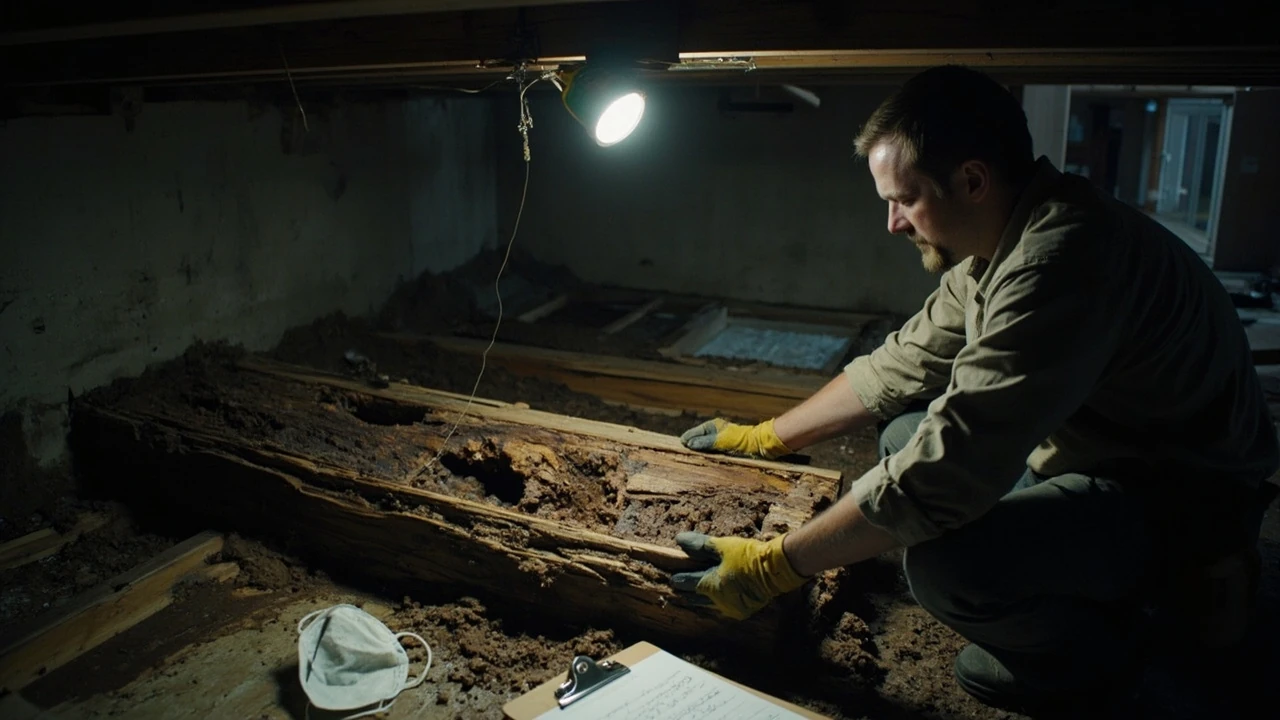

Termite damage repair: what every homeowner should understand before calling a contractor
A homeowner in the Southeast pulls back a piece of siding to repaint it and finds a thin trail of dried mud running up the wall, with the sheathing underneath crumbling under light thumb pressure. In the Southwest, someone is renovating a bathroom and discovers a soft spot in the subfloor near a plumbing penetration. In the Midwest, a real estate inspector photographs a sill plate that looks intact from the outside but sounds hollow when tapped. None of these situations is rare, and each one ends in the same question: what does termite damage repair actually involve, and who needs to be involved before a single piece of wood is replaced?
Termites are among the most expensive structural pests a U.S. homeowner can face, and the cost of putting a house back together is only one part of the problem. The other part is sequencing: the colony has to be controlled first, the damage has to be fully documented, and only then can reconstruction begin. This article walks through how that process works in practice, what the realistic repair categories are, how to think about cost and insurance, and where a homeowner is most likely to make an expensive mistake. It is written for readers who are early in the process and trying to understand the road ahead, not for engineers or pest-control specialists looking for a technical reference.
Why the order of operations matters in termite damage repair
The single most common mistake homeowners make is to fix the wood before the insects are gone. Rebuilding over an active colony is a form of throwing money into a wall, and it can also hide ongoing damage from the very people trying to stop it. Pest-control professionals are explicit about this: they want to confirm that activity has stopped and that the conditions that allowed the infestation have been addressed before any structural work begins.
This sequencing also matters because the same contractor who replaces a rotted joist may not be the right person to certify the structure as sound afterward. A structural engineer, a licensed pest-control operator, and a remodeling contractor are three different roles, and a complete repair usually involves more than one of them. Homeowners who understand this at the start tend to spend less, because they avoid redoing work and they negotiate cleaner scopes of work with each trade.
The two broad categories of termite damage
Almost every repair conversation in this space comes back to a single question: did the insects damage anything that holds the house up, or did they damage things that just sit inside the house? The answer determines who does the work, what it costs, and whether the homeowner should worry about habitability while the repair is in progress.
Structural termite damage
Structural termite damage affects load-bearing elements: floor joists, subfloors, sill plates, rim joists, support beams, posts, headers above windows and doors, and the framing around stair openings. When these members are compromised, the structure can sag, floors can become bouncy or uneven, doors and windows can stop latching, and in serious cases ceilings or floors can fail. The pest-control industry treats this category as the highest-priority case for repair because the consequences of ignoring it are not just cosmetic.
Structural repair typically calls for temporary shoring before any wood is removed, followed by sistering new lumber alongside damaged members or cutting out the damaged section and splicing in a replacement. A structural engineer is often the right person to specify the repair, particularly for beam, post, or multi-member framing. Permits are commonly required when load paths are altered, and a building inspector may need to sign off before walls or ceilings are closed back up.
Non-structural and cosmetic damage
Non-structural damage includes everything from baseboards, window trim, and crown molding to hardwood flooring, kitchen cabinets, built-in shelving, and interior wall finishes. It also includes damage to furniture, subflooring under a finished floor that is not contributing to the structural system, and exterior trim that has no load role. The repair here is often more about finish quality than engineering, and a skilled carpenter or remodeling contractor can usually handle it without an engineer.
Cosmetic damage can still be expensive in absolute terms. Replacing a run of solid oak flooring, a wall of custom cabinets, or a hand-built stair tread can run into the thousands of dollars even when nothing structural is wrong. The distinction matters mostly for how a homeowner talks to a contractor, an insurance adjuster, or a buyer’s inspector later in the process.
How a professional termite damage repair assessment actually works
Most homeowners first meet a pest-control operator, not a contractor. The pest operator’s job is to confirm the species, locate the colony, treat it, and document the damage for the homeowner. A good inspection report is more than a treatment quote: it describes the visible damage, marks the affected areas on a sketch of the house, and sometimes notes conditions that contributed to the infestation, such as wood-to-soil contact, plumbing leaks, or poor ventilation in a crawl space.
After treatment is complete and the home is confirmed clear, the structural assessment begins. For small, isolated areas, a licensed remodeling contractor may be able to evaluate the damage and propose a repair on the same walkthrough. For larger or unclear cases, a structural engineer visits the site, opens a few access points if needed, and produces a written repair specification. The specification becomes the basis for contractor bids and, in many jurisdictions, for the building permit application.
Homeowners often want to skip the engineer to save money. That can be a reasonable call for cosmetic work, but it is usually a poor call when load-bearing members are involved. Sistering a joist looks straightforward in a video, but the wrong fastener schedule, the wrong lumber grade, or a missed point of rot can turn a repair into a callback. The engineer’s fee is often a small fraction of the structural repair it specifies, and it gives the homeowner a document to hand to the contractor.
Common repair methods, from simple to invasive
For additional context, There is no single right way to fix termite-damaged wood. The method depends on how much of the member is gone, where the member sits in the structure, and what the surrounding conditions look like. The list below is roughly ordered from least to most disruptive, and it is worth understanding why a contractor might pick one over another.
- Wood consolidants and hardeners. For small areas of surface damage, a consolidant resin can restore enough compressive strength to keep the member in service. This is most common on older, dry wood with shallow galleries and no active structural load concern.
- Sistering new lumber. A new board is fastened alongside the damaged member to share the load. This is the workhorse repair for joists, rafters, and some beams, and it is usually preferred over full replacement when the surrounding framing is sound.
- Splicing in a replacement section. When the damaged area is localized in the middle of a member, a section can be cut out and a new piece fitted in with structural hardware. This is common for sill plates and for joists with a known damage zone.
- Full member replacement. When a post, beam, or rim joist is too compromised to reinforce, the whole member is removed and replaced. This is the most invasive option and usually requires temporary shoring, permits, and a structural engineer.
- Framing repairs around penetrations. Termites often follow plumbing, electrical, and HVAC penetrations because the gaps in framing give them access. Repair here usually means re-framing the opening to code, sealing the penetration, and replacing the damaged members on either side.
- Subfloor and finish-floor replacement. When damage extends through the subfloor, the subfloor panels are cut out and new panels are glued, screwed, and patched into the existing floor system. A finish floor, if present, is usually replaced to match the surrounding area.
- Cabinet, trim, and built-in replacement. For cabinetry and custom built-ins, the work is more about finish carpentry than framing. In some cases a cabinet shop can fabricate a replacement section; in others, full replacement is the cleaner answer.
What termite damage repair typically costs in the United States
It is not possible to give a national average cost that will be useful in a specific house, but the categories below are roughly how the industry and homeowner forums describe the range. The figures are general order-of-magnitude figures meant for planning, not quotes. Real costs depend heavily on region, structural complexity, and the extent of the infestation.
| Repair type | Typical scope | General cost range | Who usually does the work |
|---|---|---|---|
| Minor surface repair and wood filler | Small galleries in trim, baseboards, or non-structural wood | Low hundreds of dollars per area | Homeowner or handyman |
| Sistered joist or rafter | One or two framing members reinforced alongside | Often in the four-figure range, per repair | Remodeling contractor or framer |
| Subfloor replacement, small area | Patch of subfloor under a finished floor | Often in the four-figure range, per area | Carpentry or remodeling contractor |
| Structural sill plate or rim joist repair | Section replacement at the foundation line | Often in the four- to five-figure range | Structural repair specialist with engineer input |
| Major structural rebuild (multiple members) | Whole-room or whole-section framing repair | Often in the five-figure range and up | General contractor with engineer |
| Cabinet, flooring, or built-in replacement | Per-room finish work after structural repair | Varies widely by material and scope | Finish carpenter, flooring pro, or cabinet shop |
Two patterns show up consistently in public cost discussions. First, costs scale sharply with how long the infestation was active before discovery, because repair volume is what drives the bill, not unit price. Second, the most expensive repairs tend to be the ones where damage was hidden behind a finish surface, because demolition to access the damage adds a layer of work that has to be redone in reverse.
How cost factors break down across a typical project
Looking at the same projects a different way, the line items that move the total are usually the same. The table below sorts typical cost drivers from smallest to largest share of the bill, which is how most contractors mentally stack a project even if they do not present it that way.
| Cost driver | Where it shows up in the project | Why it moves the total |
|---|---|---|
| Pest treatment and clearance | Before any repair work | Treatment, follow-up inspections, and the clearance letter that triggers construction |
| Engineering and permits | Before structural work | Engineer’s specification, permit fees, and required inspections |
| Demolition and access | Opening walls, floors, or ceilings to reach damage | Often the most underestimated line, especially when finishes have to be matched |
| Framing and structural lumber | Sistering, splicing, or full member replacement | Lumber cost has swung enough in recent years to noticeably change a bid |
| Finish restoration | Drywall, paint, flooring, trim, cabinets | Match-the-existing work is more labor than the original installation |
| Containment and staging | Dust control, temporary shoring, daily cleanup | Real cost in occupied homes, often billed as a separate line |
Insurance, warranties, and what is usually covered
This is the part of the conversation homeowners most often get wrong, and it is worth being precise about. In the United States, standard homeowners insurance policies typically do not cover the cost of repairing damage caused by termites or other wood-destroying insects. The same is usually true of the cost of treating the active infestation. The broader cost impact has been summarized publicly: termites cost Americans more than five billion dollars in damage each year, and most insurance plans do not cover that damage.
What that means in practice:
- Treatment is almost always out of pocket. Liquid treatments, bait systems, and follow-up inspections are the homeowner’s expense, even if the damage is severe.
- Repair is usually out of pocket. Structural and cosmetic repairs to the home are typically the homeowner’s expense, with some limited exceptions discussed below.
- There are limited exceptions. If a covered peril such as a burst pipe created the moisture condition that supported the infestation, the water damage portion of the claim may be partly covered. A home warranty, if in force, may cover some limited repair scenarios depending on the contract.
- Disclosure has long-tail consequences. Untreated or undocumented termite history can affect a future sale, a refinance, or a buyer’s insurance application. Documented treatment and repair, on the other hand, becomes a positive part of the home’s record.
Homeowners who want some financial protection have a few options. Wood-destroying insect coverage can sometimes be added as an endorsement to a homeowners policy, and many pest-control companies offer renewable repair warranties that cover retreatment if termites return within a defined window. These are not the same as full repair coverage, but they do shift some of the risk.
How to choose a contractor for termite damage repair
Picking a contractor is half about credentials and half about how the contractor talks to the homeowner about the scope. A few practical checks are worth making before signing anything.
- Confirm that the colony is gone first. A contractor who wants to start demolition before treatment is verified is a contractor to slow down. The pest-control professional’s clearance letter is the document that should trigger the repair work.
- Ask for the engineer’s letter when loads are involved. For any structural repair, a written specification from a licensed engineer protects both the homeowner and the contractor. It also becomes part of the permit file.
- Get at least two bids on comparable scopes. The scopes have to be comparable, which usually means each contractor is bidding the same written specification. Vague bids on vague scopes are how cost overruns happen.
- Check licensing, insurance, and references. State contractor licensing, general liability, and workers’ comp are baseline. A short list of past jobs of similar size is even better.
- Ask how the work will be staged. For occupied homes, the order in which rooms are taken out of service matters. A good contractor has a written plan for dust control, daily cleanup, and access around the work area.
- Confirm who handles permits and inspections. In most jurisdictions the contractor pulls the permit, but the homeowner should know which inspections to expect and when. A permit-and-inspection trail is also the homeowner’s protection if the work is later questioned.
Repair vs. rebuild: when a house is past saving
The phrase “beyond repair” gets used loosely, and most homes are not actually past saving. It is rare but possible for some termite species to damage a house beyond repair when an infestation is left untreated for many years. The most destructive termite in the United States is the Formosan termite, a type of subterranean termite found in the southern U.S. and along coastal areas, and a large Formosan colony can cause significant damage to a house in roughly two years if uncontrolled. Other species take much longer to produce the same level of damage, and some drywood termite colonies are so small that it can take more than two decades to cause damage severe enough that the house cannot be repaired.
The practical test for “repair vs. rebuild” usually comes down to three things: the proportion of the structural framing that is compromised, the cost of the engineering and reconstruction relative to the value of the house, and the homeowner’s tolerance for a long, invasive project. In a moderately damaged home, repair is almost always cheaper and faster than a teardown and rebuild. In a home where most of the framing and the mechanical systems are gone, the math can flip. A structural engineer and a trusted contractor are the right people to model that decision, not a homeowner reading a forum at midnight.
What homeowners can do during the repair to prevent a repeat
Repair is the right time to remove the conditions that supported the infestation in the first place. A standard inspection report usually goes beyond a damage inventory and identifies areas that make a home more susceptible to termite problems. Common contributing conditions include woodpiles close to the structure, plant debris and dead shrubs against the siding, plumbing leaks in crawl spaces, and inadequate ventilation under the house.
A few practical adjustments are worth considering:
- Move firewood and lumber off the ground and away from the foundation.
- Trim back landscaping so soil, mulch, and vegetation do not contact the siding.
- Fix plumbing leaks and any drainage that routes water toward the foundation.
- Add or improve crawl space ventilation where the existing setup is poor.
- Seal plumbing, electrical, and HVAC penetrations through the framing.
- Schedule annual termite inspections rather than waiting for visible signs.
None of these steps makes a home immune, but together they remove the most common invitations for a colony to settle. Annual inspections in particular matter because structural failure is much less likely with regular inspections and treatments.
How termite damage repair fits into a broader home project
Many homeowners discover termite damage during a planned remodel, especially in bathrooms, kitchens, and laundry rooms where water and termites have a tendency to meet. When that happens, the remodel and the repair often run together, and the question becomes how to sequence the work. The cleanest order is to treat first, document the damage, get an engineering specification for the structural portion, and then run the structural repair and the remodel as a single project under one general contractor. Two different contractors working in the same space at the same time is a recipe for finger-pointing if anything goes wrong.
Homeowners who are already planning a project can also use the existing plans to fix the cause, not just the symptom. Replacing a section of wall during a bathroom remodel is the right moment to add blocking, seal penetrations, and address ventilation. Skipping those steps because they were not in the original scope is how the same area ends up on the work list a second time. For readers weighing this kind of work against other home repairs, a clear written scope, a clear contract, and a clear plan for what happens if the work uncovers more than expected tend to matter more than the specific trade involved.
Frequently asked questions
How do I know if the damage is structural or cosmetic?
Structural damage affects load-bearing members like joists, beams, posts, and sill plates. A licensed contractor or structural engineer can confirm by inspection, sometimes with a probe or by opening a small access point. Cosmetic damage is limited to trim, flooring, cabinets, and other finish materials that do not carry load.
Who should I call first: a pest control company or a contractor?
Call a licensed pest control operator first. The infestation has to be confirmed, treated, and cleared before any meaningful repair work begins. Most contractors will not start demolition until they see a clearance letter from the pest company.
Is termite damage usually covered by homeowners insurance?
In most U.S. policies, no. Standard homeowners insurance typically does not cover termite treatment or termite-related repairs, although limited coverage may apply if a covered peril created the conditions for the infestation. A wood-destroying insect endorsement or a home warranty can sometimes fill part of the gap.
How long does termite damage repair usually take?
Small cosmetic repairs can be completed in a day or two. A typical structural repair that involves shoring, framing, subfloor, and finish work can take one to several weeks depending on scope, inspections, and material lead times. Larger whole-section repairs can run longer.
Do I need a permit for termite damage repair?
It depends on the scope and the jurisdiction. Cosmetic repairs usually do not require a permit. Structural repairs that alter framing, load paths, or mechanical systems typically do. The contractor or engineer should know the local rules and pull the permit when one is required.
Can I live in the house during the repair?
For cosmetic and small structural repairs, yes, with some dust and access disruption. For larger structural projects that involve shoring, demolition, and temporary loss of a room or a floor, it depends on how the work is staged. A good contractor can usually keep the home livable with a clear plan, but some homeowners choose to stay elsewhere during the worst of it.
How can I keep termites from coming back after the repair?
Remove the conditions that supported the colony: fix moisture problems, move wood and soil away from the structure, seal penetrations, improve ventilation, and keep up with annual inspections. A renewable treatment and repair warranty from a pest control company adds another layer of protection.
What is the difference between subterranean and drywood termite damage?
Subterranean termites build mud tubes and typically enter the structure from the soil, often causing damage from below upward. Drywood termites live inside the wood they are eating and usually enter through exposed wood or attic spaces. The two types call for different treatment approaches, which is why identification matters before repair planning begins.
Is it worth getting a structural engineer for a small repair?
For non-structural or cosmetic work, usually not. For any repair that involves a load-bearing member, an engineer’s specification is usually money well spent. It defines the work clearly, supports the permit, and gives the homeowner documentation for insurance or future sale purposes.