
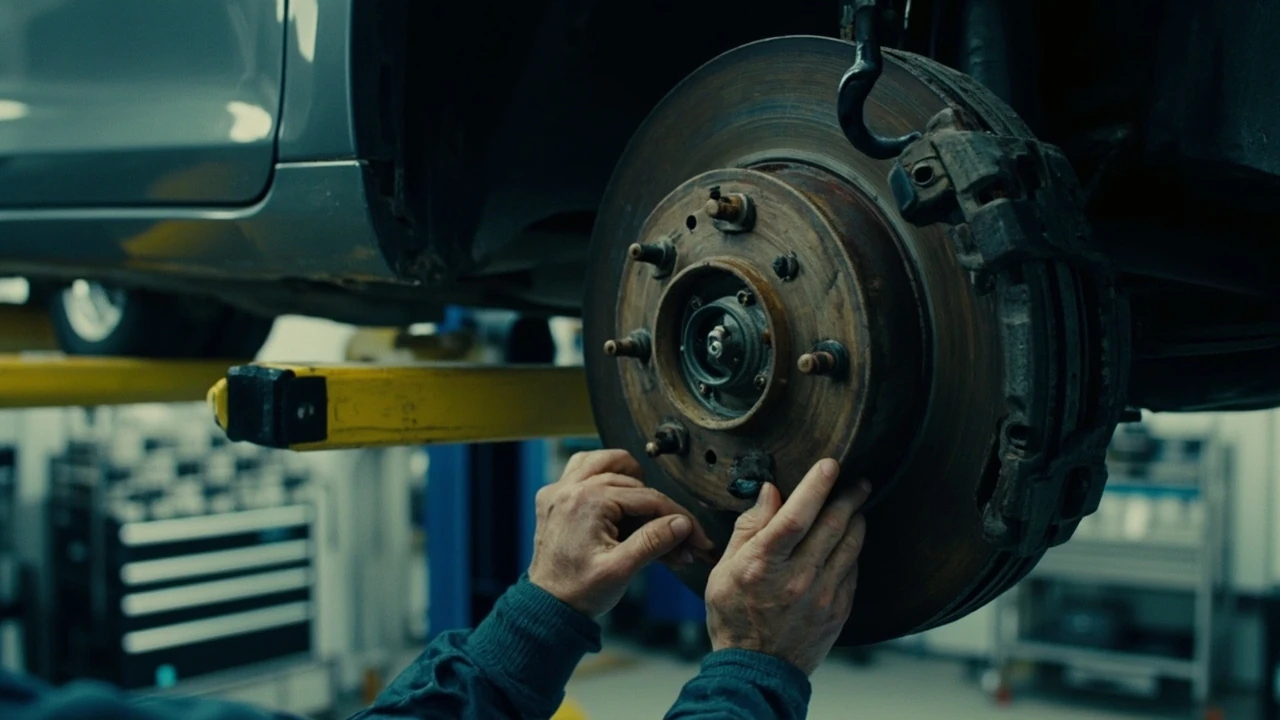

Brake repair service: what a driver actually gets for the money
When a driver presses the brake pedal, they expect the car to slow down the same way it did yesterday. A brake repair service exists for the moment that expectation breaks. The pedal can start to feel soft, the car can pull to one side under braking, a warning light can appear, or an unexpected grinding noise can show up on a cold morning. None of those symptoms are abstract. They are the everyday reasons people hand a car to a shop, and they are also the entry point for this guide.
This article is written for U.S. drivers who want a calm, practical look at how a professional brake repair service actually works, what it should cover, what it should not include, and what realistic decisions look like before the car is on the lift. It is not a product recommendation for a specific brand of pads, and it is not a teardown of caliper hydraulics. It is an owner’s-eye view of the process, with enough mechanical detail to make the estimate and the conversation with the shop easier to follow.
Why drivers end up booking a brake repair service
Most drivers do not book a brake repair service because they were browsing service menus. They book because something changed. Understanding the most common triggers helps frame what a good shop should actually do when the car arrives.
- Audible warning. High-pitched squeal under light braking, a deeper grinding noise, or a metallic scrape that starts only when the wheels are turning usually points to pad or rotor wear.
- Pedal feel change. A pedal that sinks closer to the floor, feels spongy, or requires more travel than it used to is a soft-pedal symptom that often traces to fluid, the master cylinder, or a brake line issue.
- Pulling under braking. If the car pulls left or right only when the brakes are applied, the cause is often a stuck caliper, uneven pad wear, or a hydraulic imbalance rather than an alignment problem.
- Vibration through the steering wheel or pedal. A pulsing brake pedal or a shaking steering wheel during stopping usually means rotor thickness variation, hot spots, or warping from heat stress.
- Dashboard warning. A brake warning light, an ABS light, or a separate pad-wear indicator is a clear signal that a diagnostic check is the first step, not a parts swap.
- Visible fluid or leaks. Brake fluid under the car, on a wheel, or inside a wheel well is treated as urgent because hydraulic loss directly affects stopping force.
None of these symptoms is enough on its own to name the failed part. A real brake repair service starts with the symptom, then verifies the cause on the vehicle before any parts are ordered. That order matters, because brake wear is uneven between axles and between sides, and what looks like a pad problem can sometimes turn out to be a caliper, hose, or proportioning valve issue.
What a professional brake repair service is expected to cover
A service visit is a sequence, not a single task. The items below describe what a complete brake repair service usually includes when a customer brings a car in with a real complaint rather than for a scheduled fluid swap.
- Symptom interview and road check. A technician asks when the symptom appears, how it has changed, and under what conditions it is worst. A short test drive often follows, especially for intermittent symptoms.
- Visual inspection of all four corners. Each wheel is removed or turned so the pads, rotors, calipers, hoses, and mounting hardware can be checked for wear, leakage, and corrosion.
- Pad and rotor measurement. Remaining pad friction material is measured against minimum thickness, and rotor thickness and runout are checked against the manufacturer’s service limits.
- Hydraulic system check. Brake fluid level, color, and condition are noted, and the system is checked for external leaks at calipers, lines, and the master cylinder.
- Diagnostic scan for ABS and electronic systems. Modern vehicles use wheel-speed sensors, an ABS control module, and sometimes electronic stability control. Stored fault codes and live data are reviewed before parts are replaced.
- Written estimate with parts, labor, and alternatives. A complete estimate should list the failed part, the proposed replacement, the labor hours, and any parts that are at the limit but not yet failed, so the customer can decide.
- Repair, road test, and final report. After the work, a second test drive confirms the symptom is resolved, and the customer receives a written summary of what was replaced, what was inspected, and any recommendations for follow-up.
The order is not optional. A shop that quotes a price over the phone without inspecting the car has skipped at least four of these steps, and that creates room for surprise charges and incorrect repairs later. A clean brake repair service is structured so the customer sees the same sequence from intake to pickup.
Common repair options a shop may present
After the inspection, the customer is usually given a short list of options. The names vary by shop, but the underlying decisions are similar across the industry. The table below summarizes what each option typically includes and what to ask before agreeing.
| Service option | Typical scope | Best suited for | Questions to ask the shop |
|---|---|---|---|
| Pad replacement only | New front or rear brake pads, hardware kit, brake cleaner; rotors measured but reused if within spec | Vehicles with rotor thickness still well above minimum and no pedal vibration | What is the measured rotor thickness now, and what is the discard spec? |
| Pad and rotor replacement | New pads plus new rotors on one or both axles, hardware, and a brake fluid check | Rotors at or near minimum thickness, visible hot spots, pedal vibration, or a second brake job on a high-mileage car | Are the new rotors coated, slotted, or drilled, and is that a real upgrade or a marketing claim? |
| Caliper service or replacement | Rebuild or replacement of a stuck or leaking caliper, new seals, fresh brake fluid bleed | Cars with uneven pad wear, fluid leaking from a caliper, or a caliper that fails to release | Is the caliper being replaced with a new, remanufactured, or used unit, and what is the warranty? |
| Brake fluid exchange | System flush with new fluid that meets the vehicle’s specification, often performed alongside pad work | Any brake repair service that opens the hydraulic system, and as periodic maintenance | What fluid specification is being used, and how much fluid is included in the quoted price? |
| ABS or electronic diagnosis | Scan tool read of ABS modules, wheel-speed sensor test, and pinpoint testing of related wiring | Illuminated brake or ABS warning light, traction or stability faults linked to braking | Are the fault codes being cleared without repair, or is the root cause being addressed? |
| Master cylinder or brake line repair | Replacement of the master cylinder, hard lines, or flexible hoses | Soft pedal that does not improve with bleeding, visible hydraulic leaks, or rusted steel lines | Is the replacement part new or remanufactured, and is the bleeding procedure included? |
Each row in this table represents a different scale of work, and that scale is what drives the price. A pad-only job is a short visit. A caliper replacement, a master cylinder job, or an ABS diagnosis takes longer, uses different parts, and requires a different skill set. A clear estimate makes the scale visible before the work begins.
How shops typically price a brake repair service
Pricing varies sharply by region, vehicle, and parts choice, so a national average is more useful than a single number. The table below shows the kind of cost ranges drivers report in the U.S. market. These are planning figures, not quotes, and the actual cost at a specific shop can be lower or higher depending on the vehicle and the parts selected.
| Type of work | Common cost range for a U.S. passenger car | Main drivers of price |
|---|---|---|
| Front brake pads, parts and labor | Often a few hundred dollars per axle | Pad grade, caliper design, and whether rotors are reused |
| Rear brake pads, parts and labor | Often a few hundred dollars per axle | Drum versus disc rear brakes, integrated parking brake hardware |
| Rotor replacement, one axle | Higher than a pad-only job, often in the low to mid four figures when premium rotors are used | Rotor material, brand, and whether the job is done in pairs |
| Caliper replacement, one corner | Often a few hundred to over a thousand dollars per corner | New versus remanufactured caliper, integrated parking brake complexity |
| Brake fluid exchange | Usually under a couple hundred dollars as a standalone service | Fluid specification, whether the system is fully flushed or topped off |
| ABS module or sensor diagnosis and repair | Wide range, often a diagnostic fee plus parts | Vehicle platform, sensor availability, and whether the module itself has failed |
Two patterns are worth knowing. First, parts are usually a smaller share of the bill than labor on a routine pad job, and the opposite is true on caliper and ABS work, where the part itself is expensive. Second, replacing pads and rotors on both sides of an axle is almost always the correct scope, because uneven friction between sides can cause the pulling symptom that started the visit. A shop that wants to replace parts on only one side of the axle should be asked to explain why.
How to choose a shop for a brake repair service
Brakes are safety-critical, and a low price is not the only signal that a shop is the right one. A few practical checks make the decision easier and reduce the chance of a comeback visit.
- Look for transparent estimates. The estimate should name the parts by part number or specification, not by a generic label, and should list labor as a number of hours or a flat rate, not a single combined number.
- Ask about the parts being installed. Quality differences between economy, mid-grade, and premium friction materials and rotors are real. The shop should be willing to explain the choice without dismissing the question.
- Check for a written warranty. Pad and rotor work is often warrantied for a defined period or mileage. A shop that does not provide a written warranty, or that offers a vague verbal one, is a warning sign.
- Confirm the inspection scope. A complete brake repair service starts with all four wheels inspected, not a guess based on the customer’s description alone.
- Ask whether the shop services the specific braking system. Vehicles with integrated electronic parking brakes, automatic hold, or brake-by-wire systems require scan-tool procedures after pad replacement. A generalist shop can handle many of these, but only if it has the right tools and training.
- Pay attention to how the estimate is explained. A good shop walks the customer through the failed part, the borderline part, and the future maintenance item in plain language. A shop that rushes this conversation usually rushes the repair as well.
The decision is rarely about finding the cheapest brake repair service. It is about finding a shop that explains what is being done and why, stands behind the work with a real warranty, and inspects the car before quoting the price. Drivers who keep that checklist in mind tend to have fewer repeat visits and fewer surprise charges.
What to expect during the appointment
Knowing the sequence of a typical visit makes the time at the shop less stressful. Most brake repair service appointments follow a similar arc, even when the underlying work is different.
- Drop-off and intake. The service writer records the symptoms, the mileage, the customer’s driving pattern, and any prior brake work on the vehicle.
- Inspection and estimate. The technician inspects the brakes, measures friction material and rotor thickness, and writes an estimate. The customer is usually contacted for approval before any work begins.
- Parts ordering, if needed. Some parts are not on the truck and have to be ordered. Same-day completion is not always realistic, especially for vehicles with less common calipers or integrated electronic parking brakes.
- Repair and reassembly.
The repair itself includes removing the wheels, replacing the failed parts, cleaning the mounting surfaces, installing new hardware, torquing the lug nuts and caliper bolts to specification, and bleeding the system if a hydraulic component was opened. A test drive follows, with attention to pedal feel, pulling, and warning lights.
- Final report and pickup. The customer receives a printed or digital summary of the work performed, including the parts installed, the torque values where relevant, and any recommendations for future service.
If a shop plans to keep the car longer than originally estimated, that should be communicated before the deadline passes, not at the end of the day. A clear schedule is part of the service, and it is reasonable to ask for an update if the work runs long.
After the repair: bedding in and the first week
New brake pads and rotors do not perform at their best immediately. They need a controlled bedding-in period, where the friction surfaces are exposed to a series of moderate stops that transfer a thin layer of pad material onto the rotor face. Most pad manufacturers publish a bedding procedure in the box, and it usually looks like a short sequence of stops from moderate speed, followed by a cool-down period without heavy braking.
For the first week or two after a brake repair service, drivers should avoid the following habits:
- Hard braking from highway speed before the pads have bedded in, which can glaze the new rotor surface.
- Sustained downhill braking, which can overheat fresh components and lead to uneven wear or brake judder.
- Aggressive driving on a fresh pad set, since the first few hundred miles are the period when the friction profile is still being established.
A short, gentle test drive after pickup is also a good idea. The pedal should feel firm, the car should track straight under braking, and the warning lights that triggered the visit should be off. If any of those conditions are not met, the car should go back to the shop before the customer accepts the work as complete.
How to know whether the repair is working
Evaluating a brake repair service is not a matter of trust. It is a matter of checking a few specific things before the car leaves the lot, and again over the first few weeks.
| Check | What to look for | What it suggests if something is off |
|---|---|---|
| Pedal height and firmness | Pedal feels similar to its position before the symptom started, with no extra travel | Possible air in the hydraulic system, a soft line issue, or a master cylinder concern |
| Tracking under braking | Car stops in a straight line with no pull to either side | Possible caliper or hydraulic imbalance that was not resolved |
| Noise on light application | Quiet or a faint hum from new pad material, no grinding or scraping | Possible hardware not reinstalled correctly, a missing shim, or a debris problem |
| Warning lights | No brake, ABS, or traction lights after the test drive | Sensor issue, incomplete scan-tool procedure, or a separate fault that was not addressed |
| Brake feel on the first real stop | Confident, linear deceleration without pulsing | Possible rotor thickness variation, warped rotor from shipping, or a contaminated surface |
| Fluid level after the work | Reservoir at the full mark with the new fluid color noted in the report | Possible leak, an underfilled system, or fluid that was not actually changed |
These checks are not a substitute for a professional inspection, but they give the driver a way to confirm that the original complaint has been resolved and that no new issue has been introduced by the work itself.
Where a brake repair service fits in a broader maintenance plan
Brakes are not a single component. They are a system, and a brake repair service usually touches a few of its parts at the same time. A driver who thinks about the system rather than the single repair tends to spend less over the life of the car.
- Pair replacements when possible. Replacing pads on both sides of an axle and rotors in pairs keeps friction even and reduces the chance of pulling and judder.
- Address the root cause, not just the symptom. A sticking caliper can destroy a new set of pads in a few thousand miles. Cleaning or replacing the caliper during the same visit protects the new parts.
- Treat brake fluid as scheduled maintenance. Most manufacturers recommend a brake fluid exchange on a defined interval because the fluid absorbs moisture over time. A brake repair service that opens the hydraulic system is a good moment to do the flush.
- Keep records. A simple log of pad and rotor replacement dates, the parts used, and the shop that performed the work makes future estimates more accurate and prevents repeat diagnostics on the same issue.
The goal is not to do more work. It is to make sure that each brake repair service is the last one the car needs for a while, rather than the first of several short-interval visits that add up to a larger bill.
Common mistakes to avoid when booking a brake repair service
Most brake problems do not become emergencies on their own. They become emergencies because small symptoms were ignored, or because a quick fix replaced the failed part without addressing the underlying cause. A few patterns come up often enough to be worth naming.
- Replacing pads without measuring rotors. New pads on a rotor that is already at the minimum thickness will work for a short time and then return with vibration and noise.
- Bleeding only one corner. If the system was opened, it usually needs to be bled at all four corners, not just at the corner that was worked on.
- Skipping the torque step on caliper bolts. Brake caliper bolts are torque-to-yield or torque-spec fasteners in most modern cars. A torque wrench is not optional.
- Using the wrong brake fluid. DOT 3, DOT 4, DOT 5, and DOT 5.1 are not interchangeable. The correct specification is on the reservoir cap or in the owner’s manual.
- Clearing warning lights without diagnosis. An ABS light cleared by disconnecting the battery will return if the underlying sensor or wiring problem is not repaired.
These are not exotic errors. They are the kind of shortcuts that show up at every busy shop, and a customer who knows what to ask is the best protection against them.
A practical checklist before approving a brake repair service
Walking into a shop with a short list of questions turns the conversation from a sales interaction into a service interaction. The checklist below is meant to be printed or saved on a phone.
- What did the inspection find at all four corners, and what is the measured pad and rotor thickness?
- Which parts are at the limit, and which are being replaced as preventive maintenance?
- What is the brand and grade of the pads and rotors being installed, and what is the warranty?
- Will the work be done in axle pairs, and why or why not?
- Is brake fluid being exchanged, and what specification is being used?
- Are the caliper bolts and lug nuts being torqued to specification, and is there a record of those values?
- What is the test drive procedure after the repair, and what signs should the customer watch for in the first week?
- Is there a written warranty covering parts and labor, and for how long?
A shop that answers these questions clearly is much more likely to deliver a clean brake repair service. A shop that is uncomfortable with any of them is a reason to ask more questions, or to take the car somewhere else.
Frequently asked questions
How long does a typical brake repair service take?
Most pad-only jobs are completed within a few hours, but the actual time depends on the vehicle, the parts on hand, and the workload of the shop. A job that includes caliper replacement, rotor replacement, or a brake fluid exchange can take longer, and some repairs require parts to be ordered, which extends the visit to a second day.
How often should brake pads be replaced?
Pad life depends on driving style, vehicle, and pad material. Many passenger cars go tens of thousands of miles between pad replacements, while a vehicle that is driven hard in traffic can wear pads much sooner. The right answer for a specific car comes from measuring the remaining friction material, not from a calendar.
Do I need to replace rotors every time I replace pads?
Not always. Rotors are replaced when they are at or near their minimum thickness, when they show deep wear, hot spots, or cracks, or when the pedal vibrates under braking. A measured rotor with even wear and enough remaining material can often be reused with new pads.
What does it mean if the brake pedal feels soft after a repair?
A soft pedal after a brake repair service usually points to air in the hydraulic system, a leak at a fitting, or a master cylinder issue. The car should be returned to the shop so the system can be bled and inspected, rather than driven until the pedal improves on its own.
Is a brake fluid exchange really necessary?
Brake fluid absorbs water over time, and that lowers its boiling point. A brake repair service that opens the hydraulic system is a good moment to exchange the fluid, and many manufacturers recommend a periodic flush on a defined interval even if no other brake work is being done.
Why does my car pull to one side when I brake?
Brake-related pull usually traces to a sticking caliper, uneven pad wear, a brake hose that has collapsed internally, or a hydraulic imbalance between sides. The cause is found by inspecting all four corners, not by replacing parts on the side the car pulls toward.
Can a single warning light mean different things on different cars?
Yes. A brake warning light can mean low fluid, a parking brake that is not fully released, a pad-wear sensor that has reached its limit, or a fault inside the ABS module. A scan-tool read of stored codes is the starting point, because it tells the technician which system is reporting the fault.
Should I use the cheapest brake pads a shop offers?
Economy pads are legal and functional, but they often wear faster, generate more brake dust, and can be noisier than mid-grade options. The right answer depends on the vehicle, the driving pattern, and the budget. A shop that explains the difference between the grades, instead of steering the customer to one option without explanation, is a better partner for the decision.
What is the difference between an ABS sensor and a brake pad wear sensor?
An ABS wheel-speed sensor measures how fast each wheel is rotating and feeds that data to the ABS module. A pad-wear sensor is a simple electrical contact embedded in the pad that closes a circuit when the friction material is thin. They serve different functions, and a brake repair service that touches one does not necessarily address the other.
What should I do if a brake warning light comes on after a recent repair?
The car should be driven carefully back to the shop that performed the work, or to a shop that can read the relevant control modules. Continuing to drive a car with an unresolved brake warning is not safe, and the fix is usually a quick diagnostic step rather than another full brake repair service.