
Drain cleaning companies: how to choose a reliable service
A single slow sink rarely feels urgent, but a backup that spreads across two fixtures usually changes that quickly. Homeowners and property managers tend to meet drain cleaning companies for the first time during a weekend backup, a holiday, or a late-night shower drain that suddenly stops swallowing water. That timing usually leads to a rushed decision, and rushed decisions are where most pricing complaints and shoddy workmanship begin.
What drain cleaning companies actually do, what equipment they carry, and how they structure pricing varies more than most homeowner-facing marketing suggests. This guide walks through the real working difference between local outfits, large regional brands, and the franchise plumbing chains that buy up search results. It also covers the practical checks that separate a legitimate service from a call center that simply dispatches subcontractors.
What drain cleaning companies actually do
Specialist drain cleaning companies focus on clearing blockages and restoring flow inside the drain, waste, and vent system of a building. General plumbers also clear drains, but the work is usually only one part of a much wider plumbing practice. Drain cleaning-only outfits tend to run leaner trucks, carry more specialized cable and jetter equipment, and price the visit as a discrete service rather than as part of a broader plumbing call.
The typical service menu includes:
- Clearing single-fixture clogs in sinks, tubs, showers, and floor drains
- Clearing main line and building drain stoppages that affect multiple fixtures
- Camera inspections to identify the cause and location of recurring problems
- Hydro jetting, which uses high-pressure water to scour the inside of pipes
- Preventive maintenance programs for restaurants, apartment buildings, and other high-use properties
- Root cutting and root treatment where tree roots have invaded a sewer line
- Cleanout installation where a building lacks a usable access point
Most residential visits fall into the first two categories. The remaining services are usually offered only by companies that invest in higher-end equipment, or that focus on commercial and multi-unit residential work.
Residential vs. commercial drain cleaning companies
Residential and commercial drain cleaning require different equipment, different scheduling, and different pricing. A homeowner who calls a commercial-focused company may end up paying for a jetter truck that the clog did not need, while a restaurant that hires a small residential operation may find the company cannot handle a 6-inch line or a grease interceptor.
| Factor | Residential drain cleaning | Commercial drain cleaning |
|---|---|---|
| Typical pipe diameter | 1.5 to 4 inches | 4 to 8 inches or larger |
| Equipment commonly used | Handheld auger, small electric machine, plunger, air-burst tool | Electric drain machine, hydro jetter, vacuum truck, grease pump |
| Service window | Standard business hours, plus on-call for emergencies | Often nights, weekends, and pre-opening hours to avoid downtime |
| Contract structure | One-off service call | Recurring maintenance contract with documented inspections |
| Billing model | Flat-rate or per-job quote | Per visit, monthly retainer, or per-line pricing |
For most homeowners, a residential-focused company is the right fit. For a restaurant, an apartment complex, or a building with a commercial kitchen, a company that maintains commercial grease lines and understands health-department expectations is usually the better choice.
Common warning signs that you need a drain cleaning company
Most drain problems announce themselves long before a full backup. Catching those early signs is often the difference between a single-line auger job and a wet-vac, mop, and drywall replacement project.
- Water backing up into a shower or tub when a nearby fixture drains
- Toilets that gurgle or bubble when a sink or washing machine discharges
- Sinks that drain slowly even after a basic plunger attempt
- Repeated need to use a store-bought chemical cleaner to keep a line moving
- Foul sewer odor from a seldom-used drain, especially a floor drain
- Water pooling around a basement floor drain during heavy rain
Any one of these can be a one-off. When two or three appear together, the cause is more likely in a shared branch line or the main building drain. A camera inspection at that point usually pays for itself by pinpointing whether the issue is grease, roots, a broken pipe, or a simple soft clog.
How drain cleaning companies price a service call
Pricing structure is one of the most common sources of frustration with drain cleaning companies. A few industry practices drive most complaints.
| Pricing model | How it works | What to watch for |
|---|---|---|
| Flat rate per drain | One quoted price to clear a specific drain, often with a defined effort window | Read the fine print for trip charges, after-hours fees, and what counts as a separate drain |
| Time and materials | Hourly labor plus the cost of any parts or consumables | Ask for a not-to-exceed number and a clear estimate of how long the job should take |
| Main line vs. branch line | Two different price points depending on which part of the system is being cleared | Confirm the price before work starts, especially if the company cannot guarantee it is the main line |
| Emergency or after-hours | Premium rate for nights, weekends, and holidays | Ask whether the premium is a flat surcharge or a multiplier of the regular rate |
| Camera inspection add-on | Often quoted separately as a diagnostic line item | Some companies offer it free if a clearing job is performed; ask before booking |
Reliable drain cleaning companies explain their pricing structure on the phone before sending a truck. They also confirm whether the trip charge, diagnosis, and the actual clearing work are billed together or separately. A company that refuses to discuss any of this until the technician is standing in the kitchen is often relying on pressure tactics in person.
Equipment a good drain cleaning company should carry
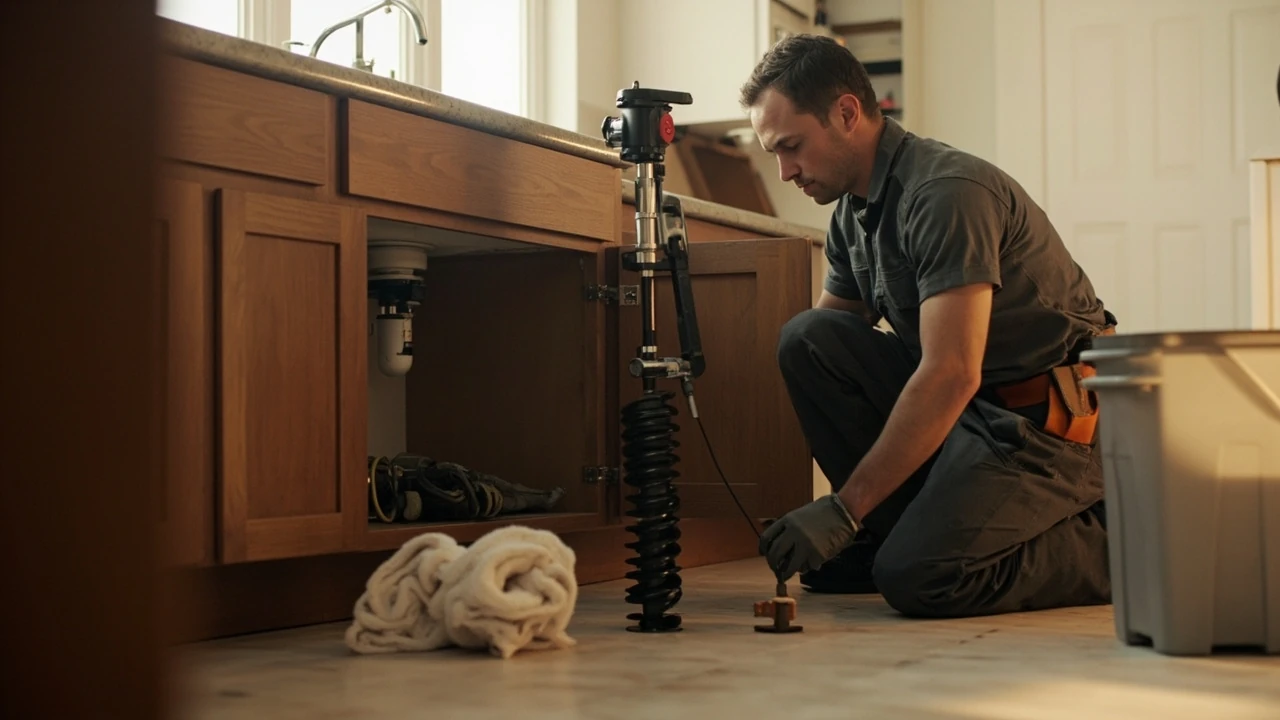
The tool that fixes a clog depends on what is causing it. A good drain cleaning company arrives with a kit that lets the technician match the tool to the problem, rather than a single cable that gets used on every job.
- Handheld drain auger for sinks, tubs, and small-diameter lines within roughly 25 feet of the fixture
- Closet auger designed for toilets, with a sleeve that protects the porcelain
- Electric drum machine for longer branch lines and most residential main lines
- Sectional cable machine for heavy roots and commercial work
- Hydro jetter for grease, sludge, and heavy scale in larger lines
- Inspection camera with a locator for diagnosing recurring problems and confirming a clean line
- Air-burst or water-pressure tools as alternatives for some single-fixture clogs
The drain cleaning methods themselves are well documented in industry resources. For example, the overview at Wikipedia’s entry on drain cleaners explains how handheld augers, electric machines, and hydro-mechanical systems differ in reach, pipe compatibility, and safety profile. Reading that kind of overview before a service call makes it much easier to evaluate whether a technician is recommending the right tool for a particular drain.
How to vet drain cleaning companies before booking
The cheapest and fastest way to sort serious operators from phone-room resellers is to ask a small set of direct questions. Most will answer them on the phone. The companies that cannot, or that deflect with vague reassurances, are usually the ones that produce complaints.
- Ask for the company name on the truck and the legal business name on the invoice.
- Confirm the license number for your state and look it up in the state plumbing board database.
- Ask whether the technician is a W-2 employee or a 1099 subcontractor dispatched from a call center.
- Request a written quote that separates the trip charge, the diagnostic fee, and the clearing work.
- Ask what equipment the technician is likely to bring and which tool will be tried first.
- Confirm insurance coverage and whether the company carries both general liability and workers’ comp.
- Ask whether a camera inspection is included, available as an add-on, or performed only on request.
- Request a clear warranty statement, including what is covered and for how long.
A company that handles these questions well before a truck rolls is almost always easier to work with once the work starts. The same checks apply to broader home-service decisions, and similar vetting logic shows up in the remodelcraftusa.com guide on water heater replacement, where license verification and written quotes are framed as the baseline for any plumbing decision.
Red flags when hiring a drain cleaning company
Some warning signs repeat often enough in consumer complaints to be worth calling out directly. None of these are deal-breakers on their own, but several in combination usually justify moving on to a different provider.
- Door-to-door canvassers offering a free drain inspection, especially after a storm or local flooding
- Quotes that are dramatically lower than every other local option with no clear reason for the discount
- Refusal to provide a written estimate before work begins
- Pressure to add unrelated repairs, such as a full sewer replacement, without a camera inspection
- No physical business address, only a toll-free number and a website
- Cash-only payment, especially for larger jobs
- Refusal to pull a permit for work that legally requires one
Most of these red flags apply across home-services work. The same caution that applies to foundation repair decisions applies here: an inspection or diagnosis should produce evidence, not a sales pitch.
What to expect during a professional drain cleaning visit
Knowing the normal sequence of a professional visit makes it easier to tell whether a technician is doing the job properly or improvising.
- Walk-through of the affected fixtures and any others that are draining slowly.
- Identification of the cleanout location, or decision on whether one needs to be installed.
- Initial mechanical clearing with a hand auger or electric machine sized to the line.
- Test flow by running water through the affected fixtures.
- Camera inspection if clearing does not restore full flow, or if the technician suspects a structural problem.
- Written summary of findings, with recommendations and a separate quote for any follow-up work.
A reasonable clearing visit on a single residential branch line usually takes 30 to 60 minutes once the technician is on site. Main line work that requires pulling a toilet or running a long cable from an exterior cleanout can run longer. If a technician finishes an unusually fast visit on a stubborn main line without inspecting afterwards, that is a sign the clog is likely to return.
DIY vs. hiring a drain cleaning company
Plenty of drain clogs do not require a professional. The trick is knowing which ones probably do, so a quick fix does not turn into a bigger problem.
| Situation | DIY is usually fine | Call a drain cleaning company |
|---|---|---|
| Single slow sink | Yes, plunger or small handheld auger | Only if it returns after a second attempt |
| Hair clog in shower | Yes, hair snake or zip tool | Only if multiple fixtures are slow at the same time |
| Toilet that backs up | Yes, plunger or closet auger | Yes, if the toilet backs up when a sink or tub is run |
| Multiple fixtures affected | No, the cause is likely in a shared line | Yes, this almost always needs a professional |
| Recurring slow drain | No, repeated use of chemical cleaners can damage pipes | Yes, a camera inspection is the only reliable diagnostic |
| Sewer odor from floor drain | No, the cause is usually deeper in the trap or branch line | Yes, especially if the drain has not been used in a long time |
Store-bought chemical cleaners work in a narrow range of cases and can damage older pipes if used repeatedly. As the Wikipedia overview on drain cleaners notes, chemical openers rely on corrosive acids or alkalis, and overuse can shorten the life of metal pipes and certain plastics. A professional visit is usually cheaper than a damaged trap or a weakened joint.
Preventive maintenance that actually reduces service calls
Drain cleaning companies see the same handful of causes over and over. A small amount of prevention reduces the number of emergency visits and the total spend on plumbing each year.
- Keep fats, oils, and grease out of kitchen drains, even with a garbage disposal
- Use hair catchers in showers and clean them weekly
- Avoid flushing wipes, paper towels, or hygiene products, even those labeled flushable
- Run hot water through kitchen drains after each use to move soap and food residue
- Periodically fill seldom-used floor drains with a bucket of water to keep trap seals intact
- Schedule preventive hydro jetting on restaurant lines and other high-use commercial drains
- Have a main line camera inspection every few years if the property has mature trees near the sewer
For households on municipal sewer systems, the local utility sometimes publishes a list of items that should never enter the drain. Following that list is usually a more reliable guide than product marketing. For households on a septic system, the same rules apply, plus the need to pump the tank on the schedule the installer recommends.
Cost ranges and what drives them
Drain cleaning costs vary by region, but the shape of the pricing is fairly consistent. A few of the main drivers show up in almost every market.
- Time of day: nights, weekends, and holidays carry a premium
- Line type: a single fixture is cheaper than a main line that affects the whole home
- Access: a cleanout outside the home is faster than pulling a toilet or cutting into a wall
- Cause of the clog: soft clogs clear quickly, while roots or a broken pipe require more time or a separate repair
- Equipment: a hand auger costs less to run than a hydro jetter or a camera inspection
- Local market: labor rates and competition vary sharply between metros and rural areas
Asking a drain cleaning company for a written estimate that includes all of these factors avoids most surprise charges. The same principle is what experienced homeowners use when comparing contractors on bigger jobs, including the kind of work covered in the remodelcraftusa.com bathroom remodeling guide.
How insurance, warranties, and guarantees actually work
Most reputable drain cleaning companies offer some form of workmanship guarantee, but the length and conditions matter. A 30-day guarantee on a single-fixture clearing is common, while a 90-day or longer guarantee on a main line is a stronger signal. The guarantee usually covers the same line clearing the same way, not a different problem in a different part of the system.
Homeowner’s insurance rarely covers a routine drain clearing. It may cover sudden water damage caused by a backup, and a separate sewer and drain endorsement is sometimes available for properties with a history of backups. That kind of policy is worth discussing with an insurance agent, especially on older homes with mature trees on the property.
Frequently asked questions
How do drain cleaning companies charge for a service call?
Most charge either a flat rate per drain or time and materials, with separate fees for the trip, the diagnosis, and any add-ons like a camera inspection. Reliable companies explain all of this on the phone before sending a technician.
What is the difference between a plumber and a drain cleaning company?
General plumbers handle a wide range of work, including drain clearing as one service among many. Drain cleaning companies focus specifically on clearing and maintaining drain, waste, and vent systems, and they often carry more specialized equipment for that work.
Are chemical drain cleaners safe to use regularly?
Occasional use on a soft clog is generally fine on modern pipes, but frequent use can damage older metal pipes and certain plastics. Enzymatic cleaners are a gentler option for routine maintenance but work slowly.
How long does a professional drain cleaning take?
A single-fixture clearing usually takes 30 to 60 minutes once the technician is set up. Main line work, especially with an exterior cleanout and a long cable run, can take 90 minutes to a few hours.
Do I need a camera inspection with every drain cleaning?
Not for a one-off clog, but a camera inspection is worth the cost if the same line keeps backing up or if multiple fixtures are affected. It identifies whether the cause is grease, roots, a sag in the pipe, or a structural break.
Can drain cleaning companies fix a broken pipe?
Most can clear a blockage, but only some perform pipe repair or replacement. If the camera shows a cracked, collapsed, or offset pipe, the company will usually refer the repair portion to a plumbing contractor.
What should I do before the technician arrives?
Clear the area under the affected sink, locate any known cleanouts, and stop running water into the affected fixtures. Avoid using chemical cleaners immediately before the visit, since they can splash back during mechanical clearing.
Are 24-hour drain cleaning services worth the premium?
For an active backup that is causing property damage, yes. For a slow drain that can wait until morning, scheduling during regular hours saves the after-hours surcharge. A short phone call describing the situation usually gets an honest recommendation from a reputable company.
How do I tell if the main sewer line is the problem?
When more than one fixture backs up at the same time, especially on the lowest level of the home, the main line is the most likely cause. Toilets that bubble when a nearby sink drains are a strong signal, and water appearing around a basement floor drain usually confirms it.
Do drain cleaning companies handle restaurant grease lines?
Some do, but not all. Commercial grease trap and grease line work is a separate specialty, and restaurants usually need a company that runs a scheduled maintenance contract rather than a one-off residential service.
Practical next step
Before booking a service, write down which fixtures are affected, how often the problem happens, and what you have already tried. A short, accurate description on the phone gives a drain cleaning company enough information to quote the job honestly and to send the right equipment on the first visit. That single step usually does more to control cost and outcome than any other part of the process.