
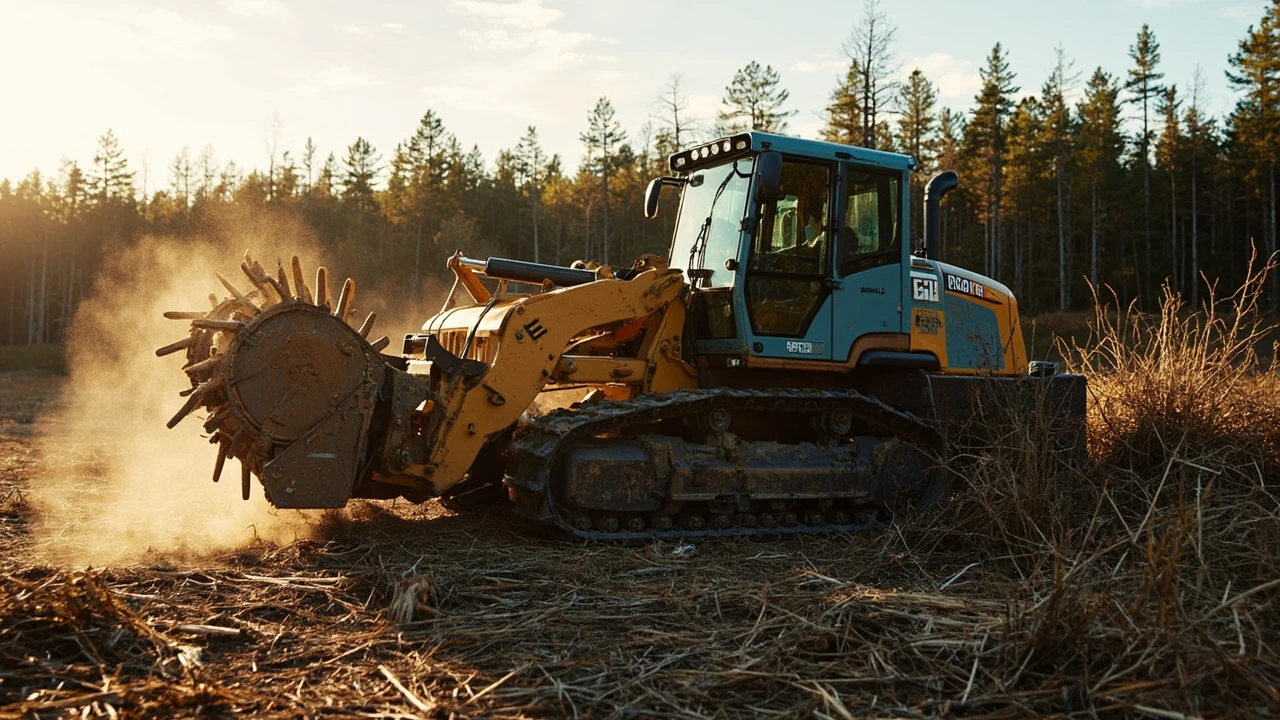

Forestry mulching: a practical way to clear land without burning or hauling
A property owner stands at the edge of an overgrown five-acre field, looking at a tangle of sweetgum, cedar saplings, and waist-high brush. The first instinct is to call a bulldozer, light a burn pile, or start looking for someone with a wood chipper. None of those are wrong in every case, but each one brings a long list of costs, permits, and downsides. Forestry mulching takes a different approach: a single tracked machine drives into the brush, grinds trees and saplings into a layer of wood chips, and leaves the soil largely untouched. The job that used to take a crew a week can sometimes be finished in a day, with the chips left in place as a natural erosion blanket.
This guide explains how forestry mulching actually works, what it is good at, where it falls short, and how to decide whether it is the right clearing method for a specific piece of land. It is written for landowners, ranchers, contractors, and habitat managers who want a clear-headed look at the process rather than a sales pitch.
What forestry mulching is, in plain terms
Forestry mulching is a land clearing method that uses one machine to cut, grind, and clear vegetation in a single pass. Instead of felling trees, dragging them to a chipper, hauling off the debris, and then dealing with stumps, a forestry mulcher shears small trees and brush down to ground level and turns the material into chips that fall where the machine is working. The chips stay on the ground, which is the point that most separates mulching from traditional clearing.
The machine itself is usually a dedicated carrier, such as a tracked forestry tractor, with a heavy steel cutting head mounted on the front or rear. That head spins a drum fitted with steel chipper tools, sometimes called teeth, hammers, or blades depending on the manufacturer. As the drum rotates, the tools slice through saplings, brush, and small trees, and the resulting chips are spread behind or under the machine.
Forestry mulchers are also sold as attachments. Excavators, skid steers, and compact track loaders can all be fitted with a mulching head, which gives operators a way to reach tighter spots, work on slopes, or follow a tree line with more precision. A larger carrier with a fixed mulching head is the most common setup for wide-acre jobs, while excavator-mounted heads are useful for selective work near fences, structures, or sensitive habitat edges.
How the equipment actually works
The working end of a forestry mulcher is a heavy cylindrical drum. On the drum are rows of fixed or swinging steel tools, each one designed to take repeated impact without shattering. The drum spins at a controlled speed in one of two orientations: about a horizontal axis, like a horizontal grinder, or about a vertical axis, like a large mower deck tipped on its side.
The orientation matters more than most buyers realize.
- Horizontal-axis mulchers tend to be the heavier machines. They can handle larger material, sometimes felling trees up to roughly 30 inches in diameter at the upper end of the scale, although the practical limit is usually smaller.
- Vertical-axis mulchers are lighter and faster. They are well suited to brush, saplings, and smaller trees, but the safe cutting diameter drops to roughly 6 to 8 inches on most production heads.
Material is fed into the drum by the forward motion of the machine, and the operator controls how aggressively the head engages the vegetation. Modern machines use variable-speed hydraulic drives so the operator can match drum speed to the density of the growth. A skilled operator can clear thick underbrush slowly and evenly, then accelerate across a sparse stand without stalling the head or throwing chips in unsafe directions.
Wear parts are a real part of the economics. Blades, hammers, and teeth are designed to be replaceable. They wear down against rocks, sand, and repeated impact, and they are the single most common maintenance line item on a working mulcher.
What forestry mulching is used for
The same basic tool shows up in a surprisingly wide range of jobs. Some are straightforward land clearing. Others are environmental or right-of-way work where the goal is not to remove every tree but to manage vegetation for a specific outcome.
| Application | Typical goal | How mulching is applied |
|---|---|---|
| Residential and commercial land clearing | Prepare a homesite, drive, pasture, or building pad | Grind brush and trees down to grade; chips stay as a temporary ground cover |
| Right-of-way maintenance | Keep roads, pipelines, and utility corridors free of tall growth | Continuous clearing along a strip, usually with a tracked carrier or excavator head |
| Trail and access road creation | Cut walking, riding, or utility paths through woods | Selective clearing along a planned route, leaving desirable shade trees |
| Wildfire fuel reduction | Reduce ladder fuels and ground fuel loads before fire season | Thin small trees and brush across a broad area; create defensible space near structures |
| Invasive species control | Remove buckthorn, salt cedar, juniper, and other aggressive species | Targeted mulching of invasive stands while native vegetation is left in place |
| Wildlife habitat management | Maintain openings, browse, and travel corridors for game species | Create food plots, edge feathering, and access to water sources choked by growth |
| Post-fire cleanup and erosion control | Stabilize bare slopes after a wildfire | Spread a coarse layer of chipped material over exposed soil to slow runoff |
That range is part of the reason forestry mulching has spread from a niche clearing method into a routine tool for contractors, conservation groups, and utility crews.
Where mulching makes sense, and where it does not
Forestry mulching is a strong choice when the goal is to convert standing vegetation into ground-level chips, the property is accessible to a tracked machine, and the operator wants to disturb the soil as little as possible. It is a weaker choice when the goal is to remove biomass from the site, when trees are too large to fell safely with a rotary head, or when the ground is so rocky that the teeth will be destroyed faster than the brush is cleared.
| Situation | Mulching tends to be | Reason |
|---|---|---|
| Overgrown pasture with brush and saplings under 6 inches | Well suited | Fast, low soil disturbance, chips help suppress regrowth |
| Mixed woods with 12 to 20 inch hardwood and softwood trees | Marginal | Larger trees push the head past its safe felling range and slow production |
| Steep slope with loose topsoil | Well suited for tracked machines | Low ground pressure, no uprooting, chips help hold the soil |
| Rocky ridge or boulder field | Poorly suited | Tooth wear and fire risk from sparks against stone |
| Site that must be graded or built on immediately | Sometimes a problem | Stumps remain below grade and can interfere with excavation later |
| Land where biomass must be removed for fire or pest reasons | Only if combined with other steps | Chips stay on site unless they are raked, collected, or burned later |
Property owners who want a clean, graded pad ready for a foundation usually still need a dozer or excavator to push stumps and root mats. Mulching can be the first step in that sequence, not the only step.
Forestry mulching compared to traditional land clearing
It helps to put mulching next to the older methods that have been used for decades. Each has a real place; the right one depends on the site, the budget, and what comes after the clearing.
| Method | What it does | Soil impact | Biomass left on site | Typical best fit |
|---|---|---|---|---|
| Forestry mulching | Grinds standing vegetation into chips in one pass | Low | Yes, as a chip layer | Brush, saplings, selective clearing, fuel reduction |
| Bulldozer clearing | Pushes trees over, uproots stumps, scrapes topsoil | High | Often piled and burned | Pad sites, roads, large pasture conversions |
| Excavator with thumb and shear | Fells, sorts, and stacks trees; stumps removed separately | Moderate to high | Logs removed, brush piled | Lots with marketable timber or heavy timber |
| Hand clearing with chainsaws and chippers | Fells by hand, feeds a chipper, hauls debris | Low to moderate | Hauled off or piled | Small lots, sensitive sites, selective work |
| Controlled burn | Burns piled or standing vegetation under a permit | Surface heat effect | Converted to ash | Range management, large acreages with the right conditions |
The trade-off that drives most decisions is biomass. Mulching leaves the wood on the ground. Burning or hauling removes it. If the next step is replanting pasture grass, the chip layer is usually an asset. If the next step is pouring a concrete slab, the chips are a problem that has to be dealt with before construction.
What forestry mulching costs and why quotes vary
Pricing for forestry mulching is quoted in a few different ways, and the spread can be wide. Most contractors will give a per-acre price for open brush and a higher per-hour or per-acre price for heavier work. The variables behind those numbers are real, and a serious quote should account for them.
- Density of vegetation. Light brush with sparse saplings is a different job from a choked right-of-way that has not been touched in fifteen years.
- Average stem size. A field of two-inch saplings clears far faster than a stand of twelve-inch hardwoods, even at the same per-acre rate.
- Terrain. Flat ground is faster. Steep or rough ground slows the carrier and limits how aggressively the operator can engage the head.
- Rock content. Stones wear teeth quickly and raise the risk of sparks. Operators either price for that wear or decline rocky work entirely.
- Site access. If a tracked machine has to be hauled long distances, or if the entry is too narrow for a lowboy, mobilization can be a large share of the total bill.
- Disposal expectations. Mulching in place is faster than raking, windrowing, and burning the chips, and the cost reflects that.
A useful benchmark from a 2005 industry estimate, still cited in trade coverage, was an average of about $25 per cubic yard of mulched material at that time. Published reporting has also described the broader U.S. market for mulch and composting products as approaching $1 billion in annual revenue in recent years. Those figures are anchors, not quotes, and a real number for a specific job should always come from an on-site walk-through.
Production rates: what a machine can actually clear in a day
Production numbers for forestry mulching get thrown around loosely. Marketing material talks about clearing many acres per day. Field results depend on the variables above, plus the skill of the operator and the machine class.
Heavier tracked mulchers can work through dense brush at meaningful pace, and in some conditions they can clear on the order of several acres in a single day. The upper end of the published range, around ten acres per day, applies to lighter vegetation on accessible ground. Once stem size goes up, slope goes up, or access tightens, daily production falls sharply. The honest answer to “how much can you clear” is almost always “it depends,” and a contractor who gives a confident number without walking the site is not yet ready to give a real one.
Environmental and soil effects
The environmental case for forestry mulching rests on a few specific effects that show up in the field, not on general claims about being “green.”
- Soil structure stays intact. Because the machine grinds above the surface, the root mat and topsoil are not scraped, ripped, or piled. That matters on slopes and on sites where erosion is a concern.
- Organic matter returns to the soil. The chip layer breaks down over time, feeding the same soil that grew the trees in the first place.
- Erosion control on burned or disturbed land. After a wildfire, a coarse grind left on the surface slows runoff and keeps ash and sediment from washing into streams.
- Reduced equipment count. One carrier can replace a dozer, an excavator, a chipper, and a hauling setup on simpler jobs, which cuts fuel use and on-site emissions.
There are limits to those benefits. The chip layer can temporarily tie up nitrogen as it decomposes, which can slow pasture regrowth in the first season. In dry conditions, a thick layer of fine chips can become a fire risk of its own until it weathers. And on rocky ground, the sparks from teeth on stone are a real ignition hazard, which is one reason many contractors carry water and keep fire suppression close at hand.
Wildfire fuel reduction and defensible space
One of the most common reasons a landowner, a community, or a utility calls for forestry mulching in the western United States is fuel reduction. Wildfire behavior is driven by the continuity of fuel from the ground up to the canopy, and a large share of that fuel is small trees, brush, and fallen limbs. Removing that ladder fuel is one of the few treatments that has consistent field support behind it.
Mulching for wildfire work usually means reducing stem density, lowering the height of brush, and creating breaks that slow a fire’s approach to a structure or a road. Proactive work before fire season is less expensive and more effective than reactive work on an active fire line. After a fire, mulching can also be used to stabilize slopes and reduce sediment runoff into waterways, which is its own separate benefit.
Invasive species and habitat work
Forestry mulching is also used to push back against invasive plants. Species such as buckthorn, multiflora rose, salt cedar, and juniper can take over a pasture or a riparian buffer and crowd out natives. A forestry mulcher can grind those invasive stems down to ground level without the soil disturbance that comes with a dozer, which gives native grasses and forbs a chance to come back.
Wildlife habitat work uses mulching in a different way. Instead of clearing everything, the operator thins selectively. Edge feathering, food plot prep, and the opening of water access blocked by understory growth are all common tasks. The same machine that clears a pasture can be used to maintain a wildlife opening in a way that keeps the surrounding woods intact, which is often the point.
Limitations and disadvantages worth knowing
Forestry mulching is a strong tool, but it is not a universal one. The honest list of disadvantages is short and worth taking seriously before committing to a project.
- Stem size limits. Most production mulchers are designed for material under roughly 6 to 8 inches on a vertical-axis head, and even larger horizontal machines have a practical upper bound. Trees past that size are either unsafe to fell with a rotary head or simply slow the job to a crawl.
- Stumps remain. Because the machine cuts at or near the surface, the stump and major roots are still in the ground. If the next step is a lawn, food plot, or building pad, additional work is usually needed.
- Rocky ground. Teeth grinding on stone wear out fast and can throw sparks. Some sites are simply not safe to mulch.
- Throwing debris. Rocks, wire, and other hidden objects can be thrown from the head. Deflectors reduce the risk but do not eliminate it, which is why operators clear bystanders and structures from the work area.
- Biomass stays on site. The chips are a benefit in many cases, but if the goal is to remove fuel load, the chips are still fuel until they break down.
- Access for fueling and service. Mulching is fast, but the machine still needs a way in for fuel, hydraulic oil, and routine maintenance.
How to plan a mulching project
A good mulching project starts with a clear answer to a few questions. Walking the site with a contractor who actually runs a mulcher is the most useful step, but the same questions can be worked through in advance.
- What is the end state? Pasture, food plot, homesite, trail, defensible space, or habitat opening. The end state drives how aggressive the cut needs to be.
- What is the average and maximum stem size? Walking the property and measuring a few representative trees will save a lot of guesswork in the quote.
- Are there utility lines, fences, or structures nearby? The machine needs room to swing and the operator needs a safe standoff.
- What is the slope? Tracked machines can handle surprising grades, but the operator still needs to know the limits.
- What is under the brush? Old fence wire, abandoned vehicles, and construction debris are all dangerous when they hit a spinning drum.
- Are there any protected species, wetlands, or permit requirements? Riparian work in particular can trigger state or local review, even on private land.
A written scope that names the acreage, the target stem size, the chip finish, and what is excluded (such as stump removal, fence clearing, or haul-off) is worth the time it takes to put together. It also gives both sides something to point back to if the job changes mid-stream.
Choosing a forestry mulching contractor
The difference between a good mulching job and a bad one is usually the operator, not the machine. A few things are worth checking before signing a contract.
- Experience on similar ground. A contractor who has done pasture reclamation is a different hire from one who specializes in right-of-way or post-fire work.
- Insurance. Forestry mulching is heavy equipment work on rough ground. Workers’ comp, general liability, and equipment coverage are not optional.
- References and recent jobs. A short visit to a recent site, or a quick call to a past customer, is the most reliable way to judge the quality of the cut and the cleanup.
- Written scope. Acreage, target stem size, exclusion zones, and what happens if the scope changes should all be in writing.
- Equipment class. A dedicated forestry carrier will out-produce a skid steer with a light-duty head in heavy brush. Match the machine to the job, not the other way around.
Safety on a mulching site
Forestry mulching is one of the safer forms of mechanical land clearing when it is done by a trained operator, but it is not a casual job. Thrown debris, equipment rollover on slopes, and the risk of stump holes hidden in brush are real. Anyone on the ground within the work area should be the operator only, and bystanders should be kept well back. Operators typically work with a spotter or a second set of eyes when visibility is limited, and they carry fire suppression because sparks from rocks are a known hazard.
Property owners who plan to be on-site during the work should agree on a hold zone with the operator before the machine starts. Curiosity is not a good reason to be inside the work envelope of a machine that can throw chips and small rocks at high speed.
Frequently asked questions
What is forestry mulching in simple terms?
Forestry mulching is a land clearing method in which a single machine with a rotating drum and steel cutting tools grinds standing trees, saplings, and brush into chips on the spot. The chips are left on the ground as a mulch layer, and the soil is left largely undisturbed.
How big of a tree can a forestry mulcher handle?
It depends on the machine and the orientation of the cutting head. Vertical-axis mulchers are usually rated for material up to about 6 to 8 inches in diameter. Horizontal-axis mulchers can handle larger stems, in some cases up to roughly 30 inches, but felling trees near the upper end of that range is slow and hard on both the equipment and the operator. A useful overview of the difference between the two head types is in the English Wikipedia article on forestry mulching, which provides useful background for this point.
How many acres can a forestry mulcher clear in a day?
Heavy tracked machines can clear on the order of several acres per day in favorable conditions, and in lighter vegetation some operators report rates up to around ten acres per day. Real production drops quickly as stem size, slope, rock content, and access get harder. A site walk-through is the only way to get a credible production estimate.
Is forestry mulching better than bulldozing?
It depends on the end goal. Mulching is better when low soil disturbance, fast brush removal, and leaving chips in place are priorities. Bulldozing is better when the site needs to be graded, stumps need to come out, or the final grade has to be exact. Many projects use both: mulching to clear surface growth first, then a dozer or excavator to shape the pad.
Does forestry mulching kill the roots?
Mulching cuts material at or just above the surface. The visible stem is removed, but the root system below the cut usually remains alive and will resprout in many species. For invasive species and brush control, follow-up treatments or repeated mulching are often part of the management plan.
How much does forestry mulching cost per acre?
There is no single answer, because pricing depends on stem size, density, terrain, rock content, and access. Light brush on open ground is at the low end; heavy, large-stem work on rough ground is at the high end. A 2005 industry estimate put the average paid per cubic yard of mulched material at about $25, which is still cited as a rough anchor. A written quote from a contractor who has walked the site is the only reliable number.
Is forestry mulching effective for wildfire defensible space?
Yes, and it is one of the more common reasons the work is done. Reducing small trees, brush, and ladder fuels lowers the continuity of fuel between the ground and the canopy, which slows the rate at which a fire can move toward a structure. Defensible space work is usually done proactively, before fire season, and is most effective when it is part of a broader fuel management plan on the property.
Can forestry mulchers work on steep slopes?
Tracked forestry machines are designed for low ground pressure and can work on grades that would be unsafe for wheeled equipment. Excavator-mounted mulching heads can reach across even steeper ground. There are still practical limits, and operators set their own cut lines based on the machine, the surface, and the weather.
What happens to the chips after mulching?
They stay where the machine ground them. Over time, the chips break down and return organic matter to the soil, while suppressing some of the earliest regrowth of weeds and grass. If a clean surface is needed for the next step, such as a building pad or a finished lawn, the chips have to be raked, windrowed, or otherwise removed.
Do I need a permit for forestry mulching?
It depends on the jurisdiction and the site. Many rural properties can be mulched without a permit, but work in regulated wetlands, near protected streams, or in areas with local burning or clearing rules may require review. The contractor or the local soil and water conservation district is usually the fastest way to find out what applies on a given property.