
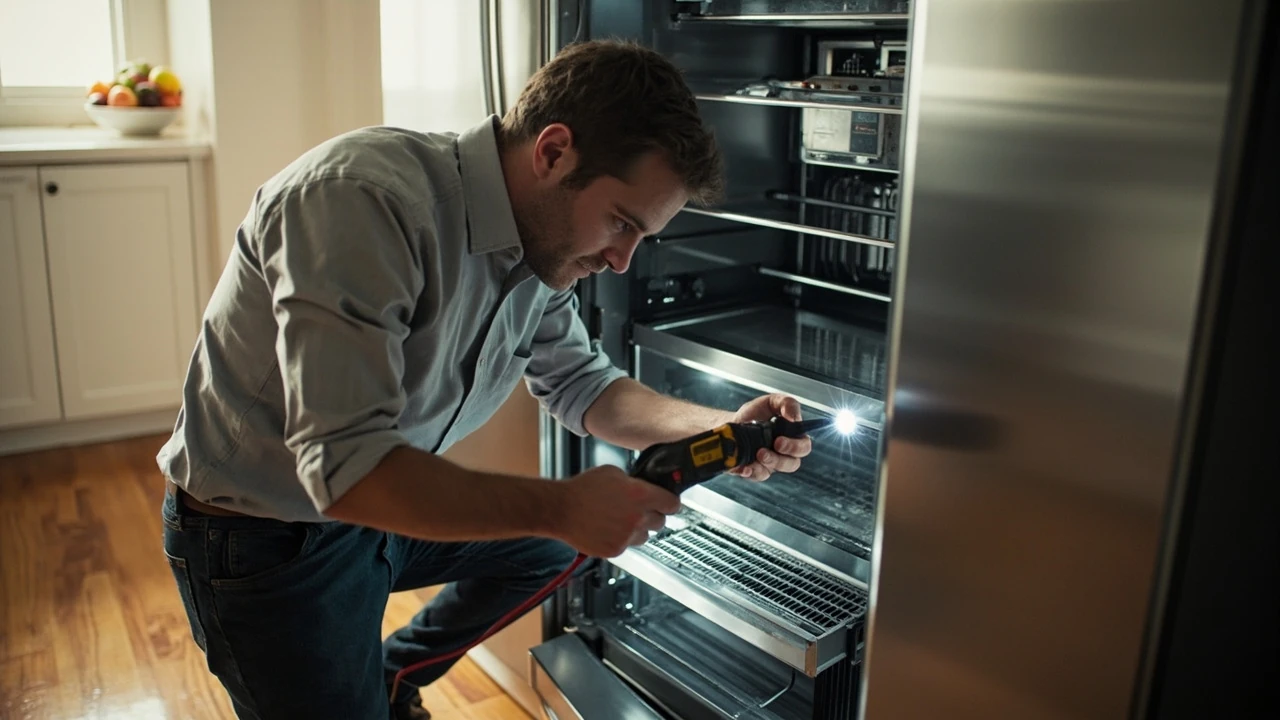

Refrigerator repair: a practical guide for U.S. homeowners
A refrigerator quietly runs for years and then, almost without warning, it stops cooling, starts cycling too often, leaks a small puddle under the crisper drawer, or fills the kitchen with a low hum that never used to be there. The average U.S. household keeps roughly $600 worth of food in the fridge and freezer at any given time, so a cooling failure is rarely just a household inconvenience. Refrigerator repair is usually faster, cheaper, and less wasteful than replacing a working compressor, but only when the diagnosis is right and the parts are still available.
This guide walks through how a refrigerator actually works, the symptoms that point to each major fault, the checks a homeowner can safely run before booking a service call, and the questions that separate a trustworthy technician from a guess-and-go visit. The goal is to help you make a calm, informed decision the next time your fridge does something it has never done before.
How a refrigerator actually cools
Every modern refrigerator, regardless of brand or finish, cools with the same basic sealed-loop system. A compressor at the back or bottom pumps refrigerant through two heat exchangers: an evaporator inside the fridge and freezer compartment, and a condenser coil that releases heat to the room. Expansion between these two stages causes the refrigerant to absorb heat inside the cabinet, and compression causes it to shed that heat outside. A thermostat, a defrost timer, and a handful of fans and sensors keep the cycle in balance.
When something goes wrong, the failure is usually one of three kinds:
- Mechanical wear on a moving part: the compressor, the evaporator or condenser fan, or the defrost heater.
- Electrical or control failure on a sensor, thermostat, defrost timer, or main control board.
- Restricted airflow or heat rejection caused by dust, ice, or poor placement, which overworks the other components.
Refrigerator repair starts by deciding which of those three categories the symptom fits. A noisy fan is mechanical. A fridge that warms up exactly every eight hours is control-related. A unit that runs non-stop but never reaches temperature is almost always airflow or condenser heat rejection.
Symptoms that decide which part to suspect
Two refrigerators can fail in very different ways. The table below maps the most common complaints homeowners describe to the parts that usually cause them. It is not a diagnosis, but it tells you what a competent technician will probably check first.
| Symptom | Most common causes | Likely parts involved | Typical repair class |
|---|---|---|---|
| Fridge and freezer both warm, no sound | No power to unit, control board failure, compressor start relay issue | Power supply, main board, start relay/overload | Technician visit, often same day |
| Cooling weak, compressor runs constantly | Dirty condenser coils, failing condenser fan, low refrigerant | Coils, condenser fan motor, sealed system | Coil cleaning is DIY; fan or sealed system is technician |
| Freezer cold, fridge warm | Failed evaporator fan, blocked air duct, defrost issue | Evaporator fan, defrost heater, thermistor | Technician visit, usually moderate cost |
| Ice or frost on back wall of freezer | Defrost system failure, door gasket leak, warm food load | Defrost heater, defrost timer/board, door gasket | Depends on part; heater is moderate |
| Water pooling under fridge | Clogged defrost drain, cracked drain pan, water inlet leak | Drain line, drain pan, inlet valve | Drain clear and pan swap are common DIY |
| Loud buzzing, clicking, or humming | Compressor start relay, condenser fan, ice maker solenoid | Start relay, fan motor, ice maker parts | Start relay is inexpensive and common |
| Ice maker not producing ice | Water inlet valve, frozen fill tube, failed ice maker module | Inlet valve, fill tube, ice maker assembly | Varies; inlet valve is a frequent fix |
| Light works, display works, no cooling | Compressor failure, sealed system leak, control board | Compressor, sealed system, main board | Highest-cost class; sometimes replacement is wiser |
Use this as a starting point. The next sections explain how to confirm each category with checks a non-technical homeowner can do safely.
Safe checks you can do before calling anyone
Many refrigerator repair visits end with a bill for something the homeowner could have confirmed in five minutes. None of the steps below require opening the sealed refrigeration system or touching wiring beyond plugging and unplugging the unit. If you are not comfortable with any of them, stop and call a professional.
- Confirm power and controls. The display panel may look dead even when the unit is working. Make sure the child lock, Sabbath mode, or vacation mode is not on, and verify the outlet is live by plugging in a lamp.
- Listen at the back or bottom. The compressor should make a low hum within a minute of plugging the unit back in. Total silence suggests a start relay, control board, or power problem, not a sealed system failure.
- Check the condenser coils. Unplug the fridge, remove the grille or back panel, and look at the coils. A thick grey fuzz blanket on the coils is a common cause of poor cooling and rising electric bills. Use a coil brush or vacuum crevice tool to clean them.
- Inspect the door gaskets. A torn or warped gasket leaks cold air continuously. Slide a dollar bill halfway under the closed door and pull; if it slides out without resistance, the seal is weak and the compressor is overworking.
- Clear the defrost drain. A pool of water under the crisper drawers usually means the defrost drain is clogged with ice or debris. A careful flush with warm water through the drain hole at the back of the freezer often solves it.
- Let the unit settle. If the fridge was just moved or the door was open for cleaning, give it 12 to 24 hours to reach temperature before assuming it is broken.
These six checks resolve a meaningful share of complaints that would otherwise turn into a service call. They also give the technician a clear starting point if you do need to book one.
When to call a professional for refrigerator repair
Once the basic checks above are done, a small group of symptoms almost always requires a licensed technician. These jobs involve refrigerant, sealed components, or live electrical work inside the cabinet.
- The compressor will not start, clicks repeatedly, or runs very hot.
- The evaporator coils are frosted solid in a pattern that does not melt with a manual defrost.
- The control board shows diagnostic codes the manual does not list as user-resettable.
- The unit has been losing cooling power for weeks and now feels only slightly cool.
- There is a smell of burnt plastic, ozone, or refrigerant oil near the compressor area.
For these cases, the cost of a misdiagnosis is usually a second service call. A trained technician will test the start relay, run the compressor directly with a test cord, and check amperage against the nameplate rating before recommending a sealed system repair or a replacement unit.
How technicians actually diagnose a fridge
A professional refrigerator repair visit follows a fairly predictable sequence. Knowing the order helps you judge whether the technician is doing real diagnostic work or just swapping parts.
- Confirm the symptom. A good tech measures temperatures in the fridge and freezer with a calibrated thermometer and asks about the last 48 hours of behavior, not just the current complaint.
- Check airflow and sealing. Even before opening anything, the technician should inspect gaskets, vent openings between freezer and fridge, and the condition of the condenser coils.
- Test the defrost system. Because defrost failure is one of the most common causes, many visits include a forced defrost cycle, an amp draw on the defrost heater, and a thermistor resistance check.
- Test the compressor circuit. The start relay, overload, and run capacitor are inexpensive and easy to test. A failed relay is a much cheaper fix than a compressor replacement.
- Decide on the sealed system. Only after the electrical and defrost circuits are ruled out does a tech begin to suspect a sealed system problem, which is the most expensive class of refrigerator repair.
Homeowners often benefit from asking the technician to walk through this sequence in plain language. If the answer jumps straight to a compressor replacement or a sealed system leak, it is reasonable to ask what was tested first.
Repair or replace: a decision framework
There is a rule of thumb in the appliance industry that any single repair costing more than half the price of a comparable new unit is worth a serious second look. The table below offers a more structured way to decide. It assumes you already have a written estimate from a technician and a model number you can price online.
| Factor | Lean toward repair | Lean toward replacement |
|---|---|---|
| Age of refrigerator | Under 8 years old | Over 12 years old |
| Type of failure | Fan, relay, gasket, defrost, water valve | Compressor or sealed system leak |
| Estimated repair cost | Under 35 percent of a new comparable unit | Over 50 percent of a new comparable unit |
| Energy use | Unit is less than 10 years old and reasonably efficient | Unit predates current energy standards and runs hot |
| Availability of parts | Common brand with current parts in stock | Discontinued model with lead times of weeks |
| Cosmetic condition | Interior and exterior are still solid | Doors, drawers, and shelving are deteriorating |
For context, the U.S. Energy Information Agency reports that refrigerators typically use about 7 to 8 percent of household electricity, so an old unit that has to run constantly to stay cool can quietly double that share. A high repair bill on a 14-year-old fridge is rarely the better long-term decision.
What a fair refrigerator repair estimate looks like
A reasonable estimate is a written document, not a verbal range, and it should clearly separate three line items. Many homeowners focus on the first number and miss the rest.
- Diagnostic fee. A flat amount credited toward the repair if you proceed. It should be stated up front.
- Labor hours. A specific number, multiplied by an hourly rate, with a worst-case ceiling.
- Parts cost. Either a firm price for a known part or a clear note that the part is being ordered and will be quoted before installation.
Watch for vague language such as “system repair” or “control issue” with no part listed, or estimates that bundle a diagnostic fee into the labor without telling you. Both make it hard to compare one quote against another.
How to choose a refrigerator repair service
The most reliable way to find a good technician is a combination of brand authorization, transparent pricing, and a real parts and labor warranty. A few practical questions to ask before booking do most of the filtering for you.
- Are you factory-authorized or independent for my brand? Authorization matters for warranty coverage on parts.
- Do you provide a written estimate before any work begins?
- What is the warranty on parts and labor, and is it in writing?
- Do you carry common parts for my model, or will there be a follow-up visit?
- Can you describe the diagnostic steps you will run before replacing parts?
For a real example of how a local repair company describes its process, the Lake Appliance Repair OKC refrigerator repair page walks through common symptoms, the brands their technicians handle, and how they decide between repair and replacement advice. Pages like this give you a useful baseline to compare any quote you receive in your own area.
Common refrigerator brands and what affects serviceability
Brand matters less for the science of cooling and more for parts availability, authorized service networks, and diagnostic documentation. A few patterns are worth knowing before you book a visit.
- Whirlpool, Maytag, Amana, and JennAir share a large parts ecosystem, so most components are in stock at regional distributors.
- GE and Monogram have strong authorized service networks and well-documented technical sheets, which usually means faster, more accurate diagnosis.
- Samsung and LG produce most of their own sealed system parts, and some control boards are brand-locked, so third-party technicians sometimes need brand authorization to get them.
- Frigidaire and Electrolux use a similar platform, which makes cross-brand parts common on basic components like defrost heaters and fans.
- Kenmore appliances are made by other manufacturers; the model number, not the badge, decides which parts fit.
If you can find the model and serial number on the sticker inside the fridge or behind the kick plate, write them down before calling. They save time on the phone and let the technician confirm parts are on the truck before driving over.
Preventive habits that reduce future repair calls
Most refrigerator repair issues are accelerated by a small set of habits. None of these are difficult, and together they tend to extend the life of the unit by several years.
- Vacuum the condenser coils once a year. Pets, cooking smoke, and dust build up faster than most owners expect.
- Check door gaskets twice a year with the dollar-bill test, and clean them with mild soap and water so the seal stays pliable.
- Avoid packing the freezer so tightly that air cannot circulate around the evaporator fan.
- Keep the fridge between 37 and 40 degrees Fahrenheit and the freezer near 0 degrees; the compressor runs harder when set colder than necessary.
- Let hot food cool to room temperature before placing it inside, especially in large pots.
- Leave a couple of inches behind the unit so the condenser can reject heat properly.
Questions worth asking during the service visit
Even with a good technician, the visit goes more smoothly if you treat it like a short interview. A few prompts help you learn the actual condition of the unit, not just the part that was replaced today.
- What was the original cause of the symptom you found?
- Are any other parts near the end of their expected life?
- Is there anything I can do to keep this part from failing again?
- How long should this repair last under normal use?
- If the part fails again, what does the warranty cover and what does it exclude?
The answers give you a much clearer picture of the unit’s overall health and help you plan for the next decision rather than being surprised by it.
What to do if the repair does not solve the problem
Even good diagnoses can be wrong. If the same symptom returns within the warranty window, you are entitled to a follow-up at no additional labor cost. Document the date, the temperature readings you saw, and any noises or codes. A clear record turns a disputed callback into a routine one.
If the same technician or company cannot resolve the issue across two visits, ask for the diagnostic notes and parts invoices in writing. They are useful if you need a second opinion from another provider, and they are often required if you later file a claim under a manufacturer or home warranty plan.
Frequently asked questions
How long should a refrigerator last before it needs major repair?
Most refrigerators run reliably for 10 to 15 years. The first major repair, usually a fan, control board, or defrost component, often shows up between years 7 and 10. After year 12, repair costs rise quickly because parts are discontinued and the sealed system is more likely to fail.
Is it worth repairing a refrigerator that is more than 10 years old?
It depends on the failed part. A $150 fan motor on a 12-year-old fridge is usually worth fixing. A $700 compressor replacement on the same unit is harder to justify because the new compressor may not outlast the rest of the cabinet. The rule of thumb is to compare the repair cost to roughly half the price of a comparable new model.
What is the most common refrigerator repair?
Across most service companies, defrost system problems and evaporator or condenser fan failures are the most common repairs. They are also among the most affordable, because the parts are simple, well-documented, and stocked by most distributors.
Can a homeowner safely replace a refrigerator compressor?
No. Replacing a compressor requires opening the sealed refrigerant system, which is regulated, requires specialized recovery equipment, and must be done by an EPA-certified technician. DIY compressor replacement is both unsafe and, in most U.S. states, illegal.
Why is my fridge running but not getting cold?
Most often the cause is restricted airflow or poor heat rejection. Dirty condenser coils, a failing condenser fan, or a blocked evaporator fan will make the compressor run continuously without actually cooling the cabinet. A failed start relay or control board can also cause the compressor to never start at all.
How do I know if the problem is the refrigerator and not the outlet?
Plug a lamp or phone charger into the same outlet. If the lamp works and the fridge display is dark, the issue is the outlet, the power cord, or the fridge’s internal wiring rather than the cooling system itself. A tripped GFCI or a dedicated circuit that has been switched off is a common, easy-to-miss cause.
What is a fair price for a refrigerator repair visit?
Prices vary by region, but a typical diagnostic fee in the U.S. runs from $80 to $150, with simple repairs like a start relay or door gasket in the $150 to $300 range. Compressor or sealed system work can run into four figures, which is why a written estimate and a clear parts breakdown are essential.
Should I unplug my fridge if it starts making a new noise?
Most noises are safe to monitor for a day or two. Unplug the unit only if you smell burning, see smoke, or the compressor area is extremely hot to the touch. In those cases, cut power at the outlet or breaker and call a technician before plugging the unit back in.
Do refrigerator repairs come with a warranty?
Reputable companies offer a written warranty on both parts and labor, commonly 90 days to one year. Manufacturer parts may carry a longer warranty on their own. Always ask for the warranty terms in writing before the work begins.
Is it better to repair or replace an old refrigerator that is still cooling?
If the fridge is cooling properly and the repair is a small, common part, repair is almost always the better choice. If the unit is more than 12 years old, the repair is expensive, and the energy use is clearly rising, replacement is usually the smarter long-term decision. A short conversation with a technician about the overall condition of the unit is often the most useful next step.